


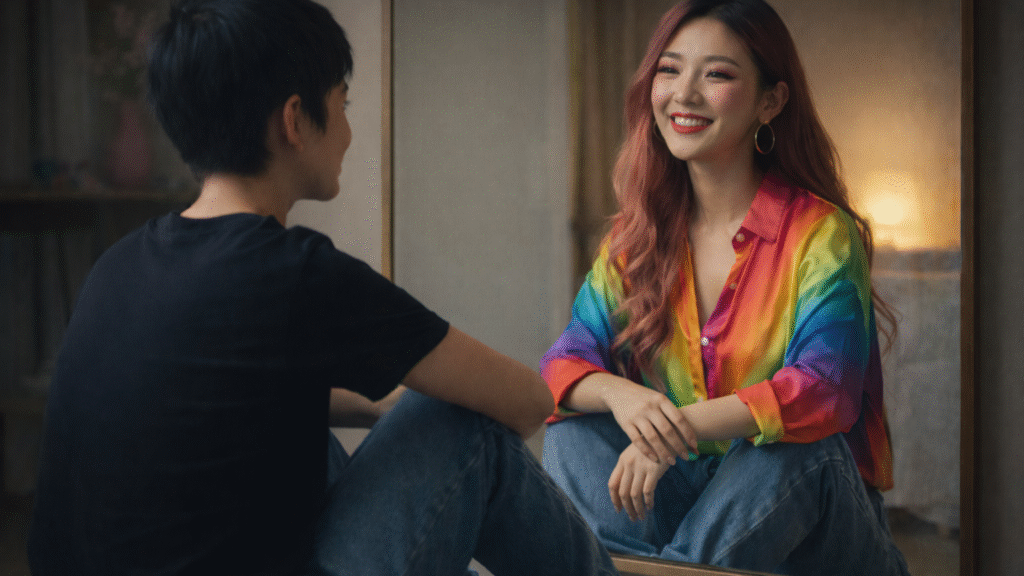
For decades across Southeast Asia, a girl with cropped hair, loose jeans and a swagger was called one thing: tomboy. It was a word whispered by mothers, teased by classmates, printed in teen magazines and accepted—if not fully embraced—by society. But something is changing. From Bangkok cafés to Manila universities and Jakarta’s Instagram feeds, the tomboy label is quietly fading. In its place, a new identity is rising: the out lesbian—self-defined, politically conscious and increasingly visible in public life. The shift is not just about language. It signals a deeper transformation in how Asian women understand sexuality, gender and power.
In Thailand, the “tom-dee” culture was once a well-known social script. A tom—short for tomboy—was a masculine-presenting woman who dated a “dee,” a feminine woman. The pairing mirrored heterosexual gender roles: one protector, one protected; one dominant, one demure. It created a recognizable framework that allowed same-sex relationships to exist without fully confronting patriarchy. Families might not approve, but they understood the roles. The tomboy was often treated as a phase, an extension of youthful rebellion, something that might resolve itself with marriage.
The Philippines developed its own version. “Tomboy” became a catch-all term for gender-nonconforming girls and women, especially in working-class communities. A tomboy could be tough, athletic, outspoken—someone who occupied space in ways traditionally reserved for men. Yet the word rarely centered sexual orientation. It described style, attitude, even behavior, but not necessarily a stable, lifelong identity. A tomboy might still be expected to “settle down” with a man one day.
That ambiguity once served a purpose. In conservative societies, the tomboy label provided a kind of social camouflage. It allowed women to express masculinity and form romantic bonds with other women without explicitly declaring themselves homosexual. The word felt local, culturally embedded, less confrontational than the imported term “lesbian.” It softened the politics of desire.
But younger generations are no longer satisfied with soft edges. Global media has transformed the landscape. Asian teenagers now grow up with Netflix series featuring openly lesbian characters, with K-pop idols hinting at fluid aesthetics, with TikTok creators discussing queer theory in bite-sized clips. The vocabulary of sexuality has expanded rapidly: lesbian, queer, non-binary, butch, femme. English-language terms circulate easily across borders, carried by social media and digital activism.
For many young women in urban centers, calling oneself a lesbian is not merely descriptive—it is declarative. It asserts sexual orientation rather than gender inversion. It says: I am not playing a masculine role within a heterosexual framework. I am a woman who loves women. The difference is subtle but profound.
Legal changes have reinforced this shift. Taiwan’s legalization of same-sex marriage in 2019 marked a watershed moment in Asia. Even in countries without marriage equality, corporate diversity policies, pride parades and university gender studies programs have introduced formal recognition of lesbian identity. “Lesbian” is now a rights-bearing term that appears in policy documents, NGO reports and court debates. Tomboy, by contrast, remains informal and socially coded.
Feminist movements have also played a critical role. Across Asia, younger activists increasingly link sexuality to bodily autonomy and resistance to patriarchy. Identifying as a lesbian can be an explicit rejection of compulsory heterosexuality and male dominance. In this context, the tomboy-dee dynamic—often built around masculine/feminine binaries—feels outdated to some. It risks reproducing the very hierarchies that feminist politics seeks to dismantle.
Yet the story is not one of simple replacement. Class and geography still shape identity choices. In rural areas and working-class neighborhoods, “tomboy” remains widely used and understood. It carries familiarity and, in some cases, a degree of social tolerance. Among older generations, the word may feel safer. Declaring oneself a lesbian can still provoke moral panic, religious backlash or family rejection. Even within cities, identity can be strategic. A woman might call herself a tomboy at home to avoid conflict, lesbian among friends, and queer online. Labels become tools, chosen according to audience and risk. The rise of the out lesbian does not erase the tomboy; it coexists with it, sometimes uneasily.
There is also nostalgia for what may be lost. Tomboy cultures developed their own aesthetics, slang and community rituals. In Thailand, tom-dee networks created distinct social spaces—clubs, university groups, friendship circles—that shaped a generation’s understanding of love and belonging. As global queer language becomes dominant, some worry about the erasure of local nuance. Is this progress, or cultural homogenization?
Still, the broader arc is clear. More Asian women today are publicly claiming lesbian identity than ever before. They are writing blogs, leading NGOs, appearing in advertising campaigns, standing on pride stages. They are not merely tolerated as gender curiosities but recognized—however imperfectly—as sexual minorities with rights and voices.
The death of the tomboy label, then, is less an obituary than a coming-of-age story. It reflects women’s growing economic independence, expanded educational access and increasing digital connectivity. It signals a move from coded survival to open articulation. Where the tomboy once navigated within the shadows of patriarchy, the out lesbian steps into the light, insisting on being named on her own terms.
Asia remains far from uniformly accepting. Backlash is real. Legal protections are uneven. Families still struggle. But the vocabulary has shifted, and vocabulary shapes reality. When women move from being described by others to defining themselves, power subtly changes hands. Perhaps the most important question is not whether the tomboy is disappearing, but who now gets to decide what a woman’s love means. For a growing number of Asian women, the answer is no longer society, nor tradition, nor imported theory alone. It is the woman herself—cropped hair or long, masculine or feminine—speaking her identity out loud and refusing to let it be translated into something safer for everyone else.
I used to be “the tomboy.” Short hair, oversized shirts, permanently scuffed sneakers, and an attitude that said, “Don’t even try.” Aunties clucked. Teachers sighed. Boys were confused. Girls were curious. Back then, in our corner of Asia, “tomboy” was the label that made everyone feel safer. It explained me without really explaining me. It suggested a phase. A rebellion. A detour before the proper road of husband, children, respectability.
Well. Plot twist.
I am now a thoroughly middle-aged, unapologetically bisexual Asian woman with excellent skincare, better politics, and zero interest in being anyone’s phase.
When I was young, “tomboy” meant I could exist without saying the dangerous word: lesbian. It meant I could love girls while pretending it was about style. It meant I could hold hands in public if we looked like a “protector” and a “princess.” It was a costume stitched from local expectations—masculine enough to make sense, feminine enough to remain unintelligible.
But here’s the thing: I wasn’t trying to be a boy. I wasn’t trying to imitate a man. I was trying to breathe.
The older I got, the more I realized that my cropped hair and swagger weren’t a rejection of womanhood. They were my version of it. And somewhere between heartbreak, activism, questionable fashion choices, and a few glorious romances with both women and men, I outgrew the script. Not the queerness. The script.
Today, young women across Asia are skipping the detour. They’re calling themselves lesbian, queer, bi, pan—sometimes all before breakfast. They don’t need the camouflage I needed. They have language. They have Pride parades. They have group chats that would have scandalized my entire neighborhood in 1997.
Do I miss the old tomboy culture? Sometimes. It had its own tenderness, its own codes. But it also had limits. It quietly reassured society that we were just playing with gender, not rewriting it. It softened the threat.
Now? There is no softening. There is naming. And naming matters. Because when I say I am bisexual, middle-aged, Asian, and thriving, I am not asking for tolerance. I am describing reality. The tomboy label was a doorway. I walked through it. On the other side, I found something better: a self not defined by fear, nor by borrowed masculinity, nor by other people’s comfort.
I was a tomboy. And now look at me. Still queer. Still fabulous. Just fully, gloriously, myself.