


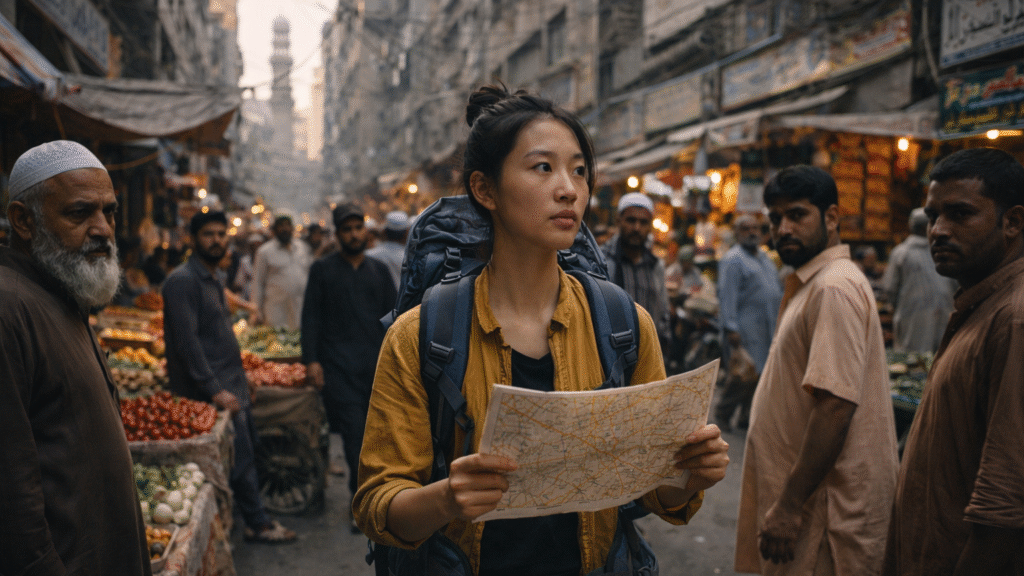
At 11pm in Tokyo, a young woman in jeans and sneakers steps out of a metro station, checks her phone, and walks calmly back to her hotel under bright streetlights. A week later in Bangkok, another solo traveller squeezes through a night market, alert but exhilarated, one hand on her bag as vendors call out. A month after that, in Jaipur, a third woman adjusts her scarf, ignoring the stares as she negotiates a rickshaw fare with firm eye contact. Three regions. Three moods. Three different versions of what “safe” means when you are a woman travelling alone in Asia.
Asia is not one safety story. It is a spectrum — from ultra-structured predictability to vibrant, chaotic immersion. For female solo travellers, the difference between East Asia, Southeast Asia, and South Asia isn’t just about crime statistics. It’s about how visible you feel, how much mental energy you spend managing attention, and how easily you can move through public space without second-guessing yourself.
East Asia — think Japan, South Korea, Taiwan, and much of urban China — consistently ranks as the most comfortable region for women travelling alone. In countries like Japan and South Korea, violent crime rates are low, public transport runs like clockwork, and streets are well lit late into the night. You can take the last train, get mildly lost, and still feel fundamentally secure. Police presence is visible but not intimidating. CCTV cameras are everywhere. Lost wallets often reappear. The biggest “cons” here are subtle rather than threatening. Language barriers can make problem-solving stressful, particularly outside major cities. Emotional isolation can creep in — the culture is polite but reserved. And in crowded commuter trains in Japan, groping has historically been an issue, which is why women-only carriages exist during rush hour. Still, compared with most global regions, East Asia offers structure. Predictability. The ability to exhale.
Southeast Asia tells a different story. It is perhaps the world’s most popular region for solo female travellers — and for good reason. Thailand’s beaches, Vietnam’s old towns, Malaysia’s food culture, Indonesia’s islands: the variety is intoxicating. In places like Singapore, safety standards rival East Asia. In Thailand, Indonesia or Vietnam, the experience varies by neighbourhood. The pros are obvious. Tourism infrastructure is built for backpackers. Hostels are social and often female-friendly. Ride-hailing apps function well in major cities. Staff in hotels and cafes are used to independent women travellers. Violent crime against tourists remains relatively rare in most established destinations. But Southeast Asia demands more situational awareness than East Asia. Petty theft, bag snatching, and scams are common enough to require vigilance. In nightlife areas — especially party islands and red-light districts — unwanted male attention can escalate quickly if alcohol is involved. Catcalling is more frequent. Transport standards vary wildly once you leave big cities. The region is safe — but not autopilot safe.
Then comes South Asia, which inspires both deep devotion and sharp caution among solo women. Countries such as India, Nepal, and Sri Lanka offer extraordinary cultural richness: Himalayan trekking routes, Mughal architecture, ancient temples, layered spiritual traditions. Many women describe life-changing journeys here. Yet this is the region where gender dynamics are most visible in public space. Staring can be intense. Unsolicited photos are not uncommon. Questions about marital status arrive quickly. Crowded trains and buses require confidence and spatial awareness. After dark, movement may feel more restricted, especially outside affluent urban areas.
This does not mean constant danger. Millions of women travel South Asia safely every year. It does mean higher mental load. Dressing conservatively often reduces unwanted attention. Choosing well-reviewed accommodation matters. Many experienced travellers build in rest days to decompress from the constant visibility. In exchange, they gain immersion at a depth that is harder to access in more buffered societies.
Comparing the three regions is less about ranking and more about personality fit. If you are travelling solo for the first time, value independence at night, and prefer infrastructure that simply works, East Asia is the easiest entry point. You will likely feel physically safe and structurally supported. If you are comfortable navigating lively environments, keeping an eye on your belongings, and balancing alertness with spontaneity, Southeast Asia offers the broadest mix of comfort and adventure. If you are confident, culturally curious, and prepared to set clear boundaries — and if you understand that empowerment sometimes means managing attention rather than avoiding it — South Asia can be profoundly rewarding.
Safety, for female solo travellers, is not just about avoiding harm. It is about freedom of movement, emotional bandwidth, and how often you must calculate your next step. In East Asia, calculation is minimal. In Southeast Asia, it is moderate. In South Asia, it is frequent but manageable with preparation. None of these regions are monolithic. A business district in Kuala Lumpur feels different from a remote island in Indonesia. A tech hub in Bangalore feels different from a rural town in Rajasthan. And your own age, confidence level, and travel style shape everything.
The real pro of Asia, across all three regions, is this: women are travelling it alone in record numbers. They are navigating subways in Seoul, night markets in Chiang Mai, and mountain trails in Nepal. They are building street smarts, global friendships, and a sense of competence that outlasts any journey. The cons? They are the universal ones: unwanted attention, uneven infrastructure, the occasional scam artist. None are unique to Asia. All are manageable with awareness.
So the question is not whether Asia is safe for solo women. It is which version of Asia fits the kind of traveller you want to be.
Let me tell you something, darling: when people ask, “Is Asia safe for solo women?” what they’re really asking is, “Will I be allowed to exist in public without being bothered?” And that’s a very different question from crime statistics.
I’ve travelled this continent long enough to know that safety is layered. In East Asia — think Japan, Korea, Taiwan — the system protects you. Trains run on time. Streets are lit. Rules are followed. You can walk home at midnight and your biggest problem might be choosing between ramen shops. That’s structural safety. It’s the kind that lets you relax your shoulders.
Southeast Asia? Ah, that’s flirtier. Warmer. Louder. In Bangkok, Bali, Ho Chi Minh City, you’re visible. Not endangered, necessarily — but noticed. You hold your bag tighter in night markets. You say “no” more often. You develop that firm-but-smiling boundary voice. It’s not dangerous by default, but it requires presence. Awareness. A little street choreography.
And then South Asia. Intense. Brilliant. Exhausting. Transformative. You will be seen — fully, unapologetically, constantly. Stares are part of the landscape. Questions come quickly. You learn to dress strategically, to move strategically, to claim space strategically. Some women feel overwhelmed. Others feel electrified. Both reactions are valid. It depends on your stamina and your appetite for immersion.
But here’s the part nobody likes to say out loud: the “danger” narrative about Asia is often exaggerated by people who’ve never actually travelled it alone. Meanwhile, the everyday micro-negotiations women perform in New York, Paris, or Sydney somehow don’t count as danger because they’re familiar.
Safety isn’t about avoiding all discomfort. It’s about knowing your capacity. East Asia gives you ease. Southeast Asia gives you vibrancy with vigilance. South Asia gives you growth through friction.
And none of them are monolithic. Singapore feels nothing like rural Indonesia. Bangalore feels nothing like a small-town village. Context is everything.
So my advice? Choose the region that matches your current confidence level — not your bravest fantasy self. Build your solo muscles gradually. Learn how you react when you’re stared at, when a taxi driver circles twice, when a man won’t take “no” immediately.
Asia isn’t too dangerous for women. It’s too complex for lazy generalizations.
And complexity, my love, is where real independence is forged.