


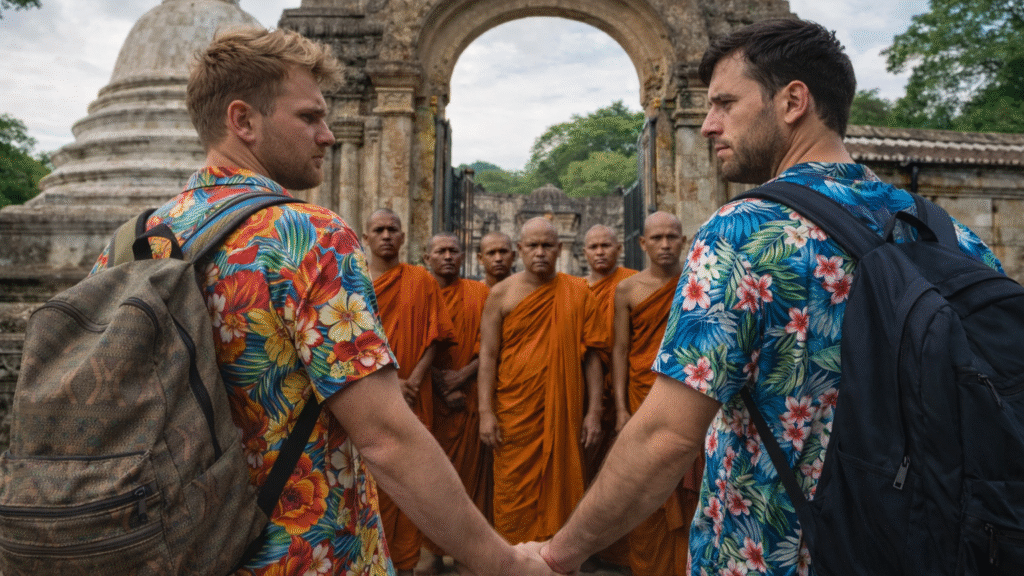
Sri Lanka’s abrupt withdrawal of official support for LGBTQ tourism has sent ripples through the global travel industry, raising urgent questions about pink economy ambitions, post-crisis recovery, and the island’s uneasy relationship with sexual diversity. Just months after tourism authorities signaled interest in courting queer travelers as part of a broader strategy to revive the country’s battered economy, Colombo appears to have stepped back, reflecting deep domestic sensitivities around homosexuality, religion, and national identity. For an island long marketed as a paradise of beaches, tea estates, and Buddhist heritage, the episode exposes the limits of branding when culture, politics, and morality collide.
Tourism is not a trivial matter for Sri Lanka. Before the 2019 Easter Sunday bombings and the Covid-19 pandemic, the sector accounted for roughly 10–12 percent of GDP, employing hundreds of thousands directly and indirectly. The devastating economic crisis of 2022, which led to fuel shortages, mass protests, and the ousting of President Gotabaya Rajapaksa, made the revival of foreign visitor revenue even more urgent. Successive governments have sought to diversify markets, tapping into wellness tourism, digital nomads, and increasingly the so-called “pink dollar” — the spending power of LGBTQ travelers, estimated globally in the hundreds of billions of dollars annually.
Yet Sri Lanka’s legal and cultural landscape complicates such outreach. Same-sex intimacy remains criminalized under colonial-era provisions of the Penal Code, notably Sections 365 and 365A, inherited from the British in the 19th century. Although prosecutions are rare, the existence of these laws casts a long shadow. Human rights organizations such as Human Rights Watch and Amnesty International have repeatedly documented harassment, arbitrary arrests, and discrimination faced by LGBTQ Sri Lankans. In 2023, a private member’s bill to decriminalize same-sex relations gained momentum in Parliament, with then-President Ranil Wickremesinghe expressing cautious support, but the process has been slow and politically fraught.
The island’s majority Sinhala-Buddhist population often sees itself as the guardian of a moral and cultural order shaped by Theravada Buddhism, known locally as Sinhala Bauddhaya (Sinhala Buddhism). While Buddhist doctrine does not contain the same explicit prohibitions against homosexuality found in some Abrahamic traditions, social conservatism runs deep. Influential monks and lay organizations have frequently framed LGBTQ rights as a Western import, alien to “ape sanskruthiya” (our culture). Christian and Muslim minorities, too, tend to hold conservative views on sexuality, creating a rare cross-religious consensus against rapid liberalization.
Against this backdrop, the idea of actively marketing Sri Lanka as an LGBTQ-friendly destination was always going to be controversial. Tourism officials and private-sector stakeholders argued pragmatically: attracting queer travelers does not require rewriting cultural norms overnight; it requires ensuring safety, hospitality, and discretion. Boutique hotels in Colombo and Galle have long quietly welcomed same-sex couples. The capital’s small but resilient queer community organizes pride events, film screenings, and advocacy campaigns, often under the banner of “api okkoma ekai” (we are all one), emphasizing unity rather than confrontation.
However, when news broke that authorities were reconsidering or withdrawing support for LGBTQ-focused tourism messaging, it reflected more than a branding tweak. Critics within Sri Lanka reportedly accused officials of promoting immorality or damaging the country’s image as a family-friendly destination. In a political climate where governments remain sensitive to nationalist backlash, especially after years of economic turmoil, leaders may calculate that courting a niche market is not worth the domestic cost.
There is also the delicate dance of international diplomacy. Sri Lanka has, in recent years, sought closer economic ties with Western governments and multilateral lenders, whose human rights expectations include protections for sexual minorities. At the same time, it balances relationships with more socially conservative partners in Asia and the Middle East. The rhetoric around LGBTQ tourism can thus become entangled with broader debates about sovereignty, “foreign agendas,” and the legacy of colonialism — ironically, given that the anti-gay laws themselves are colonial relics.
For queer Sri Lankans, the tourism debate can feel both promising and alienating. On one hand, increased visibility and economic arguments for inclusion might strengthen calls for decriminalization and anti-discrimination protections. On the other, a focus on affluent foreign visitors risks sidelining the everyday struggles of local LGBTQ people, who face family rejection, employment discrimination, and occasional police abuse. Activists have long argued that genuine progress requires legal reform, public education, and the dismantling of stigma — not just rainbow-themed marketing campaigns.
Culturally, Sri Lanka’s history with gender and sexuality is more complex than contemporary rhetoric suggests. Pre-colonial South Asian societies, including those on the island, recognized a range of gender expressions. While Sri Lanka does not have a formally recognized third-gender category akin to India’s hijra community, anthropologists have documented fluidities in performance, ritual, and social roles. The Sinhala language itself contains nuanced terms related to gender and desire, though many are used pejoratively today. The Victorian moral codes imposed during British rule hardened attitudes and codified punishments that continue to shape legal frameworks.
In practical terms, the withdrawal of overt support for LGBTQ tourism does not necessarily mean queer travelers will avoid Sri Lanka. Many destinations with restrictive laws still receive LGBTQ visitors who navigate local contexts discreetly. Travel advisories typically recommend caution rather than outright avoidance. What changes is the narrative: instead of positioning itself alongside Thailand or Taiwan as an emerging inclusive hotspot in Asia, Sri Lanka appears to be retreating into ambiguity.
For an island striving to present itself as resilient, welcoming, and globally connected, the episode underscores a broader tension between economic pragmatism and cultural politics. Can Sri Lanka embrace diversity in the marketplace while grappling with conservative social norms at home? Can it reconcile appeals to global investors and travelers with the anxieties of citizens who fear erosion of tradition?
As debates continue in Parliament and civil society, the question is not merely about marketing strategy. It is about the kind of nation Sri Lanka aspires to be in the aftermath of crisis: insular or outward-looking, reactive or reformist. In Sinhala, the phrase “hondama deshaya” means “the best country.” Achieving that aspiration may require confronting uncomfortable truths — including the legacy of colonial laws, the realities of contemporary discrimination, and the economic opportunities of inclusion. Whether Sri Lanka ultimately doubles down on conservative caution or edges toward a more openly inclusive future will shape not only its tourism brochures, but the lived experiences of its own citizens.
Oh, Sri Lanka. My beautiful, complicated, post-crisis, tea-scented island. One minute you are flirting with the global “pink dollar,” the next you are blushing and backing away like a shy debutante who suddenly remembers the neighbors are watching.
Let me say this clearly: LGBTQ tourism is not about glitter parades on every beach in Bentota. It is not about turning Sigiriya into a rainbow disco ball. It is about one simple thing — safety and dignity. If two men from Berlin want to hold hands at sunset in Galle, or two women from Singapore want to book a honeymoon suite in Colombo, the question should not be “What will the monks say?” It should be: Are they safe? Are they welcome? Will they be treated with respect?
What fascinates me is the selective memory at play. The laws that still criminalize same-sex intimacy in Sri Lanka? British. Victorian. Imported. Colonial. Yet somehow queerness is framed as the foreign intrusion, while the colonial penal code is defended as tradition. Darling, make it make sense.
I understand the fear. After economic collapse, protests, fuel queues, and IMF negotiations, leaders are skittish. Nobody wants another culture war. Sinhala Bauddhaya (Sinhala Buddhism) is invoked like a fragile porcelain vase that must not be touched. But Buddhism, in its philosophical core, is about compassion. Karuna (compassion) is not selective. It does not come with a footnote excluding gay people.
Here’s the uncomfortable truth: you cannot market paradise and police love at the same time. The global tourism industry is watching. Young travelers — queer and straight — care about values. They Google. They read travel advisories. They ask: is this place inclusive?
But let me also whisper something to my activist friends: rainbow branding without legal reform is lipstick on a colonial pig. If LGBTQ tourism becomes just a revenue strategy, while local queer Sri Lankans still face harassment, then the whole exercise is hollow. The real work is decriminalization, anti-discrimination protections, and public education. Not a glossy Instagram campaign.
Sri Lanka stands at a crossroads. Retreating from LGBTQ tourism may calm conservative nerves in the short term. But long term? Inclusion is not just moral; it is economically smart.
And as someone who has watched Asia transform again and again, I will say this gently: history bends toward openness. Slowly. Unevenly. But it bends. The question is whether Sri Lanka wants to bend with it — or be dragged.