


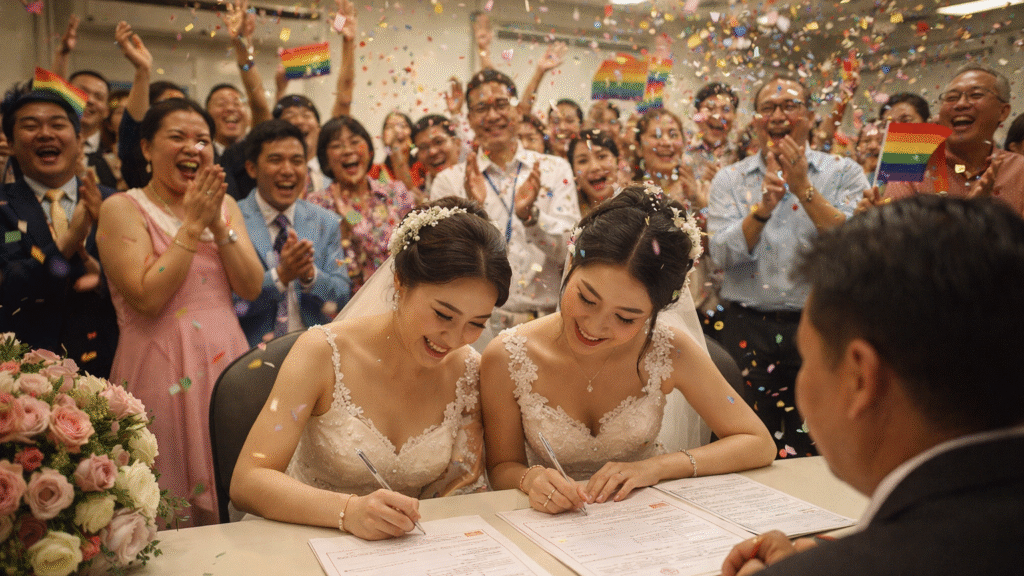
In the warm haze of a Bangkok morning on 23 January 2025, Thailand rewrote its story on love. Against a riot of rainbow flags, flower garlands, and the brilliant buzz of celebration, thousands of couples stood in line at district offices from Chiang Mai to Hat Yai, clutching bougainvillea and each other, ready to say “I do.” What seemed like a long-dreamt possibility had finally arrived: same-sex couples could, at last, marry with full legal recognition under Thai law.
Thailand’s Marriage Equality Act, which amended the Civil and Commercial Code to replace gendered words like “husband” and “wife” with neutral terms such as “spouses,” came into force on that January day — making the Kingdom the first nation in Southeast Asia, and only the third place in Asia behind Taiwan and Nepal, to legalize same-sex marriage.
What unfolded in 2025 was more than a legal shift — it was a societal pulse check. From the start, the atmosphere was joyous. At Siam Paragon in central Bangkok, the first mass wedding saw hundreds of couples walk down a rainbow carpet, surrounded by cheering friends, diplomats, and local celebrities. Their marriage certificates — no longer a symbol of something distant — were real, paper-thin badges of belonging. Yet beneath the flowers and laughter, the first year of marriage equality has become a nuanced reminder that legal change and social change don’t always move at the same pace.
For many couples, the new law unlocked practical rights once denied. Same-sex spouses can now jointly manage property, access spousal pensions, make medical decisions for an incapacitated partner, and enjoy inheritance protections equal to heterosexual couples. For bi-national couples, the possibility of spousal visas brought stability previously sought only through work permits and temporary visas.
Take the story of Pisit and Chanatip Sirihirunchai, a policeman and his partner who registered their marriage on that first historic day. “Love is a beautiful thing,” Chanatip told reporters, joy evident in his voice. Their wedding was not just a personal milestone — it was a visible marker of change in a region where such journeys are still rare.
By January 2026, over 26,000 same-sex couples had married across the country, comprising roughly ten percent of all marriages — a figure that tells its own story about acceptance, desire, and readiness to embrace new norms. But the first year also revealed that equality on paper and equality in life are not always the same thing.
Many activists say that while Thailand’s law represents a powerful breakthrough, gaps remain in family law and social protections. The country’s legal definitions still tie “parents” to traditional gender roles, creating hurdles for same-sex couples who want to adopt children with equal legal recognition. For families with children via surrogacy or international birth certificates, bureaucratic limbo can be a daily reality. Similarly, protections outside the marriage context — from fully inclusive anti-discrimination laws to hate-crime statutes — have lagged behind the glow of wedding ribbons. Community organizations continue to push for expanded protections, especially as LGBTQ+ individuals still face discrimination in employment, education, and health care.
Online, the picture is equally mixed. Despite broad public support and celebratory headlines, digital harassment and targeted vitriol toward LGBTQ+ advocates have persisted, a stark reminder that inclusion is both legal and cultural. Abroad, Thailand’s marriage equality milestone has rippled outwards too. Travel- and culture-writers visiting in late 2025 spoke of vibrant “rainbow tourism” — LGBTQ+ visitors drawn by Thailand’s natural beauty and now its progressive reputation — from Phuket beaches to Silom’s bustling nightlife.
Still, Thailand’s path is watched with interest beyond its borders. In neighboring countries like Vietnam and Cambodia, discussions have intensified about whether equal marriage rights might be next. Advocates point to Thailand’s example as both inspiration and proof that legal recognition can help foster innovation, attract talent, and strengthen national identity.
Back home, celebrations continue to punctuate the calendar. In Bangkok, events co-hosted by foreign embassies and local organizations mark the first anniversary of marriage equality with speeches, performances, and pride flags flying high — an affirmation that this achievement is both political and deeply human.
A year after the law’s dawn, Thailand occupies a unique position in Asia — a place where love no longer needs to hide behind traditions of yesterday, and where commitment between adults of all genders is recognized before the law. Yet the work ahead — from expanding family rights to building day-to-day inclusion — remains a reminder that legal equality is the beginning of a broader journey, not its end.
In a bustling café near Silom Road, one newlywedded couple summed it up simply: “We have rights now,” they laughed, “but we still have dreams.” In 2025, love won its legal place in Thailand. In 2026, its human journey is just unfolding.
I was there on that first morning — not in a white dress (please, Auntie prefers red), but standing outside a district office at 8:30 a.m., watching two nervous brides fix each other’s hair before stepping inside. One year later, I still think about their hands. They were shaking. Not because they doubted each other. Because they understood history was opening a door — and they were walking through it.
Marriage equality, my darlings, is a strange beast. It looks simple: a signature, a certificate, a photo for Instagram. But underneath that paper lies something far less photogenic and far more radical — legitimacy. For decades, LGBTQ couples here were tolerated, even celebrated in nightlife, television dramas, Pride parades. But tolerance is not protection. Visibility is not inheritance rights. Glitter is not hospital access.
What changed in this first year is not just the law. It is the quiet confidence. Couples who used to introduce each other as “my partner” now say “my spouse” without lowering their voice. That word carries weight in bureaucracies, banks, embassies, and — perhaps most painfully — family living rooms.
And yet, Auntie must remind you: marriage equality is not liberation’s final chapter. It is Chapter One. Adoption laws still wobble. Trans people still navigate paperwork that doesn’t recognize their lived reality. Online harassment still slithers through comment sections like a bored cobra. Legal reform is glamorous; cultural reform is stubborn.
I’ve heard the critics too. “Why focus on marriage?” they ask. “What about poverty? What about democracy?” As if rights are a buffet where we must choose only one dish. Equality is not a distraction from justice. It is justice. When a state tells two adults their love counts equally, it redraws the moral architecture of the nation.
And something else happened this year that numbers cannot capture. Young people watched. Teenagers in provincial towns saw rainbow-clad couples walk out of government offices smiling. They saw police officers sign documents without hesitation. They saw that the sky did not fall.
For a region still wrestling with colonial laws, religious conservatism, and political timidity, that image matters.
So yes, Auntie celebrated. I cried. I toasted strangers. I rolled my eyes at corporations slapping rainbows on everything in June. And then I went back to work — because love may have won a legal home, but equality still needs daily maintenance.
One year down. The real marriage — between law and lived reality — is just beginning.