


Before dawn breaks over Cambodia, the city is already awake. In the half-light along Phnom Penh’s riverside, children move between plastic stools and metal tables, selling jasmine bracelets, postcards, or packets of tissues to tourists finishing late dinners. Others weave through traffic at busy intersections, tapping on car windows with small hands. They are part of an uncomfortable reality behind the skyline of new condominiums and coffee chains: Cambodia’s street children — visible, resilient, and still profoundly vulnerable.
In popular imagination, “street children” are orphans sleeping under bridges. The reality is more complex. Many of these boys and girls are not entirely alone; they may return at night to cramped rented rooms on the city’s outskirts. Others drift between pavements, construction sites, and informal settlements. Some work on the streets but sleep with relatives. The phrase often used by NGOs is “street-connected children” — a recognition that their lives are intertwined with public spaces even if they are not permanently homeless.
The largest concentrations are found in urban centres such as Phnom Penh, Siem Reap and Sihanoukville — places shaped by tourism, migration, and uneven economic growth. Cambodia has made measurable progress in reducing poverty over the past two decades, yet the benefits have not reached everyone equally. A handful of obscenely rich and well-connected people roam around in their Rolls Royces, while rural families facing debt, crop failure, land loss or unstable work often migrate to cities’ slums in search of income. Children, inevitably, are pulled into the struggle.
Poverty remains the most consistent driver. When a family’s daily survival depends on informal earnings, children selling flowers or scavenging recyclable materials can mean the difference between eating and going hungry. Some parents send children out to work; others have little control over teenagers who see the street as an opportunity for independence or quick cash. Family breakdown, domestic violence, substance abuse and disability also push children toward public spaces where risks multiply.
Those risks are severe. Street children face exposure to physical violence, sexual exploitation, hazardous labour and trafficking networks. Without stable adult protection, they are easy targets for abuse. Access to healthcare is inconsistent, and malnutrition, untreated injuries and respiratory infections are common. Substance use — particularly inhalants — has long been reported among children surviving in urban environments, both as a coping mechanism and a form of social bonding.
Education, often described by officials as Cambodia’s success story, remains fragile for these children. Primary school enrollment nationwide is high, but street children are far more likely to drop out early or attend irregularly. Even when tuition is technically free, uniforms, books and “informal fees” can be barriers. For a child who earns money selling trinkets, the opportunity cost of sitting in a classroom is painfully real.
Yet the picture is not one of helplessness. Cambodia has a network of organisations that work patiently to rebuild trust and create alternatives. These NGOs’ outreach programmes meet children where they are — on the streets — offering education, vocational training, counselling and family reintegration. Their philosophy emphasizes long-term solutions rather than quick rescues. Other organisations support vulnerable families with schooling, housing and community-based care to prevent children from drifting into street life in the first place.
International agencies such as UNICEF advocate for systemic child protection reforms and caution against well-meaning but harmful “orphanage tourism.” In the past, the rise of residential care centres created perverse incentives, separating children from families who might have managed with financial or social support. Today, the emphasis is shifting toward family strengthening, community services and social protection schemes.
Government policy has evolved too, though implementation remains uneven. Cambodia has adopted child protection frameworks and action plans aimed at combating child labour and trafficking. Enforcement, however, is challenged by limited budgeted resources and the sheer complexity of urban poverty. Street children exist at the intersection of labour markets, migration patterns and informal economies that are difficult to regulate without harming already fragile livelihoods.
There is also a cultural dimension to confront. Cambodian society places strong emphasis on family cohesion and filial duty. When children are visible on the streets, it can be perceived as a failure of the family unit — bringing stigma rather than sympathy. At the same time, almsgiving traditions and spontaneous charity create an ambiguous environment: giving money may ease immediate suffering but can unintentionally reinforce the cycle of street work.
Spend time in the markets at dusk and another truth emerges. These children are not statistics. They are sharp negotiators, comedians, caretakers of younger siblings. They speak multiple languages picked up from tourists. They calculate exchange rates faster than some adults. Their resourcefulness is remarkable — and heartbreaking — because it is born from necessity.
The deeper question is not whether Cambodia has street children; many countries do. The question is whether economic growth can translate into inclusive opportunity. Infrastructure projects and foreign investment have transformed city skylines, but without robust social safety nets, the most vulnerable remain exposed. Cash-transfer programmes, accessible healthcare, quality public education and debt relief for rural households are not abstract policy ideas; they are practical tools that could reduce the flow of children to city pavements.
The future of Cambodia’s street children will depend on sustained commitment — from government, civil society, and communities themselves — to treat them not as nuisances or tourist curiosities, but as citizens with rights. Progress will not be measured only by how many children are removed from intersections, but by how many families are stable enough that children never need to be there in the first place.
As the sun rises higher over the Mekong, the children who worked the night shift fade back into alleyways and rented rooms. The city moves on, busy and ambitious. Whether it carries them forward — or leaves them behind — is a test of the country’s next chapter.
Every time I go to Phnom Penh, I see them.
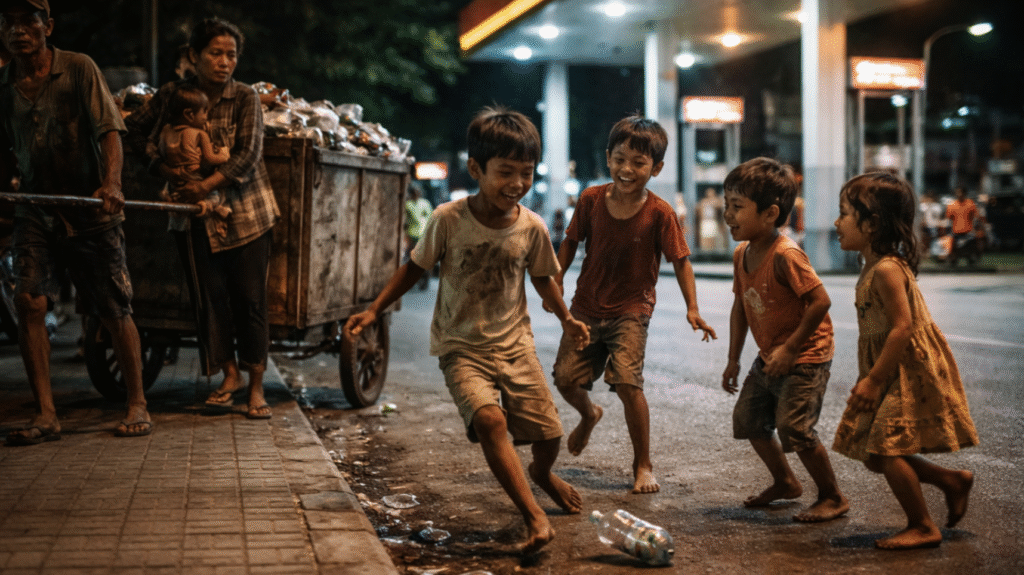
They are not hiding. They are not statistics buried in a UN report. They are right there, under the blinding noon sun and the flickering neon of evening markets. A little boy trailing behind his disheveled mother as she balances a plastic sack of recyclables. A girl, no older than eight, pushing one side of a garbage cart while her skinny father strains at the handles. Two brothers playing barefoot near a gasoline station, inventing a football out of a crushed water bottle, laughing as if the fumes and traffic were just background music.
And every time, I feel that uncomfortable mix of admiration and anger.
Admiration, because these children are tough. They navigate traffic like seasoned commuters. They count change faster than some bankers. They speak a handful of English words learned from tourists: “Lady, buy one?” “Brother, please.” They are alert, clever, socially fluent. If resilience were a currency, Cambodia would be rich.
But anger — oh, the anger — because resilience should not be required at seven years old.
Let’s be honest. These children are not on the streets because they are naughty, or because their parents are lazy. They are there because poverty is stubborn. Because debt traps rural families. Because urban growth builds shiny condos but forgets drainage systems, public housing, and living wages. Because when adults are surviving day to day, childhood becomes a luxury.
I watch mothers who look exhausted beyond their years. I watch fathers whose pride has been reduced to hauling scrap metal through traffic. This is not a morality play. This is structural inequality wearing flip-flops.
And here is the dilemma that breaks my heart: when we hand over a dollar, we feel kind. But are we helping? When tourists snap photos, are they witnessing reality — or consuming it? When we shake our heads and say, “So sad,” what exactly changes?
Cambodia is not a hopeless place. Far from it. It is dynamic, young, creative, ambitious. But ambition that does not carry its poorest children forward is hollow. Economic growth without social protection is just a prettier skyline.
Every time I see those barefoot kids, I remind myself: they do not need pity. They need systems that work. Schools that are truly free. Healthcare that is reachable. Jobs that pay enough so children don’t have to work.
Childhood should not smell of gasoline and garbage. And until it doesn’t, I will keep seeing them.