


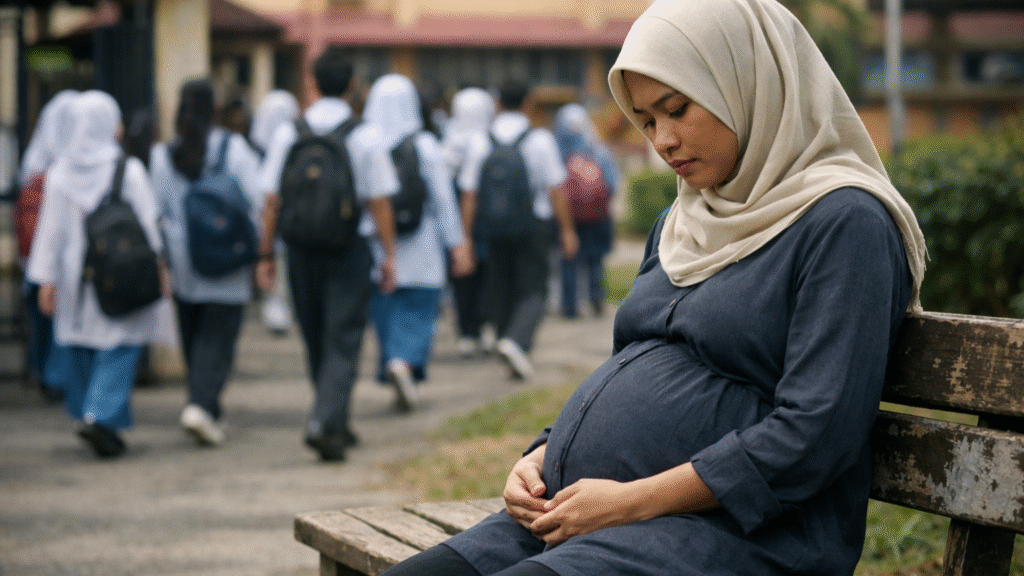
More than 21,000 out-of-wedlock teen pregnancies recorded between 2019 and 2024. The figure, revealed in Malaysia’s Parliament and widely reported by national media, has reignited debate over teenage pregnancy, sex education, child marriage and moral policing in this Muslim-majority Southeast Asian nation. Behind the stark statistic lies a complex web of cultural expectations, religious norms, digital-age relationships and uneven access to reproductive health services that shape the lives of Malaysian girls from Kelantan to Johor.
According to data presented to lawmakers, thousands of girls under 18 have given birth outside marriage over the past five years. While Malaysia’s overall fertility rate has been declining, teenage pregnancies—particularly those classified as anak luar nikah (child born out of wedlock)—remain a persistent concern. Health Ministry figures and past parliamentary replies show that many of these pregnancies involve girls aged 15 to 17, though cases involving younger adolescents have also been recorded. Civil society groups note that the numbers likely underrepresent reality, as stigma drives some families to conceal pregnancies or seek discreet arrangements.
In Malaysia, sexuality is not merely a private matter; it is deeply entangled with religion, law and community reputation. Islam is the religion of the federation, and for Muslim Malays—who make up the majority—sexual relations outside marriage are prohibited under hukum syarak (Islamic law). State-level syariah courts can prosecute offences such as zina (illicit sexual relations). Although prosecutions often focus on moral enforcement raids rather than pregnant teenagers themselves, the social consequences for girls can be severe. Shame, school dropout, family conflict and even abandonment are not uncommon outcomes.
Yet the phenomenon cuts across ethnic and religious lines. Malaysia’s multi-ethnic society includes Malays, Chinese, Indians and indigenous communities, each with distinct cultural attitudes toward dating, family honour and early marriage. In conservative rural areas—particularly in parts of Kelantan and Terengganu—community leaders have occasionally framed teen pregnancy as evidence of moral decline influenced by Western media and social platforms. In urban centres such as Kuala Lumpur and Penang, youth advocates point instead to gaps in comprehensive sexuality education and limited access to confidential reproductive health services.
Officially, Malaysia does provide some form of sexuality education through the school curriculum, often embedded within subjects like physical education or Islamic studies. However, critics argue that the content tends to emphasise abstinence and moral values rather than practical information about contraception, consent and healthy relationships. Organisations such as the Federation of Reproductive Health Associations Malaysia (FRHAM) have long called for more evidence-based, age-appropriate education. They argue that silence does not prevent sexual activity; it simply leaves teenagers uninformed and vulnerable.
Complicating matters further is the legal landscape around child marriage. While Malaysia raised the minimum civil marriage age to 18, exceptions remain under Islamic family law, allowing Muslim girls to marry below 18 with syariah court approval. Child rights advocates worry that in some cases, pregnancy can accelerate applications for early marriage as a way to “regularise” the situation and avoid social stigma. Government leaders in recent years have pledged to curb child marriage, but implementation varies by state.
There is also a darker dimension behind some statistics. Police and welfare reports have documented cases of statutory rape, sexual grooming and exploitation involving minors. Under Malaysian law, sexual intercourse with a girl under 16 is statutory rape, regardless of consent. Activists stress that not all teen pregnancies are the result of consensual relationships between peers; some involve significant age gaps or coercion. The Women and Girls Protection Division within the Social Welfare Department has highlighted the need for stronger protection mechanisms and more youth-friendly reporting channels.
The Covid-19 pandemic years—2020 and 2021—introduced new vulnerabilities. School closures, economic stress and increased online exposure created conditions in which unsupervised digital interactions flourished. Regional studies across Southeast Asia suggested spikes in teenage pregnancies during lockdown periods, as access to contraception and counselling services was disrupted. Malaysian NGOs reported similar patterns, though comprehensive post-pandemic data are still being analysed.
For the girls themselves, the consequences are immediate and long-lasting. Teen mothers are statistically more likely to leave school early, face limited job prospects and experience mental health challenges. In a society where family reputation carries immense weight, young mothers may find themselves isolated. Some are placed in protective shelters; others are quietly supported by extended families. A smaller number choose adoption, though this remains culturally sensitive. The term buang bayi (baby dumping) periodically surfaces in headlines, reflecting extreme cases where desperation overrides support networks.
Government responses have included public awareness campaigns, youth counselling services and collaboration with religious authorities to promote moral guidance. But debates in Parliament and on social media reveal a nation divided over solutions. Conservative voices call for stricter enforcement of moral codes and parental supervision. Progressive advocates push for comprehensive sex education, confidential access to contraception and a rights-based approach that prioritises girls’ health and agency.
Malaysia’s demographic future adds another layer of irony. With a total fertility rate now below replacement level, policymakers worry about ageing and labour shortages. Yet when it comes to teenage sexuality, the conversation remains framed primarily through morality rather than public health or gender equality. The tension between modernisation and tradition is visible in everyday language: malu (shame), maruah (honour), keluarga (family), and tanggungjawab (responsibility) all shape how communities respond to a pregnant teenager.
The 21,000-plus figure is not just a statistic; it represents thousands of individual stories unfolding in classrooms, villages and apartment blocks across Malaysia. It exposes the limits of silence as policy and the cost of treating adolescent sexuality solely as a moral failing. Whether the country moves toward more comprehensive, youth-friendly approaches—or doubles down on enforcement and stigma—will determine whether the next parliamentary disclosure tells a similar story or signals meaningful change.
Twenty-one thousand girls. When I read that number in the parliamentary reply, I did not see a statistic. I saw classrooms with one empty chair. I saw WhatsApp messages deleted in panic. I saw a 16-year-old staring at two pink lines in a bathroom, whispering ya Allah under her breath and wondering who she can tell without bringing malu (shame) upon her keluarga (family).
Malaysia is not unique. Teenage desire does not stop at national borders, nor does curiosity obey hukum syarak (Islamic law). What is unique is how fiercely we insist on pretending that silence is a solution. We wrap adolescent sexuality in moral panic, then act surprised when the numbers surface in Parliament like a ghost we tried to bury.
Let me be clear: this is not about encouraging teenagers to have sex. It is about acknowledging that some already do. Pretending otherwise does not protect them; it simply protects adult comfort. If comprehensive sex education feels “too Western,” then tell me why unplanned pregnancy is somehow less foreign. Biology, my loves, is not colonial.
I have sat in too many community halls across Southeast Asia listening to officials talk about maruah (honour) while girls quietly drop out of school. Honour seems to survive. The girls’ futures do not. When a pregnancy becomes a crisis, the fastest “solution” is often early marriage—tie the knot, regularise the scandal, move on. But a wedding ring does not magically create emotional maturity, financial stability or safety.
And let’s talk about boys. Where are they in this conversation? Why is the weight of consequence carried so visibly on a girl’s body while the boy often fades into the background? If we are serious about tanggungjawab (responsibility), it must be shared.
What breaks my heart most is the language. Anak luar nikah—a child “outside marriage.” As if the baby has committed an offence by existing. Words matter. They shape how teachers treat a student, how neighbours gossip, how a grandmother sighs at the dinner table.
Malaysia is modern enough to build skyscrapers that glitter across Kuala Lumpur’s skyline. Surely it is modern enough to give its teenagers accurate information, confidential health services and the dignity of not being reduced to cautionary tales.
We can cling to shame, or we can choose care. One path produces headlines every few years when Parliament reads out the numbers again. The other path produces quieter outcomes: girls finishing school, boys learning accountability, families choosing compassion over fear.
If I must pick a side, you already know where Spicy Auntie stands.