


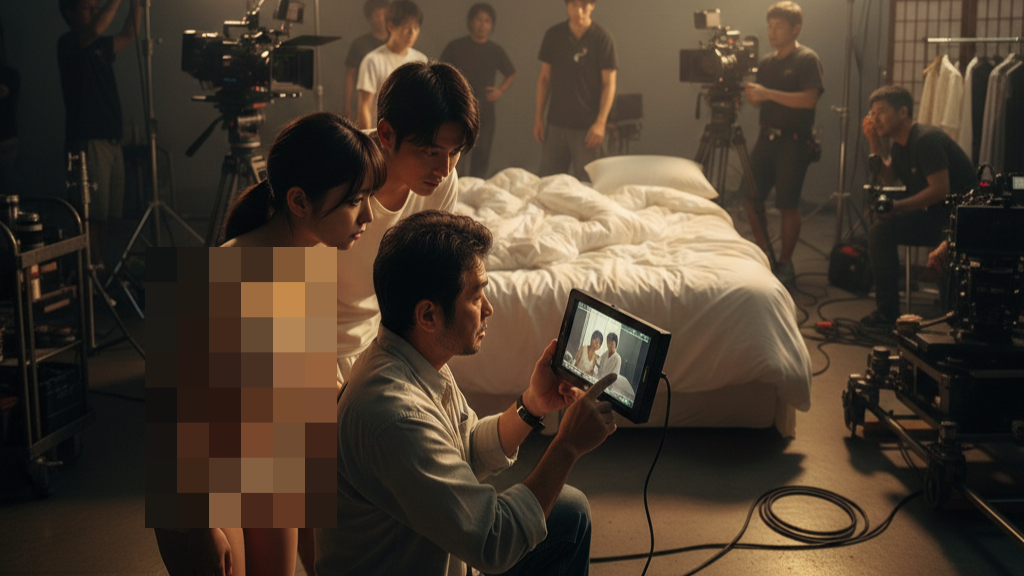
Japanese censorship rules around sexual imagery are often described as paradoxical, but they are better understood as the product of legal history, cultural compromise, and a long tradition of avoiding explicit definitions. What looks arbitrary from the outside is, inside Japan, a carefully maintained balance between prohibition and permission, enforced less by clear statutes than by precedent, fear, and habit.
The legal foundation lies in Article 175 of the Penal Code, which prohibits the distribution of waisetsu (猥褻, obscenity). The law itself is remarkably vague. It does not define obscenity in anatomical terms, nor does it list forbidden body parts or acts. Instead, courts have historically interpreted waisetsu as material that “arouses sexual desire, offends a sense of sexual morality, and violates proper concepts of modesty.” This formulation dates back to early twentieth-century rulings, shaped by Meiji-era anxieties about modernity, Western influence, and social order. Crucially, the courts came to treat visible genitalia as the clearest marker of obscenity, while leaving everything else undefined.
Because the law never specifies methods of compliance, censorship in Japan developed through practice rather than legislation. By the postwar period, publishers and film producers had learned that obscuring genital detail was enough to satisfy prosecutors. This gave rise to bokashi (ぼかし, blur or mosaic censorship), first applied to printed photographs and later standardized in film and video. The blocky pixelation familiar today is not mandated by law; it is simply the safest technique the industry knows. Since courts never clarified how much obscuring is “sufficient,” producers consistently overdo it to avoid legal risk.
Live-action adult video, usually referred to as AV, is treated with the greatest caution. Because it depicts real bodies and real sexual activity, it sits closest to the legal danger zone. Studios therefore apply heavy mosaics to the penis and vaginal opening while leaving surrounding areas visible. This selective censorship often confuses outsiders, but it follows decades of unchallenged precedent. If prosecutors have never pursued a case based on a visible anus or pubic hair alone, those features are considered legally safe. The goal is not coherence or morality, but predictability.
Over time, AV studios have developed sophisticated techniques to work within these constraints. Camera angles are chosen to emphasize faces, movement, or narrative framing rather than anatomical detail. Lighting is adjusted to soften outlines before mosaics are applied. Editing favors rapid cuts that reduce scrutiny of any single frame. Some productions intentionally shoot at higher resolutions so that, after censorship, the remaining image still looks sharp. None of this is about artistic freedom; it is about managing risuku (リスク, risk) in a system where one misjudgment can lead to prosecution, fines, or blacklisting.
Manga and anime operate under a different, looser logic. Courts have historically treated drawings as hyōgen (表現, expression) rather than direct representation of reality. Because illustrated bodies are not real bodies, they are perceived as less immediately obscene. This distinction allowed erotic manga to flourish even while live-action material remained tightly controlled. As a result, hentai manga often depicts anatomy in ways that would be illegal in AV. Even so, many publishers still include symbolic censorship, such as white bars or light mosaics, more out of caution and market convention than strict legal necessity.
Anime occupies an ambiguous middle ground. Motion and sound increase perceived realism, so animated works sometimes face stricter self-regulation than static manga. The result is inconsistency: a printed comic may show more detail than its animated adaptation. Again, this is not dictated by statute, but by industry instinct and the desire not to become a test case.
The contrast between pornography and art further exposes the system’s flexibility. Nude photography, sculpture, and painting are widely exhibited in Japan, including works that clearly show genitalia. The key distinction lies in mokuteki (目的, purpose) and bunmyaku (文脈, context). Courts assess whether a work is presented as art, education, or culture rather than as a tool for sexual arousal. A photograph in a gallery, a medical textbook, or a historical reproduction is framed as geijutsu (芸術, art) or gakujutsu (学術, academic study), and therefore judged under a different standard. The same image sold in an adult shop would likely be illegal.
This context-based approach allows Japan to maintain a public image of modesty while accommodating a vast adult industry. It also explains why enforcement appears selective. Police rarely raid major studios unless political pressure rises or a producer is seen as pushing boundaries too openly. Periodic crackdowns tend to coincide with conservative moral campaigns, after which the industry quietly recalibrates and continues.
International distribution adds another layer. Many Japanese producers release uncensored versions of their work abroad through overseas subsidiaries. Because Article 175 applies only to domestic distribution, the same content can be legal or illegal depending entirely on where it is sold. This geographic workaround further reduces pressure for reform, since consumers who want uncensored material can already obtain it, just not officially “in Japan.”
What emerges from this history is not a coherent moral system, but a pragmatic one. Japanese censorship persists because it allows all parties to avoid confrontation. Legislators do not have to redefine obscenity. Courts do not have to issue controversial rulings. The industry retains profitability. Society maintains a veneer of restraint. The result is a stable contradiction, one in which what is blurred matters less than the fact that something is blurred at all. In that sense, Japanese censorship is less about sex than about boundaries. The mosaic is a symbolic gesture, a visual acknowledgment that a line exists, even if everyone agrees the line itself makes little logical sense.
I remember the first time I watched Japanese porn with a group of foreign friends. There was wine, there was giggling, and then there was that collective pause. Someone finally asked the obvious question: “Why is that blurred but that isn’t?” Welcome, darling, to Japan’s most committed relationship: the one between sex and denial.
Japanese censorship isn’t about modesty. If it were, the country wouldn’t have an adult industry so vast it could probably prop up the economy in a bad quarter. It’s about choreography. A ritual. A shared agreement that everyone will pretend not to see what they are very obviously seeing. The pixelation isn’t there to stop arousal. It’s there to reassure the law that it still matters.
What fascinates me isn’t the blur itself, but how precise it is. Pubic hair? Fine. Anus? Absolutely fine. Fluids, sounds, contortions that would make a yoga instructor weep? Go ahead. But show a penis head or a vaginal opening clearly and suddenly the Republic is at risk. This isn’t morality—it’s legal calligraphy. One stroke too far and you’ve committed a crime.
And the industry plays along beautifully. Directors become masters of implication. Editors turn mosaics into punctuation marks. Performers arch, angle, and perform around the blur like dancers avoiding a spotlight. It’s erotic kabuki: highly stylized, deeply artificial, and weirdly elegant once you stop expecting realism.
Then there’s manga and anime, the rebellious younger siblings who get away with far more. Draw it, exaggerate it, make it tentacled or impossible, and suddenly it’s “expression,” not obscenity. Real bodies are dangerous. Imagined ones are just culture. Somewhere, a legal scholar is nodding very seriously at this distinction.
What really gives the game away is art. Put genitals in a gallery, call it photography or sculpture, and the blur magically disappears. Same body, different room. The message is clear: sex is acceptable as long as it doesn’t admit it wants to excite you.
This is why I can’t take Japanese sex censorship seriously. It isn’t prudish; it’s performative. It allows the country to be sexually explicit while claiming restraint, permissive while sounding conservative. Everyone wins, except honesty.
And maybe that’s the point. The mosaic isn’t hiding sex from us. It’s helping Japan save face while enjoying it anyway.