


Chiang Mai is rarely mentioned when Thailand’s sex industry is discussed. The global imagination goes straight to Bangkok’s neon avenues, Pattaya’s excess, or Phuket’s tourist spectacle. Northern Thailand’s largest city, by contrast, is marketed as gentle and spiritual: temples at dawn, digital nomads with laptops, yoga retreats, cafés shaded by frangipani trees. Yet for decades, Chiang Mai has sustained a quiet, largely invisible market for male sex work, shaped not by flashiness but by discretion, migration, and silence.
The roots of the scene can be traced back to the late 1980s and 1990s, when Chiang Mai became a key stop on the Southeast Asian backpacker trail. Western travelers, aid workers, and long-stay expatriates arrived alongside a growing tourism economy. As gay tourism expanded regionally, Chiang Mai developed a small but steady gay nightlife. Unlike Bangkok, the city never formed an openly branded red-light district for men. Instead, transactional sex emerged inside existing venues—bars, show clubs, massage parlors—and through informal arrangements that allowed the city to preserve its respectable image.
By the early 2000s, clusters of gay-friendly bars appeared in and around the Old City and later in Nimmanhaemin. Young men worked as hosts, dancers, or companions, entertaining customers with conversation, drinks, and performances. Sex was rarely advertised and almost never explicit, but it was widely understood. Negotiations happened quietly. Clients and workers would leave together, or exchange contact details for later meetings. This ambiguity was essential. Chiang Mai’s economy depends heavily on tourism, but it also sits within a socially conservative northern Thai context where overt sex work—especially between men—remains deeply stigmatized.
The men who enter this work are rarely from Chiang Mai’s middle class. Research and NGO reporting show that many male sex workers come from marginalized backgrounds: ethnic minority communities from northern hill areas, internal migrants from poorer provinces, and migrants from Myanmar, particularly Shan men. For some, lack of Thai citizenship or secure documentation limits access to education, healthcare, and formal employment. Sex work becomes less a choice than a stopgap, a way to survive in a city where rents are rising and low-skilled wages remain stagnant.
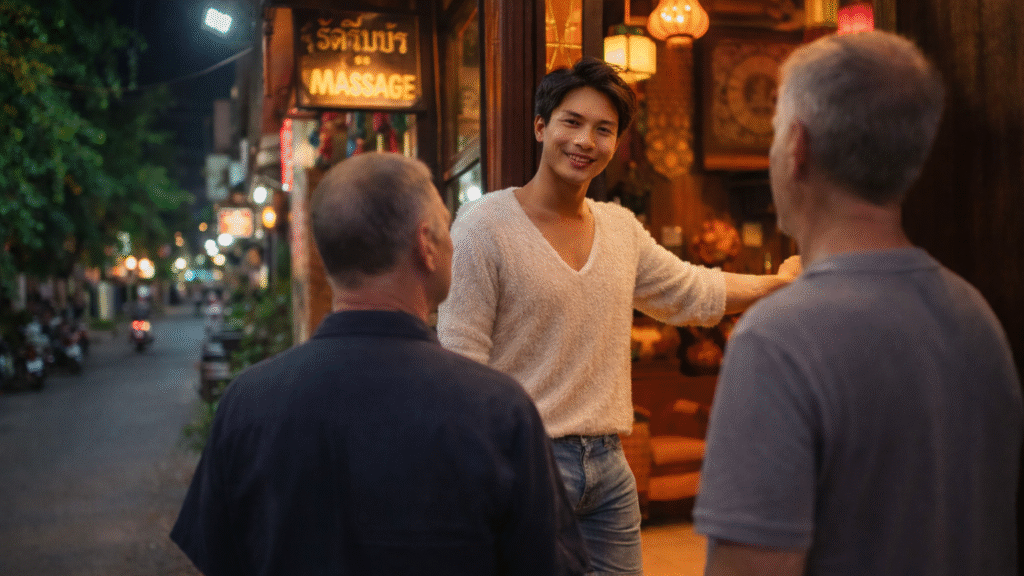
The market today operates through overlapping channels. Some men work in bars or entertainment venues, officially hired as hosts or performers. Others provide massage services, either within licensed shops or informally. A significant number describe themselves as freelancers, meeting clients through nightlife networks, introductions, or increasingly through digital platforms. Chiang Mai’s scene is small enough that repeat customers are common, and relationships can blur the line between transaction and companionship. Prices are negotiated privately and vary widely depending on age, appearance, and the nationality of the client.
Behind this quiet surface lies a harsher reality. Studies focused on Chiang Mai’s sex industry have documented high levels of coercion, particularly in bar-based venues, where workers may face pressure from managers, debt dependency, or lack of alternatives. Entry into sex work at a young age has also been recorded, underscoring how poverty and migration create pathways into exploitation. These findings complicate any simple narrative of empowerment or free choice. In Chiang Mai, consent often exists alongside constraint.
Thailand’s legal framework adds another layer of vulnerability. The Prevention and Suppression of Prostitution Act applies equally to same-sex transactions, making public solicitation illegal while leaving venue-based work in a tolerated gray zone. In practice, enforcement in Chiang Mai is inconsistent. Police raids are not routine, but the constant possibility of scrutiny keeps workers cautious. For migrants, the greater threat often comes from immigration enforcement. Undocumented status can turn a workplace dispute or health emergency into a risk of detention or deportation. As a result, abuse, theft, and violence frequently go unreported.
Health concerns have long shaped responses to male sex work in northern Thailand. Chiang Mai is one of the country’s key hubs for HIV prevention and outreach among men who have sex with men and male sex workers. Community-led organizations such as MPLUS Foundation have built extensive programs offering HIV testing, PrEP, STI treatment, counseling, and drop-in centers. These services have improved access to care, but stigma remains a powerful barrier. Many men hide their work from families and communities, fearing shame more than legal consequences. Mental health stress, isolation, and substance use appear repeatedly in outreach accounts.
What keeps Chiang Mai’s male sex work scene so invisible is not its absence, but its careful containment. The scale is smaller than in Thailand’s major red-light cities, the transactions are quieter, and the workers themselves are often migrants or minorities with little public voice. This invisibility suits the city’s branding as cultural and wholesome, but it also ensures that the people sustaining this hidden economy remain largely unprotected.
Today, as Chiang Mai continues to attract tourists, retirees, and remote workers, the conditions that gave rise to male sex work remain unchanged. Inequality, migration, and limited legal protection still shape who enters the scene and how long they stay. The industry adapts—moving venues, changing languages, shifting online—but it does not disappear. Male sex workers in Chiang Mai exist in the city’s shadows, navigating desire and necessity in a place that prefers not to see them at all.
I’ve lived long enough in Asia to know that when a city insists it is “gentle,” “cultural,” and “pure,” someone is quietly paying the price for that image. Chiang Mai is a masterclass in this. Temples glow at sunrise, monks collect alms, digital nomads sip oat lattes—and somewhere just out of frame, young men sell intimacy while pretending not to exist.
Male sex workers in Chiang Mai are not loud, not glamorous, and certainly not celebrated. They are discreet because discretion is survival. The city does not want them visible. Families do not want to know. Tourists do not want the inconvenience of awareness. Even progressive conversations about sex work in Thailand tend to stop at women, as if men—especially poor, migrant, ethnic-minority men—could not also be vulnerable.
What strikes me, every time, is how politeness becomes a weapon. Chiang Mai is polite. Soft-spoken. Smiling. And in that softness, exploitation slips through unnoticed. If a bar “host” is pressured into sex, who raises their voice? If a Shan or hill-tribe boy starts working too young, who asks questions? If a migrant disappears after a police stop, who remembers his name? Silence, here, is not accidental. It is cultivated.
People love to argue about “choice” when sex work comes up, usually from positions of comfort. Choice looks very different when you lack papers, connections, and money. When the city offers you hospitality jobs that pay crumbs and nightlife jobs that pay cash, fast, with strings attached. Chiang Mai’s male sex workers are not symbols of decadence. They are symbols of inequality, dressed up as entertainment.
And let’s talk about desire, too. Because this economy exists because people want it. Foreigners, Thais, older men, lonely men—many of them kind, many of them not—consume intimacy while congratulating themselves for being discreet, respectful, “not like Pattaya.” The city’s gentility provides moral cover. Everyone pretends this is different. It isn’t.
I don’t romanticize this world, and I don’t demonize it either. What I resent is the hypocrisy. The temples are spotless. The consciences less so. Chiang Mai benefits from these men’s invisibility, from their silence, from their willingness to absorb risk so others can enjoy fantasy without friction.
Spicy Auntie’s rule of thumb is simple: if a city’s beauty depends on someone else staying hidden, you should start asking who that someone is—and why they are not allowed into the picture.