


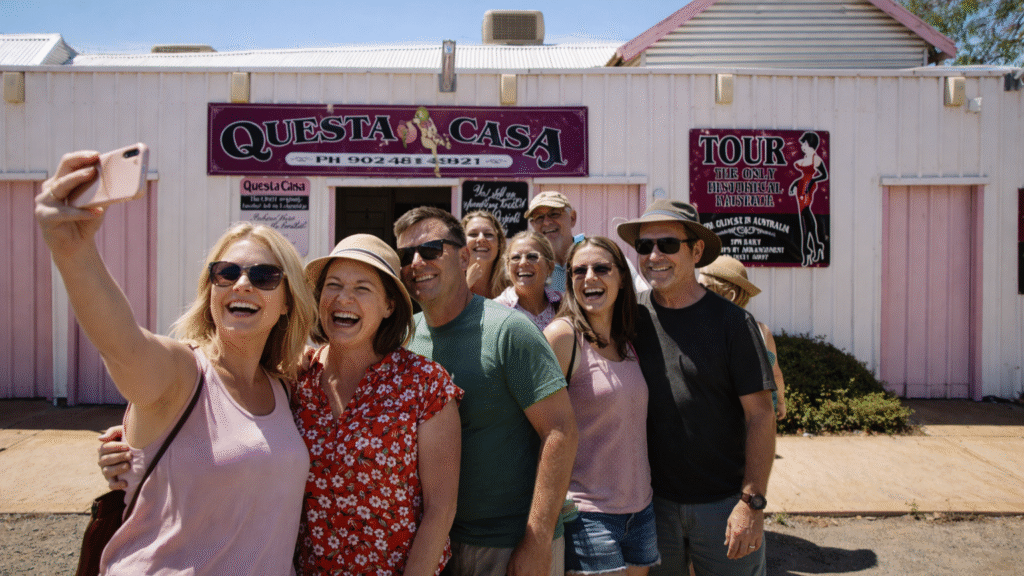
On a quiet stretch of Hay Street in the Western Australian goldfields town of Kalgoorlie stands a low, pink-painted building that has outlived boom cycles, moral panics, policing experiments and the slow collapse of the red-light district around it. Known as Questa Casa—Italian for “This House”—it is widely described as Australia’s oldest still-operating brothel, with records placing its beginnings in the early years of the twentieth century, most commonly dated to around 1904.
Questa Casa emerged during Kalgoorlie’s gold rush era, when tens of thousands of men poured into the Eastern Goldfields chasing underground wealth. Like other frontier mining towns, Kalgoorlie quickly developed a semi-formal sex industry designed to service a largely male, transient population. Hay Street became the centre of this economy. Brothels were tolerated rather than legal, policed through a mix of surveillance, registration and informal containment. Sex workers were required to live where they worked, register with police, submit to medical checks and remain socially segregated from the broader town. These arrangements were never fully codified in law but were rigidly enforced in practice.
The architecture of Hay Street reflected this system. Brothels were built with corrugated iron façades and narrow “starting stalls” along the street frontage, half-doors behind which women would sit on chairs, visible to passing clients. Negotiations took place at the threshold; entry followed agreement. This distinctive design, still visible at Questa Casa, has since become one of the site’s most photographed features and a shorthand for Kalgoorlie’s sexual frontier history.
Who worked in these venues—and under what conditions—shifted over time. Archival material from the Western Australian Museum and police records show that in the early decades of the twentieth century, Japanese women formed a significant proportion of sex workers in Kalgoorlie, alongside smaller numbers of French women and others from overseas. These women were frequently singled out for police attention and moral campaigns, and their presence was used to justify stricter surveillance of the district. While exploitation was common, the system also offered some women relative financial independence in an otherwise harsh and isolated environment.
As the decades passed, Hay Street endured but changed. By the late twentieth century, Kalgoorlie’s sex industry had become smaller, older and increasingly out of step with new technologies and social attitudes. An unofficial “containment policy” that concentrated brothels on Hay Street remained in effect until around 2000. When it was lifted, sex work dispersed into private premises, escorting and short-term arrangements coordinated by mobile phone. Traditional brothels, reliant on walk-in trade and permanent staff, struggled to compete.
It was during this period that Carmel Galvin—widely known as Madam Carmel—became the owner and operator of Questa Casa. Widowed and new to the industry, she later described her entry bluntly as accidental: “I fell into it.” By the 1990s, she was running one of the last surviving brothels on Hay Street as others closed, burned down, or were repurposed. What remained was not only a business but a building heavy with memory.
By the late 2010s, that business had become precarious. In interviews with Australian Broadcasting Corporation, Galvin acknowledged that traditional brothel work had almost vanished. At times, only one sex worker was operating at Questa Casa in an entire month. The venue increasingly relied on daytime heritage tours to survive, reframing itself as a living museum of Kalgoorlie’s sexual past. “Hay Street will never come back,” Galvin told the ABC. “Times have changed.”
The women who worked at Questa Casa in its later years remain largely undocumented, a reflection both of stigma and of the industry’s fragmentation. Unlike the early twentieth century, when ethnicity and nationality were obsessively recorded by police, modern reporting tends to mention individuals only with consent. One long-serving worker, known publicly as “BJ,” appeared in the documentary The Pink House, which explored daily life inside the brothel and the emotional labour involved in staying as the district around it emptied out. Beyond such rare cases, precise data on nationalities or backgrounds of workers at Questa Casa specifically is scarce. What can be said with confidence is that the workforce had become small, aging and increasingly isolated.
Clientele shifted as well. Where Hay Street once served thousands of miners on foot, modern Kalgoorlie’s fly-in, fly-out workforce preferred private arrangements. Walk-in clients became rarer, replaced by tourists curious about the building’s reputation and history. For many visitors, Questa Casa became less a place of transaction than a symbol—an uneasy reminder of how sex, labour and frontier economies once intertwined.
Ownership, too, became a burden. In 2019, Galvin publicly listed the property for sale, citing exhaustion and the collapse of viable trade. “You can’t make money in Kalgoorlie anymore,” another long-time Hay Street madam told the ABC at the time, capturing the broader sentiment of decline. The listing raised questions about whether Questa Casa could continue at all, or whether its future lay solely in heritage preservation.
Today, Questa Casa occupies an ambiguous position: part brothel, part museum, part memorial. It stands as one of the last physical traces of a system that was never officially sanctioned yet was central to the town’s social and economic life for more than a century. Its story is not one of glamour or nostalgia, but of endurance—of women navigating constraint and opportunity in a place built on extraction, risk and impermanence. In Kalgoorlie, gold has long been pulled from the ground and carried away. What remains on Hay Street is quieter, heavier, and harder to move.
I’ve walked past places like Questa Casa my whole adult life. Different countries, different names, same uneasy pause in the body. People pretend they’re shocked, but really they’re uncomfortable because the building remembers things the town would rather forget. Gold towns, port towns, boom towns—men come first, money comes fast, and women’s labour quietly keeps everything standing. Then everyone acts surprised when the paint starts peeling.
Let’s be honest: brothels like this didn’t survive because they were tolerated. They survived because they were useful. Useful to police who wanted order without responsibility. Useful to businessmen who wanted productivity without wives asking questions. Useful to towns that liked their morals clean and their men dirty. The hypocrisy is the most durable building material in Australia.
I’m especially tired of the way people talk about “heritage” when it comes to places like this. Heritage for whom? For tourists snapping photos of pink walls? For councils suddenly discovering history when the last woman closes the door? The women who worked there rarely get heritage plaques. Their names vanish. Their bodies age out. Their stories become whispers told by someone else.
And yes, the women were Japanese once. And French. And later, whoever could survive isolation, stigma, and the math of rent versus dignity. This wasn’t some exotic parade of desire—it was migration, economics, and limited options dressed up as vice. Moralists love to shout about prostitution until you ask them who was paying, who was policing, and who was profiting.
What really gets me is how people romanticise the “old days” while ignoring how brutally narrow women’s choices were. Registration with police. Living where you worked. Being watched, counted, and blamed. If that’s nostalgia, keep it. I prefer memory with teeth.
Today, the industry has moved online, behind doors, into phones and private listings. Everyone pretends that’s progress. But the loneliness hasn’t disappeared—it’s just better hidden. The old brothel at least had walls that knew what they were holding.
So when I hear people say, “It’s sad Hay Street is dying,” I want to ask: sad for whom? For the building? Or for a society that never figured out how to talk honestly about sex, labour, and power without punishing women for all three?
If Questa Casa finally closes, don’t light a candle. Ask harder questions. About whose work gets remembered. About whose survival gets called shame. And about why, after 120 years, we still act like sex work is a scandal instead of a mirror.