


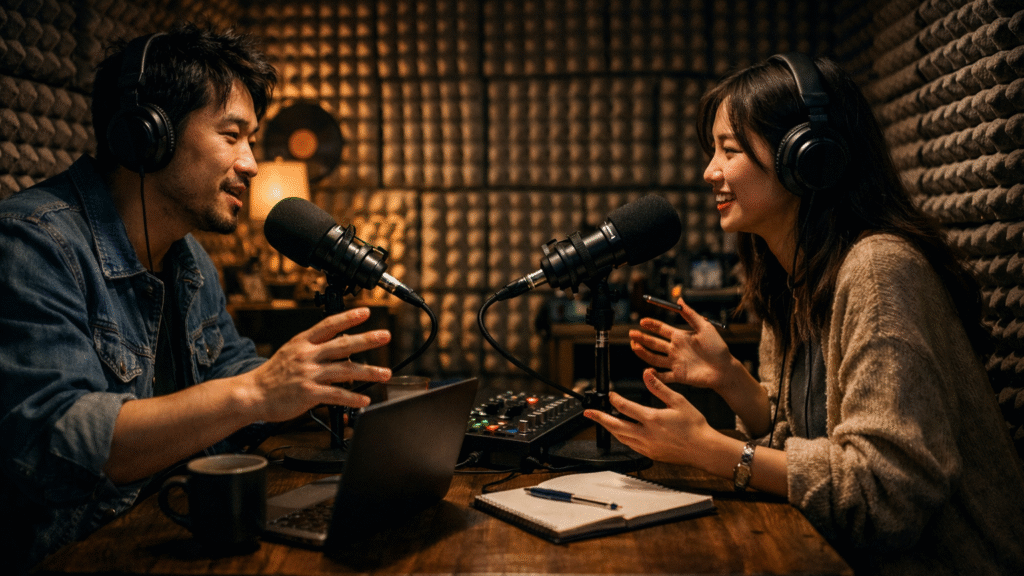
In China today, podcasts have become the place where people whisper. In cafés, on late-night walks, under blankets with headphones on, millions of listeners tune in to long, intimate conversations that would feel risky or impossible elsewhere online. According to recent reports, podcasting has exploded across the country, drawing an estimated 150 million listeners, mostly young, urban, and well educated. Yet the rules shaping this boom are starkly simple: no sex, no politics — otherwise, nearly everything is okay. That paradox defines the strange, fertile space in which gender and sexuality podcasts now exist in China.
On paper, sex is off-limits. Audio platforms rely on automated speech-to-text systems that flag keywords before episodes even go live. Explicit sexual content rarely survives. But in practice, podcasters have learned how to speak around sex without naming it, and how to discuss gender without framing it as ideology. Podcasts thrive precisely because they are slower, softer, and harder to police than short video or social media posts. Voices sound personal, conversational, almost confessional. This intimacy allows discussions of desire, marriage pressure, emotional labour, and queer identity to pass as “life stories” rather than activism.
Feminist-leaning podcasts have been especially adept at navigating this terrain. Shows like 别任性|Be A Dodo explore relationships, emotional autonomy, and women’s selfhood through personal anecdotes and academic language. Sex is rarely named directly, but it is everywhere: in conversations about why women feel guilt after intimacy, why female pleasure is misunderstood, or why marriage feels like a deadline rather than a choice. Hosts speak in the register of psychology, sociology, or personal growth, creating plausible deniability while still addressing deeply gendered experiences.
Another influential presence is 不明白播客 (literally, “The ‘I Don’t Buy It’ Podcast”), which often tackles women’s inequality, workplace discrimination, and motherhood through interviews with writers, scholars, and journalists. Here, sex appears obliquely, embedded in discussions of reproductive pressure, “剩女” (leftover women), and the state’s obsession with birth rates. What emerges is a picture of sexuality as something constantly regulated — by family expectations, by employers, by demographic panic — even when it is never described explicitly.
Queer podcasts operate under even tighter constraints, yet they persist. Lesbian and queer women’s shows, including community podcasts like LesTalk, frame desire through friendship, companionship, and shared memory. Romantic language is coded, physical intimacy softened into emotional closeness. For many LGBTQ+ listeners, these podcasts function as semi-private rooms where recognition matters more than explicit affirmation. Simply hearing someone describe a life that resembles your own can be quietly radical.
Reports highlight how podcasters constantly negotiate invisible red lines. Episodes disappear without explanation. Entire back catalogues vanish after platform rule changes. Hosts re-upload content with altered titles or re-record sensitive segments. Some creators deliberately keep their shows small, preferring loyal audiences over algorithmic visibility. Others shift from explicit social critique to storytelling, knowing that a personal narrative is less likely to be flagged than a political argument.
This environment has shaped not just what is said, but how people think about sex and gender. Conversations tend to focus on emotions rather than acts, on consequences rather than pleasure, on identity rather than politics. In one sense, this limits the scope of sexual discourse. There is little room for explicit sex education, kink, or open discussion of bodily autonomy. In another sense, it produces a distinctly Chinese audio feminism — careful, ironic, often self-protective, but persistent.
English-language podcasts about China help contextualize this phenomenon. Shows like Sinica Podcast have long discussed how sexuality has been regulated historically, from imperial morality to socialist prudishness to today’s algorithmic censorship. What feels new is how ordinary people, not just academics or journalists, are now participating in these conversations — quietly, indirectly, but at scale.
Podcasts also appeal because they resist the performance culture of Chinese social media. There is no face to scrutinize, no body to police. Voices float free of appearance, gender presentation, and age. For women and queer creators especially, this disembodiment can feel liberating. It allows for vulnerability without visibility, honesty without exposure. Listeners often describe podcasts as companions rather than content, something to carry through daily life.
Yet this freedom remains fragile. Sex and politics are not just discouraged; they are structurally filtered out. The future of gender and sexuality podcasting in China depends on how long platforms tolerate ambiguity. For now, podcasters survive by speaking sideways, by trusting listeners to read between the lines, and by accepting that silence is sometimes strategic.
In a country where sex is everywhere and nowhere at once — in advertising, in demographic anxiety, in unspoken family expectations — podcasts have become one of the few places where people can think aloud about their bodies, desires, and constraints. Not loudly. Not explicitly. But enough to be heard.
I’ve been listening to Chinese podcasts lately the way one listens at night in a conservative family house: low volume, door half-closed, ears sharper than usual. Not because the voices are loud — they’re not — but because of what they refuse to say out loud. Sex is everywhere in these conversations, precisely because it is never named. Desire appears disguised as “emotional needs.” Marriage anxiety walks in wearing a psychology degree. Queerness shows up as “close friendship” that somehow lasts decades and survives everything.
There is something both heartbreaking and impressive about this. Heartbreaking, because adult women and queer people should not have to speak about their own bodies as if they’re handling contraband. Impressive, because Chinese podcasters have turned constraint into craft. They have mastered the art of saying just enough, trusting their listeners to meet them halfway. It’s flirting by footnote. Feminism by implication. Sex education via shared sighs.
What strikes me most is how gender keeps sneaking in even when sex is officially banned. Talk about housework becomes a discussion about power. Talk about burnout becomes a story about wives who never rest. Talk about loneliness inevitably circles back to who is allowed to want — and who is expected to wait quietly. You don’t need explicit words when the entire structure of life is already sexualised, regulated, and moralised.
Audio helps. Voices are forgiving. They don’t ask for beauty, youth, or the correct gender presentation. A woman can sound tired without looking like a failure. A queer person can exist without proving anything visually. In a country obsessed with surfaces, podcasts allow people to slip out of their bodies for an hour and speak from somewhere safer. That matters more than we admit.
But let’s not romanticise this too much. Silence is not liberation. Coding is not freedom. When sex is filtered out by algorithms, it doesn’t disappear — it just becomes more unequal. Those with education, language skills, and cultural capital learn how to speak in riddles. Everyone else is left with ignorance, shame, and rumor. Whispering works, but only up to a point.
Still, I understand why people cling to these shows. In a society where sex is officially unmentionable yet constantly weaponised — through marriage pressure, fertility panic, moral campaigns — podcasts offer something rare: permission to think. Not protest. Not organise. Just think. For now, that’s what survives.
And maybe that’s the quiet lesson here. When power tells you “no sex, no politics,” people don’t stop desiring or questioning. They just get better at speaking sideways. And Auntie will always listen between the lines.