


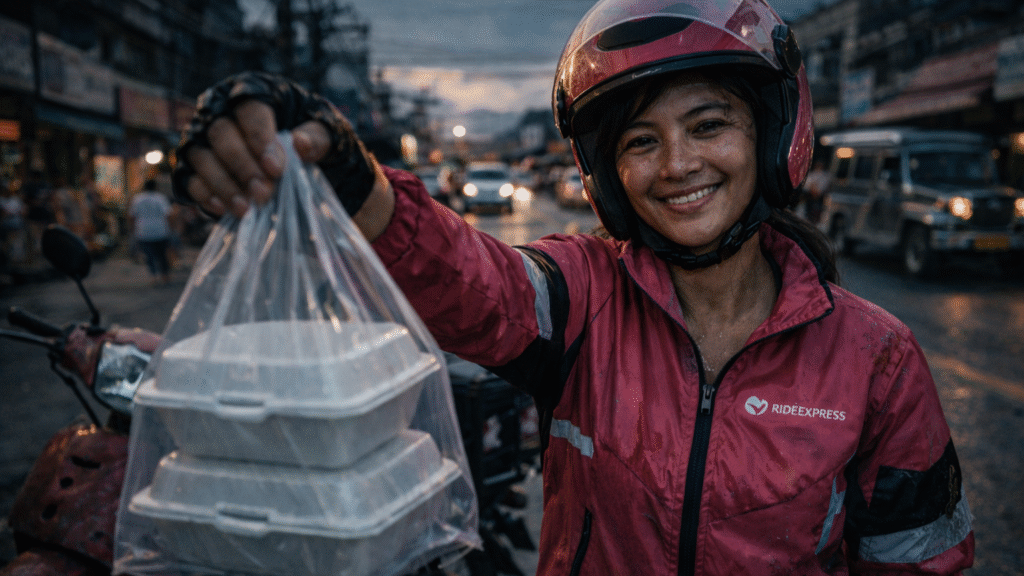
On the streets of Metro Manila, a woman on a motorcycle with a delivery box no longer turns heads. In the Philippines, female drivers and riders have carved out space in the app-based gig economy in ways that remain rare across Southeast Asia—quietly challenging the idea that ride-hailing is men’s work, and doing so not for empowerment slogans or corporate campaigns, but because it pays the bills and keeps households afloat.
Within the region’s ride-hailing and delivery platforms, the Philippines stands out less for sheer scale than for composition. Indonesia may host the largest fleets, but qualitative research, labour-rights monitoring, and extensive media profiling consistently point to a higher share of women among drivers and delivery workers in the Philippines than elsewhere in ASEAN. Platforms do not publish clean, comparable gender data, and governments do not require them to. Still, the pattern is difficult to miss on the ground: women are more present, more visible, and more socially accepted in Philippine app-based driving than in neighbouring markets.
History matters. Filipina women have long been embedded in paid work, both at home and abroad, from overseas care labour to local service industries. Earning an income has rarely been framed as incompatible with femininity or motherhood. Against this backdrop, driving or delivering for platforms such as Grab does not register as a moral rupture. It is simply another service job—mobile, informal, and increasingly digital. As one Filipina rider put it bluntly in a media interview, “We can do it too!” The statement is less a rallying cry than a matter-of-fact rebuttal to lingering stereotypes.
Economic necessity is an even stronger driver. Many Filipina riders describe platform work as a rational response to precarious labour markets, stagnant wages, and the absence of benefits in traditional employment. Ride-hailing and delivery apps offer fast onboarding, minimal credential requirements, and steady short-term cash flow. For women managing household finances—often as single mothers or primary earners—this immediacy matters. A delivery partner interviewed by a state news agency explained that she simply focused on completing jobs and serving customers, refusing to let her gender become an obstacle. The work, she said, was about survival, not symbolism.
Flexibility is frequently cited, but not in the abstract language favoured by platform marketing. Women riders talk concretely about school schedules, caregiving, and the need to remain available to family. Logging on after morning chores, pausing during childcare duties, and returning online later in the day allows women to stay economically active without exiting domestic responsibilities. This double burden is rarely framed as empowering. It is framed as necessary. As one rider noted in a profile, managing expectations and staying mentally resilient mattered more than chasing ideal working conditions: “Don’t focus on the negative.”
Service culture also lowers barriers. Decades of exposure to customer-facing work—from call centres to tourism—have made communication and conflict management familiar terrain for many Filipinas. English proficiency and digital literacy reduce friction with app interfaces and passenger interactions. This does not eliminate discrimination or risk, but it can make the job feel navigable rather than alien. Even so, women riders remain acutely aware of how they are perceived. One delivery driver recalled moments of ridicule: “There are times people laugh when they see me carrying large packages, but I just ignore them and keep going.” Persistence, rather than confrontation, is often the chosen strategy.
Safety remains the most persistent concern. Filipina drivers recount harassment, intrusive questions, and anxiety during night shifts, echoing experiences across Southeast Asia. What differs is not the presence of risk, but how it is managed. Women develop informal safety routines: limiting working hours, favouring delivery over passenger trips, sharing live locations with family members, or refusing rides that feel unsafe. Platform tools—panic buttons, ratings, identity checks—are used pragmatically but rarely trusted completely. Safety is negotiated daily, not guaranteed.
Delivery work has emerged as a particularly important entry point. Food and parcel delivery is often perceived as less risky than transporting passengers, allowing women to avoid prolonged, enclosed interactions with strangers. In provincial cities and peri-urban areas, female delivery riders are increasingly common, their visibility slowly reshaping gender norms around motorcycle work. For some, delivery becomes a stepping stone into ride-hailing; for others, it remains a preferred niche that balances income with perceived safety.
Visibility itself has consequences. Filipina women riders are frequently profiled in local media and advocacy reports, creating a feedback loop of recognition and imitation. Seeing other women succeed lowers psychological barriers to entry and normalises participation. In countries where women drivers remain rare, their absence reinforces the idea that ride-hailing is unsuitable or unsafe for women. In the Philippines, representation has helped chip away at that assumption.
None of this makes the Philippine case a feminist success story. Women riders remain exposed to income volatility, algorithmic management, and the lack of social protection that defines platform work across the region. Pregnancy, illness, and caregiving emergencies still mean lost income. Corporate narratives of “women’s empowerment” often outpace concrete improvements in insurance coverage, maternity protection, or grievance mechanisms. Higher participation does not automatically translate into better conditions.
Yet in comparative terms, the Philippines offers a revealing case. It shows that women’s participation in app-based ride-hailing is not fixed by technology alone, but shaped by labour histories, cultural norms, and economic pressure. While Indonesia almost certainly hosts more women drivers in absolute numbers, the Philippines stands out for participation as a share and for the everyday normalisation of women behind the handlebars. In a region where platforms often treat women drivers as a branding niche, Filipina riders send a quieter, clearer message: this is work, it is necessary, and they are here to stay.
I see them every day. Sometimes I’m still in my pyjamas, hair doing its own little protest, when the doorbell rings and there she is: helmet off, phone in hand, sweat on her brow, polite smile fully intact. The woman who just brought my food. Not a mascot. Not a “girl boss”. A worker.
And yet, somehow, we still talk about women riders as if they’re a curiosity. As if they appeared out of nowhere on motorbikes one fine feminist morning. Let me be very clear: women did not join the gig economy because platforms “empowered” them. They joined because rent is due, kids need school fees, parents need medicine, and bosses in “respectable” jobs don’t wait for your childcare emergencies.
In Southeast Asia, and especially in the Philippines, women riders are doing something quietly radical: they are making survival visible. They are not asking permission. They are not waiting for perfect conditions. They are riding through traffic, heat, harassment, algorithmic nonsense, and the endless expectation that women should be grateful just to earn at all.
What I admire most is not their resilience—women are always praised for that, usually as a substitute for rights—but their refusal to romanticise the job. Talk to them and you don’t hear startup slogans. You hear pragmatism. This job works today. This app pays faster. Delivery feels safer than passengers. Morning shifts fit school hours. Night shifts don’t. It’s strategy, not inspiration.
Of course there is risk. Let’s not pretend otherwise. Sexual comments. Suspicious customers. The fear that comes with dark streets and low battery warnings. And yet, notice how quickly responsibility shifts. Women are told to manage their routes better, dress more “appropriately”, choose safer hours. Platforms install panic buttons and call it progress. Society applauds their courage and moves on. Funny how danger becomes a personal challenge the moment women enter male-dominated work.
What really unsettles people, I think, is not that women ride motorcycles. It’s that they are no longer invisible while doing care work. Because bringing your food is care work. Feeding cities is care work. Holding households together with app earnings is care work. It just happens to involve engines, GPS, and a lot of unpaid emotional labour when customers act like idiots.
So the next time your food arrives, pause for half a second. Look at the woman who brought it. Not with pity. Not with surprise. With recognition. She is not breaking barriers for fun. She is working inside a system that still wasn’t built for her—and making it bend, kilometre by kilometre.
That’s not empowerment. That’s survival with teeth.