


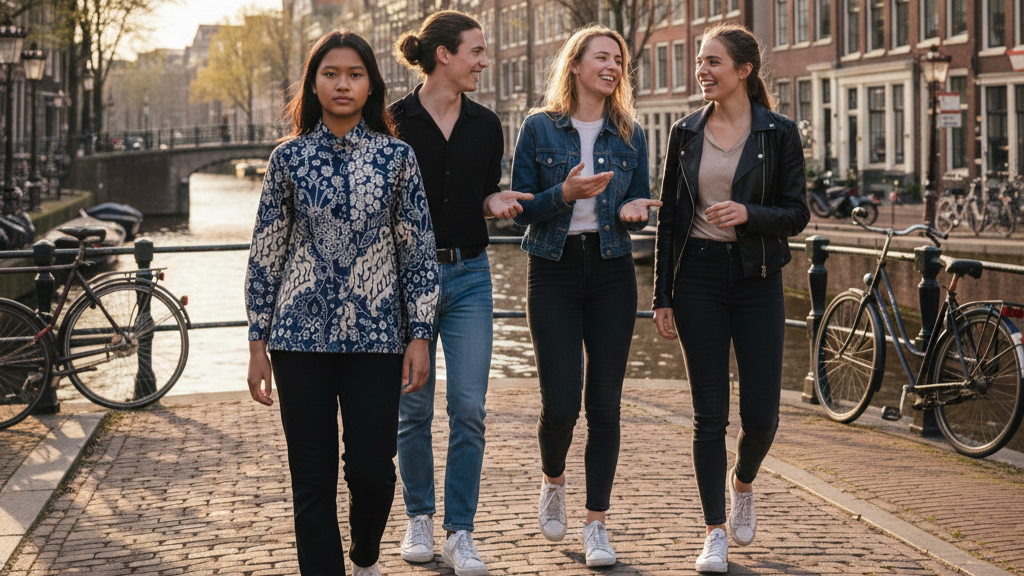
For many second- and third-generation Indo women born in the Netherlands (Belanda), Indonesia is not a homeland in the usual sense. It is not a place of childhood memories, schooling, or first loves. Instead, it exists as an emotional geography—assembled from fragments of family stories, silences, food, skin tone, gestures, and an unspoken sense of difference. Indonesia is inherited rather than lived, carried in the body more than the passport, and this makes the relationship both intimate and unresolved.
Growing up in the Netherlands, many Indo girls learn early that they are “almost Dutch.” Their names, faces, hair, or family histories mark them as slightly outside the imagined norm, even when they speak perfect Dutch and share the same cultural references as their peers. At the same time, Indonesia often remains distant and abstract, a place associated with grandparents rather than personal experience. This double positioning—never fully inside, never fully outside—shapes a form of belonging defined less by roots than by negotiation.
The colonial past looms large, even when it is rarely spoken aloud. In many Indo families, especially among women, history has been transmitted through omission. Grandmothers who survived war, displacement, or the abrupt loss of status after Indonesian independence often chose silence as a survival strategy. Mothers learned to assimilate, to keep their heads down, to be grateful for acceptance in Dutch society. Daughters inherit this silence without always understanding its origins. What is passed on is not a clear narrative, but an atmosphere: caution, adaptability, emotional restraint, and a complicated sense of loyalty to both countries.
For Indo women, this inheritance is deeply gendered. Women are often the keepers of memory in subtle forms—recipes cooked without written instructions, beauty rituals, family etiquette, and the emotional labour of holding families together across generations. At the same time, they are expected to embody successful integration: educated, polite, self-sufficient, and unproblematic. This leaves little room to express ambivalence, anger, or grief about a past that feels both personal and distant.
When Indo women travel to Indonesia, often for the first time as adults, the experience can be disorienting. These journeys are frequently described as returns, but they rarely feel like homecomings. In Indonesia, Indo women are often read as foreigners—bule—regardless of ancestry. Their accents, clothing, body language, and perceived wealth mark them as outsiders. This can be jarring for women who grew up feeling not fully accepted in the Netherlands, only to discover that Indonesia does not automatically claim them either.
At the same time, these visits expose them to lingering hierarchies shaped by colonial history. Light skin, European features, and Western passports still carry social capital in many Indonesian contexts. Indo women may find themselves treated with deference they did not ask for, benefiting from structures they morally reject. This creates discomfort and moral tension: how to acknowledge inherited privilege without embracing it, how to feel connected to a place that mirrors back colonial residues in everyday interactions.
Gender expectations add another layer of complexity. Many Indo women are raised with Dutch ideas of gender equality, autonomy, and individual choice. In Indonesia, they may encounter stronger expectations around femininity, modesty, marriage, and family duty. Even brief visits can provoke friction—with relatives who see independence as selfish, or with social norms that feel restrictive. The contrast can sharpen awareness of how freedom is unevenly distributed, and how cultural belonging often comes with conditions attached.
Language loss is another quiet fault line. Many second- and third-generation Indo women do not speak Bahasa Indonesia fluently, if at all. This absence can produce shame, especially during encounters with Indonesian relatives or locals who expect linguistic competence as proof of authenticity. Yet the loss is rarely the individual’s fault; it reflects deliberate choices made by earlier generations who believed assimilation required leaving language behind. What remains is a sense of connection that survives without words, experienced as intuition rather than fluency.
In the Netherlands, public conversations about colonial history have intensified in recent years, creating new spaces—but also new pressures—for Indo women. They are often positioned as bridges between Dutch society and its colonial past, expected to provide insight, reconciliation, or emotional labour. Yet their experiences do not always fit neatly into narratives of either victimhood or culpability. Indo women may feel both harmed by colonial structures and implicated in their legacies, both marginalised and privileged, depending on context.
What distinguishes the second and third generations is that they are increasingly willing to name these contradictions. Rather than seeking a singular identity or a clear sense of home, many Indo women speak of multiplicity: belonging that shifts depending on place, audience, and life stage. Indonesia becomes less a destination than a reference point—a mirror that reflects unresolved questions about race, gender, history, and inheritance.
For our Dutch readers, these stories complicate familiar ideas about postcolonial identity. They show that the afterlife of empire is not only a matter of archives, apologies, or monuments, but something lived daily in families, bodies, and intimate choices. For Indo women, the relationship with Indonesia is not about reclaiming a lost homeland, nor about closure. It is about learning to live with ambiguity—about recognising that ancestry can be a source of meaning without becoming a demand for loyalty, and that belonging does not always require permission from either side. Indonesia, for them, is not a place left behind or fully recovered. It is a presence that persists—sometimes warm, sometimes uncomfortable, always unfinished.
Spicy Auntie has a soft spot for Indo women, because I recognise that particular kind of tired. The tired of explaining yourself. The tired of being asked where you’re really from. The tired of loving a place that doesn’t quite love you back.
For second- and third-generation Indo women in the Netherlands, Indonesia is not a postcard memory. It’s a ghost that follows you into Dutch classrooms, offices, kitchens, and relationships. It shows up in your skin tone, your hair, your food, your family rules—and in the silences that settle whenever history gets too close to the dinner table.
What fascinates me is how Indo women are expected to be grateful twice. Grateful to the Netherlands for “accepting” them, and grateful to Indonesia for existing as a kind of cultural backdrop they’re allowed to admire from a distance. But gratitude is a terrible substitute for belonging. And Indo women know this instinctively.
Many of you go to Indonesia hoping for something—recognition, familiarity, a click. Instead, you’re handed a mirror that says foreigner, sometimes politely, sometimes not. You benefit from the colonial afterglow without ever having asked for it. People are nice to you for reasons that make you uncomfortable. You feel seen and erased at the same time. Welcome to the emotional hangover of empire.
And let’s talk about silence. Indo families are experts at it. Silence about war, about loss, about women who had no choices, about men who made too many. Your grandmothers survived by not talking. Your mothers survived by blending in. And now you’re supposed to survive by “owning your story” without ever having been told the full plot. That’s a heavy inheritance for any woman.
What I admire is that Indo women today are no longer trying to resolve the contradiction. You’re done chasing authenticity points. You’re done performing Dutchness perfectly and Indonesianness respectfully. You understand something very grown-up: identity doesn’t need permission.
You don’t owe Indonesia fluency, reverence, or romantic loyalty. You don’t owe the Netherlands endless gratitude for tolerating difference. You’re allowed to hold affection and anger at the same time. You’re allowed to feel connected without claiming ownership. You’re allowed to say: this history shaped me, but it does not get to dictate my future.
Spicy Auntie’s verdict? You are not unfinished. The story is. And for once, women like you are finally writing the footnotes in your own handwriting.