


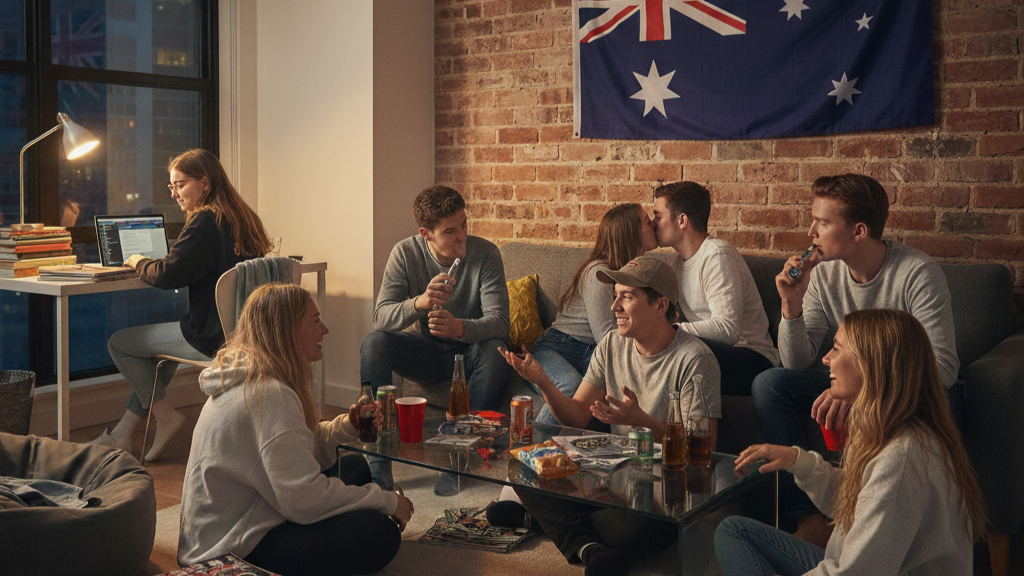
In Australia, the myth that teenagers are either hopelessly reckless or impossibly prudish keeps getting recycled, but a new nationwide snapshot of youth behaviour tells a more complicated—and more unsettling—story. The latest Sex, Drugs and Rock ’n’ Roll survey paints a picture of Aussie teens and young adults who are drinking less, smoking fewer cigarettes, but experimenting more freely with other substances, navigating sex with uneven knowledge, and absorbing cultural cues from a digital world that normalises risk while pretending it’s all just a bit of fun.
The survey, produced by the Burnet Institute and released in January 2026, draws on responses from young Australians aged roughly 15 to their late twenties. It has been running in various forms for two decades, giving researchers a rare long-term view of how youth attitudes shift over time. The most recent findings confirm a trend that public health experts have been tracking for years: traditional “binge drinking” culture is losing its grip. Fewer young people report drinking frequently, and many say they deliberately pace themselves, skip alcohol altogether, or swap beers for low-alcohol options. In a country where shouting a round at the pub once felt like a civic duty, that’s no small cultural change.
But before anyone declares victory, the same data shows risk hasn’t disappeared—it has simply migrated. Cannabis remains the most commonly used illicit drug, with a clear sense among respondents that it is relatively harmless. More worrying is the steady rise in reported use of cocaine and ketamine, substances that are no longer seen as exotic or elite but increasingly “normal” at parties, festivals and even casual social gatherings. Among young men in particular, these drugs are often framed as tools for energy, confidence and social bonding. The language is telling: they’re not “hard drugs”, just something to keep you going when the night gets loose.
Vaping is another red flag. Despite near-universal awareness that e-cigarettes aren’t harmless, a majority of respondents say they have tried them, and many use them regularly. For teens, vaping has become almost boringly mainstream, the sort of thing you do while scrolling TikTok or hanging around after school. Cigarettes, by contrast, feel daggy and old-school. The health message has landed—sort of—but nicotine has simply found a sleeker delivery system.
Sexual attitudes in the survey reveal a similar mix of openness and confusion. Many young Australians report delaying sex compared to previous generations, and there is greater acceptance of diverse sexual identities and relationship styles. At the same time, gaps in sexual health knowledge persist. Condom use remains inconsistent, particularly in casual encounters, and misconceptions about consent and intoxication are common. A troubling minority of respondents believe that being drunk or high blurs responsibility, a belief that clashes sharply with legal definitions but fits uncomfortably well with party culture narratives.
Gender divides run through almost every part of the data. Young men are more likely to report using illicit drugs and to view them as low-risk, while young women consistently express higher concern about safety, health consequences and social judgement. Women also report feeling greater pressure around sex—pressure to be desirable but not “too much”, to be adventurous but not reckless. Men, by contrast, are more likely to describe sex as casual and uncomplicated, even as they admit to poor communication around consent. In classic Aussie fashion, a lot of this is brushed off with a shrug and a “she’ll be right”, but the consequences are anything but casual.
Cultural context matters here. Australia’s youth culture has long celebrated risk-taking as a rite of passage. From schoolies week to music festivals, excess is often framed as character-building rather than dangerous. Add social media to the mix and you get a feedback loop where extreme behaviour looks normal, even expected. The survey suggests that while today’s teens may be more health-conscious in theory, they are also more exposed to constant visual cues that reward pushing limits. Being the fun one, the wild one, the one with the best story for the group chat still carries social currency.
What makes the findings genuinely disturbing is not any single statistic, but the pattern they form together. Alcohol use is down, yes, but stimulant use is up. Smoking is out, but vaping is everywhere. Sex is talked about more openly, yet basic knowledge remains patchy. Young Australians are not ignorant; they are navigating a landscape where risks are fragmented, rebranded and often minimised. The survey doesn’t suggest a generation out of control, but it does highlight one that is being asked to make complex decisions in a culture that sends mixed messages at every turn.
For policymakers and parents alike, the lesson is clear. Moral panic won’t help, and nostalgia for “simpler times” is useless. What’s needed is honest, realistic education that acknowledges how teens actually live, talk and hook up, rather than how adults wish they did. Until then, Australia will keep producing surveys that leave us shaking our heads, muttering “bloody hell”, and wondering why the same dangerous trends keep sneaking back under new names.
Spicy Auntie reads this survey with one eyebrow permanently raised and a very long sigh. Not because Aussie teens are shocking little devils—trust me, they’re not—but because adults keep congratulating themselves for noticing the wrong things. “Oh look, they drink less!” Cue applause, policy speeches, and a smug sense that the kids are finally behaving. Meanwhile, the same teens are quietly vaping like chimneys, experimenting with cocaine and ketamine as if they were flavoured energy drinks, and muddling through sex with half-knowledge and a lot of wishful thinking. But sure, let’s celebrate fewer beers.
What strikes me most is how managed risk has become. This generation didn’t invent danger; they just reorganised it. Alcohol is now seen as messy, bloating, and frankly embarrassing—nobody wants to be that bloke spewing behind a kebab shop at 2am. Drugs, on the other hand, are framed as controlled, efficient, even strategic. Stay sharp, stay hot, stay online. That’s not teenage rebellion; that’s productivity culture with better playlists. And vaping? That’s just social glue. Nobody thinks it’s healthy, but nobody wants to be the buzzkill either.
The gender divide in the survey makes my feminist eye twitch. Young men are more relaxed about risk, more dismissive of consequences, and far more confident that everything will somehow work out. Young women, meanwhile, are expected to be adventurous but cautious, sexy but sensible, up for it but never sloppy. Same old story, just with better lighting and faster Wi-Fi. When things go wrong—sex they didn’t really consent to, drugs that hit harder than expected—it’s still girls who are expected to carry the emotional and social fallout. Progress, apparently.
And let’s talk about consent for a moment. If you think being drunk or high magically turns responsibility into a grey zone, you’re not confused—you’re benefiting from a culture that lets you be. This is where adults really fail young people: by refusing to say clearly that intoxication doesn’t excuse harm, full stop. No “both sides”, no “miscommunication”, no boys-will-be-boys shrug. Teens are smart enough to handle clarity. It’s adults who keep muddying the water.
What this survey really shows is not moral decline, but moral outsourcing. Young Australians are growing up in a world where algorithms normalise extremes, advertising sells rebellion back to them, and institutions preach safety while winking at danger. We tell teens to be careful, then build a culture that rewards risk-taking with likes, status and stories worth retelling.
So no, I’m not clutching my pearls. I’m annoyed. Because none of this is inevitable. If we want safer, saner teenage lives, we need fewer scare headlines and more honest conversations—about pleasure, about limits, about power, about why “she’ll be right” so often isn’t. Until then, don’t blame the kids. They’re just navigating the mess we handed them, one vape cloud at a time.