


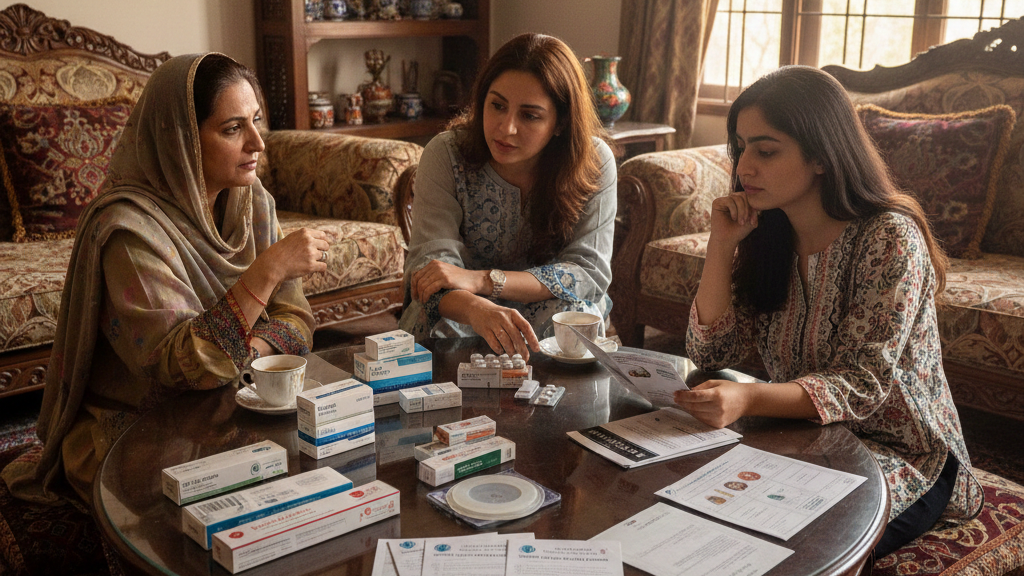
Across South Asia, female contraception has never been just about medicine. It has been about reputation, marriage politics, religious interpretation, fear of gossip, and the quiet calculations women make about how much control over their bodies they are allowed to claim. Over the past decades, contraceptives have spread widely across the region through government programs, NGO outreach, and commercial distribution, yet usage remains uneven, method choices are often narrow, and stigma still shapes what women use, when, and in secrecy.
The diffusion of female contraceptives in South Asia followed a largely state-driven path. From the 1960s onward, governments framed family planning as a development tool, linking smaller families to economic progress and maternal health. Clinics multiplied, community health workers were trained to visit homes, and free or subsidized contraceptives became part of public health systems. In countries like India and Bangladesh, outreach went door to door, with women receiving pills, counseling, or referrals without having to travel far or ask publicly. Over time, social marketing added another layer, making contraceptives available in pharmacies and small shops under familiar brand names, often advertised as tools for family wellbeing rather than sexual autonomy.
Yet diffusion did not mean choice. In much of South Asia, the “method mix” became heavily skewed. Female sterilization emerged as the dominant form of contraception, especially in India, where it accounts for the majority of modern contraceptive use. It is widely accepted, socially sanctioned, and often promoted once a woman has reached her “ideal” family size. Temporary or reversible methods—pills, IUDs, injectables, implants—have grown more slowly, despite being medically safe and widely used elsewhere. This imbalance reflects not just policy history but deep social attitudes: sterilization fits a narrative of maternal sacrifice and responsibility, while ongoing methods suggest sexual activity, choice, and the possibility of desire beyond reproduction.
Where reversible methods are used, pills and injectables are often preferred over devices like IUDs or implants, which carry heavy layers of fear and misinformation. Stories circulate of devices “moving inside the body,” causing infertility, cancer, or permanent weakness. Side effects such as bleeding or weight changes are magnified into moral warnings, passed between women as cautionary tales. In settings where healthcare interactions are rushed or judgmental, women rarely receive enough information to distinguish manageable side effects from myths, reinforcing avoidance.
Stigma and shame remain powerful regulators. Contraception is frequently treated as evidence of sexual intent rather than health planning. Unmarried women face the harshest scrutiny, but even married women may be accused of being too modern, too independent, or insufficiently obedient if they seek contraception without explicit approval. Privacy is fragile: being seen at a clinic, recognized by a pharmacist, or questioned by a neighbor can be enough to deter use. Many women therefore rely on methods that are easy to hide, discontinuous, or framed as medical rather than sexual interventions.
Religion is often cited as a barrier, but its role is more complex than popular narratives suggest. Across Islam, Hinduism, Buddhism, and Christianity as practiced in South Asia, there is no single doctrinal stance on contraception. Many Islamic scholars permit birth spacing to protect maternal health, while Hindu and Buddhist traditions historically accommodated family planning in various forms. In practice, religious language is frequently used to reinforce existing gender hierarchies rather than to articulate clear theological objections. Where religious leaders actively endorse family planning as compatible with moral life, uptake often improves; where they condemn or avoid the topic, silence hardens into prohibition.
Pakistan illustrates how religion, governance, and access intertwine. Modern contraceptive use has stagnated for years, not solely because of belief but due to fragmented service delivery, uneven supply chains, and social norms that restrict women’s autonomy. Many women report that husbands or elders invoke religion to justify opposition, even when clerical opinion in their community is more flexible. The result is a landscape where unmet need remains high, unintended pregnancies are common, and contraception is negotiated quietly within families rather than supported publicly.
Bangladesh offers a contrasting story of distribution success paired with lingering stigma. Pills and injectables are widely available through community workers and social marketing networks, making access relatively easy. Yet even here, continued use is shaped by secrecy, fear of judgment, and reliance on short-acting methods that can be stopped quickly if suspicion arises. The system works best for women who can manage contraception discreetly and consistently, and less well for those who need long-term or provider-dependent methods.
Local production adds another layer to the story. India stands out globally for developing a non-steroidal oral contraceptive, centchroman, marketed as Saheli, through public-sector research institutions. Its existence challenges the idea that contraceptive innovation must come from the West. Yet the availability of a locally developed pill has not eliminated mistrust of hormonal methods or the social pressures that discourage sustained use. In Bangladesh and Pakistan, domestic manufacturing and packaging coexist with heavy reliance on imported or donor-financed commodities, making national programs vulnerable to funding shifts and procurement delays.
Across the region, women’s contraceptive choices are constrained less by lack of awareness than by the conditions under which awareness must be acted upon. Knowing about contraception does not guarantee the freedom to use it openly, consistently, or according to one’s own priorities. Decisions are filtered through expectations of obedience, ideals of respectable womanhood, and the ever-present risk of blame if something goes wrong.
What emerges is a paradox. South Asia has some of the world’s longest-running family planning programs, yet female contraception is still treated as something to be tolerated rather than embraced. Women are encouraged to manage fertility, but discouraged from acknowledging sexuality. Permanent solutions are praised; reversible choices are questioned. Innovation exists, access has expanded, but autonomy remains fragile.
Any serious conversation about contraception in South Asia must therefore move beyond numbers and methods. It must confront the social costs women pay for controlling their fertility, the moral weight attached to “good” and “bad” contraceptive behavior, and the gap between public health goals and lived realities. Until contraception can be discussed as routine healthcare rather than whispered strategy, diffusion will remain partial, and choice will remain conditional.
I’ve spent enough time in South Asia to know this truth by heart: officially, a woman can be trusted with everything except politics and her own fertility. She can run a household on an empty wallet, carry generations of emotional labor, bleed quietly every month, give birth with barely a complaint—but ask for contraception, and suddenly she is reckless, immoral, corrupted, or “too modern.”
Contraception here is never neutral. It is loaded. It is watched. It is judged. A packet of pills is not just medicine; it’s an accusation. An IUD is not a device; it’s a rumor waiting to be born. And sterilization? Ah yes—finally respectable, because it signals that a woman’s sexuality has officially expired, safely sealed after her reproductive duties are done.
What enrages me most is the hypocrisy. States want women to control fertility, but only in the way the state finds convenient. Families want fewer children, but not a daughter-in-law who decides when and how. Religious leaders talk endlessly about morality, yet somehow never about the morality of forcing women into repeated pregnancies they did not choose. Everyone benefits from women managing reproduction, but no one wants to see them exercise sexual agency.
And let’s be clear: this obsession with “side effects” is not medical. It is moral. Bleeding, weight gain, mood changes—these become cautionary horror stories not because they are unbearable, but because they justify control. Fear is cheaper than education. Shame is easier than consent.
I am tired of hearing that South Asian women “lack awareness.” Many are painfully aware. They know exactly what contraception does and what it costs them socially. They know that being seen at a clinic can spark gossip, that a husband can weaponize religion, that a mother-in-law can turn pills into proof of disobedience. They know that privacy is a luxury and that secrecy is often the only viable method.
What should scandalize us is not that women hide contraception, but that they have to. That even where local production exists, even where services are free, even where policies claim empowerment, women still calculate risk not in medical terms, but in social survival.
Until contraception is treated as ordinary healthcare—until women are trusted as moral adults capable of pleasure, planning, and choice—we will keep pretending progress while policing bodies. And Auntie has seen enough pretending.