


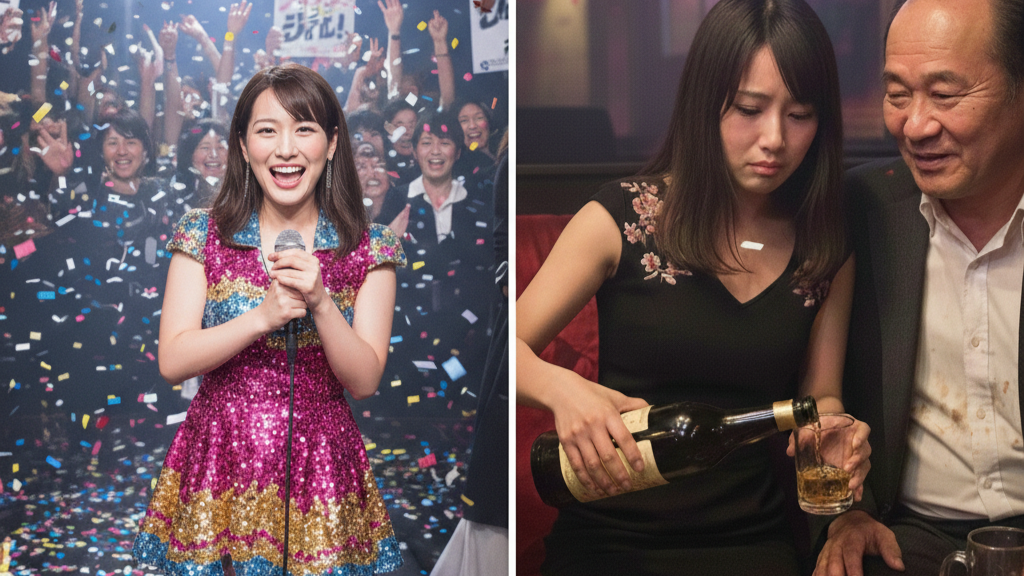
For several decades in Japan, becoming an idol was not just a fantasy sold by television and magazines. It was a credible life plan, whispered between classmates, discussed at kitchen tables, quietly encouraged by parents who saw few other doors opening as easily. The idol dream rose at a particular moment in Japanese society, when girlhood itself could be converted into opportunity—before adulthood narrowed the options.
In the 1970s and 1980s, as television colonised everyday life, young female idols appeared as luminous, carefully controlled figures: cute, polite, non-threatening, and endlessly visible. They sang simple songs, smiled brightly, and embodied a version of femininity that was ambitious without being rebellious. For many girls watching from provincial towns, idolhood looked attainable in a way university prestige or corporate careers did not. You didn’t need elite grades. You needed charm, effort, and the willingness to be shaped.
By the 1990s, the system matured into an industry. Auditions multiplied. Agencies scouted girls younger and younger. The promise shifted subtly: you no longer had to be exceptional from the start. You could grow. This idea reached its most refined form in the 2000s with groups like AKB48, whose slogan—“idols you can meet”—turned imperfection into a selling point. Fans were invited not just to admire, but to participate: to vote, to attend handshake events, to watch teenage girls become performers in real time.
For the girls themselves, this promise was intoxicating. Idol life offered early independence, a sense of being chosen, and a structured escape from ordinary paths. At fifteen or sixteen, earning money, travelling to Tokyo, appearing on stage, and hearing strangers chant your name felt like proof of worth. For girls who felt invisible at school, or constrained by expectations of quiet diligence, idol spaces provided affirmation on a scale no classroom ever could.
When it worked, it worked spectacularly. A small minority transitioned into acting, television hosting, voice acting, or influencer careers. They gained confidence, media skills, and networks that carried them forward. Even short stints could sometimes be parlayed into lasting visibility—if the timing was right, if the exit was clean, if the girl remained desirable to the industry in a new form.
But the dream contained its own expiration date.
The same system that celebrated growth also fed on replaceability. New auditions never stopped. Youth was currency, and novelty was ruthless. By their early twenties—sometimes earlier—many idols found themselves slipping down rankings, losing screen time, fading from fan attention. Graduation ceremonies framed this as maturity, a natural next step, but the reality was often closer to quiet dismissal.
The rules that governed idol life deepened the cost. Dating bans and emotional policing taught young girls that affection was something to perform but never possess. A smile could be monetized; desire could not. Romantic mistakes were treated as moral failures, sometimes requiring public apologies that bordered on ritual humiliation. For girls still forming their sense of self, the lesson was clear: your body belongs to the image, not to you.
Financially, the dream was far thinner than it looked. Most idols earned little, especially those outside the top tier. Training costs, costumes, transport, and living expenses were often deducted. Savings were rare. Contracts were opaque. Few protections existed for long-term security. Idolhood felt glamorous from the outside; inside, it resembled precarious gig work wrapped in applause.
Then came the quiet aftermath—the part rarely shown on television. For many girls who “failed,” meaning simply that they did not break through, adulthood arrived abruptly. They were in their early twenties with limited education, patchy resumes, and identities built around being watched. Some drifted through low-paid entertainment jobs, promotional gigs, or semi-visible online work. Others slid into hostessing or nightlife, where emotional performance was already familiar and youth still had market value. Some returned to their hometowns carrying an unspoken sense of shame, struggling to explain why the big dream had ended so quietly.
The psychological fallout could be severe. Former idols have spoken of anxiety, eating disorders, depression, and a persistent fear of ordinary life. After years of structured schedules and constant evaluation, freedom felt terrifying. Without fans, rankings, or management approval, many did not know who they were supposed to be.
By the late 2010s, the cracks became harder to ignore. Scandals exposed exploitation and abuse. Parents grew more cautious. Birthrates fell, shrinking the pool of hopefuls. K-pop offered a contrasting model—harsher training, but clearer pathways and global exits. Slowly, the idol dream lost some of its cultural shine.
And yet, it never fully disappeared.
Auditions still draw thousands of teenage girls. The fantasy still circulates: a chance to be seen, to matter, to delay the narrowing of adult expectations. Idolhood remains one of the few ambitions that allows girls to want more without openly challenging social norms. It promises transformation without rebellion—and that promise, however fragile, remains powerful.
The rise, success, maturity, and quiet fall of the idol dream is not just an entertainment story. It is a mirror held up to Japanese ideas about girlhood, labor, desire, and disposability. For a generation of girls, idolhood offered light, purpose, and belonging. For most, it also taught an unspoken lesson: that dreams can be monetized, managed, and discarded—long before you are ready to let them go.
I have always been fascinated—not by the idols who “made it,” but by the thousands of girls who didn’t, and who were quietly taught that this was their fault.
In Japan, the idol dream was sold to girls as something gentle and hopeful. No rebellion required. No broken rules. Just effort, smiles, and patience. Be cute, be grateful, be improving. Someone will notice. Someone will choose you. It was ambition without sharp edges, desire without teeth. And that, of course, is why it was allowed.
What strikes me most, looking back, is how early the bargain was offered. Fifteen, sometimes younger. At that age, being told that your ordinariness could be forgiven—if you worked hard enough on yourself—was intoxicating. School rarely offers that mercy. Society rarely does. The idol system whispered: you don’t need to be the best, just lovable. Try harder. Stay longer. Smile more.
And for a while, it worked. These girls were seen. Applauded. Filmed. Named. For many, that mattered more than money. Validation is a powerful drug when you’ve never had much of it.
But the system never loved them back.
What the idol dream never explained—never could—was that it ran on disposability. Youth was not a phase; it was the product. Aging was not growth; it was a liability. The same effort once praised became invisible once a newer girl appeared. Graduation ceremonies dressed this up as maturity, but let’s be honest: most were polite goodbyes to girls the industry no longer needed.
The cruelty lies not only in the fall, but in how individualised failure was made to feel. If you didn’t succeed, it wasn’t because the funnel was impossibly narrow. It was because you didn’t sparkle enough. Didn’t rank high enough. Didn’t hold attention. The system walked away clean; the girl carried the shame.
I think often about what happens after the clapping stops. About twenty-two-year-olds who have never lived unobserved. Who don’t know how to flirt without performing, how to work without being rated, how to exist without feedback loops. Some land on their feet. Many don’t. Some drift into other forms of emotional labour that feel eerily familiar. Some disappear entirely.
And still—still—the auditions fill up.
Because for girls growing up in a society that asks them to be modest, useful, pleasant, and eventually invisible, the idol dream offered something radical: a reason to take up space, even if only temporarily. To be chosen. To matter. Even if the price was silence later.
I don’t blame the girls. Not for believing. Not for trying. If anything, I blame a culture that made this one of the few dreams that felt socially permissible for them.
The idol dream didn’t just rise and fall. It aged out its believers. And then it asked the next generation of girls to line up anyway.