


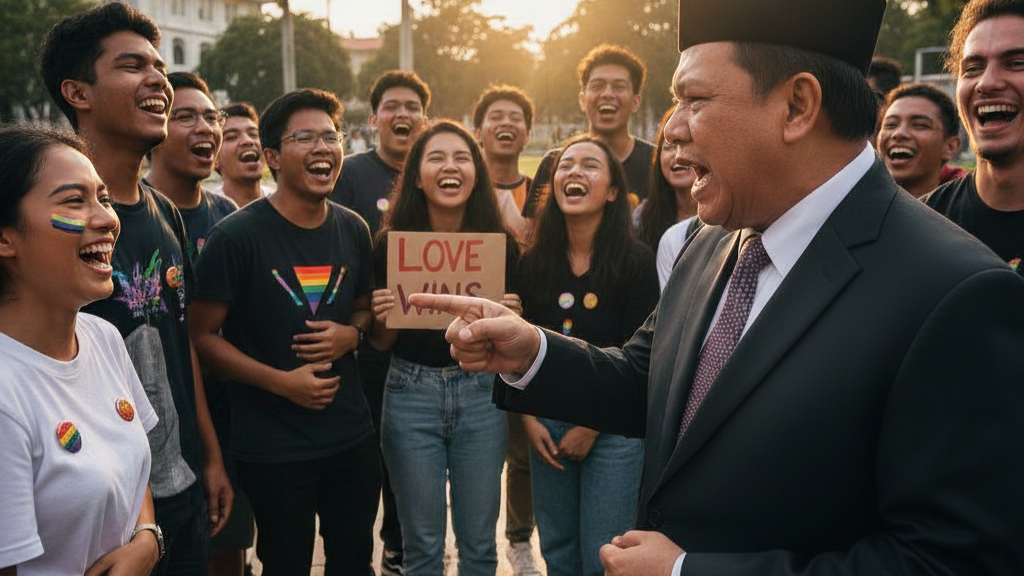
In late January, a single line tucked into a parliamentary reply managed to ignite laughter, anger, and weary disbelief across Malaysia and far beyond its borders. When a senior Malaysian minister suggested that work stress could make people gay, the remark instantly went viral, colliding head-on with science, lived experience, and a public already exhausted by moral policing. The comment made the Internet explode, but it also exposed how deeply cultural anxiety, religion, and politics continue to shape official narratives around sexuality.
The statement came from Zulkifli Hasan, Minister in the Prime Minister’s Department (Religious Affairs), in response to a parliamentary question about the “increase in LGBT cases.” In his written reply, Zulkifli claimed that a mix of factors — including work pressure, exposure to certain environments, sexual experiences, and weak religious practice — could contribute to people engaging in what he termed “LGBT acts.” He cited a mysterious 2017 study as evidence, though journalists and researchers were unable to locate or verify any such study in the public domain.
Scientifically, the claim collapsed almost immediately. Decades of research by global medical and psychological bodies show that sexual orientation is not caused by stress, trauma, or workplace conditions. The World Health Organization removed homosexuality from its list of mental disorders in 1990, and professional associations worldwide agree that being gay, lesbian, or bisexual is a natural variation of human sexuality. Stress can affect mental health, productivity, and physical wellbeing, but there is no credible evidence that it alters sexual orientation. In short, deadlines may cause burnout, insomnia, or resignation letters — but not queerness.
That scientific disconnect did little to slow the remark’s spread online. Malaysian social media users responded with a familiar mix of sarcasm and political humour, a coping strategy in a country where direct confrontation with authority often carries risk. “By this logic, I’m shocked my whole office isn’t gay already,” one widely shared comment read. Others joked that if stress truly caused homosexuality, Parliament itself should be overflowing with LGBTQ people. A particularly popular meme threatened mock “conversion” unless the government raised wages, lowered the cost of living, and fixed labour laws.
Behind the jokes, however, lay genuine anger. LGBTQ activists warned that such statements are not harmless slips but reinforce dangerous ideas — that queerness is a condition, a deviation, or a problem to be solved. Groups like Justice for Sisters stressed that framing LGBTQ identities as stress-induced behaviour fuels stigma and legitimises harassment, raids, and so-called “rehabilitation” programmes. In Malaysia, where same-sex relations remain criminalised under colonial-era laws and, for Muslims, under Sharia statutes, official misinformation can quickly translate into real-world harm.
Cultural context matters here. Malaysia’s political language around sexuality is deeply intertwined with agama (religion) and moral order. Public officials often describe LGBTQ people not as citizens with rights but as subjects of akhlak (moral conduct). Terms like songsang (deviant) or salah (wrong) still circulate in official discourse, positioning queerness as a failure of discipline or faith. In this framework, linking homosexuality to tekanan kerja (work stress) fits neatly into a broader narrative that personal struggle leads to moral collapse, rather than prompting questions about structural inequality or mental health support.
Ironically, many Malaysians noted that if stress were truly the cause, the conversation should have pivoted toward toxic workplaces, stagnant wages, and long hours. Malaysia consistently ranks high for urban work pressure, particularly in Kuala Lumpur, where young professionals juggle rising rents, family expectations, and limited social mobility. Instead, stress was weaponised as a moral explanation, not a labour issue. The joke writes itself, but the subtext is grim: it is easier to blame identity than policy.
Internationally, the remark was met with disbelief and mockery, but within Malaysia it also sparked a quieter, more telling reaction — exhaustion. For many LGBTQ Malaysians, this was not shocking news but another reminder that their existence is routinely debated without them in the room. Activists pointed out that such statements erase the reality of queer Malaysians who are happily married, deeply religious, emotionally stable, and entirely untroubled by their sexuality. Stress, they noted, more often comes from discrimination itself: fear of arrest, family rejection, workplace silence, and constant self-censorship.
In the end, the “work stress makes you gay” claim will likely fade into the archive of viral political absurdities. But its impact lingers. It illustrates how pseudoscience can still be mobilised to justify prejudice, how humour becomes a survival tool, and how cultural narratives about malu (shame) and morality continue to overshadow evidence. Malaysia’s public reaction — sharp, sarcastic, and surprisingly unified — suggests that while official rhetoric may lag behind, public scepticism is growing. Stress may not make people gay, but ignorance, many Malaysians made clear, is becoming harder to excuse.
I laughed when I first read it. I really did. That sharp, involuntary laugh you make when the absurdity is almost elegant in its stupidity. Work stress makes you gay? Darling, if that were true, half of Asia’s middle management would be marching in Pride parades by now, waving rainbow lanyards and asking HR for trauma leave. The joke practically writes itself, and judging by Malaysian social media, the public got there very fast.
But once the laughter fades, what’s left is not funny at all.
I’m not surprised — not even a little — that a senior minister could say something this ignorant with a straight face. I’ve lived in Asia long enough to know that ignorance, when wrapped in religious authority and delivered in bureaucratic language, is often rewarded rather than punished. Still, I’m upset. Upset that someone entrusted with shaping public policy, social norms, and moral guidance can casually recycle junk science and medieval thinking, and do so from the safety of a ministerial chair.
What bothers me most is not the stupidity of the statement itself, but the confidence behind it. The calm certainty that queerness must be caused by something going wrong — stress, temptation, weak faith — never by the simple fact that human beings are wonderfully, stubbornly diverse. It’s the same old story: if you don’t fit the approved template, there must be a moral or psychological failure somewhere. Preferably yours.
This also triggered a very specific memory for me. Early in the COVID pandemic, when fear was thick in the air and people were desperate for leadership, a pious Indonesian minister went on record reassuring the public that prayer would be enough to avoid catching the virus. No masks, no distancing, no science — just faith. We all know how that turned out. Bodies piled up, hospitals collapsed, and the virus remained impressively unimpressed by human devotion.
Different country, different crisis, same reflex. When reality becomes uncomfortable, reach for religion, dismiss expertise, and hope the problem will pray itself away.
The danger of these statements is not that people will suddenly believe stress turns them gay. Most Malaysians clearly don’t. The danger is that such nonsense reinforces the idea that LGBTQ people are a problem to be explained, managed, or corrected. It legitimises stigma. It gives cover to discrimination. It tells queer kids — already under immense tekanan (pressure) — that their identity is a symptom, not a truth.
So yes, I’m amused. Asian publics have a glorious talent for sarcasm, and watching authority figures get roasted is a small, guilty pleasure. But I’m also tired. Tired of ignorance being dressed up as morality. Tired of science being optional. And deeply tired of people like this being promoted instead of quietly removed from the microphone.