


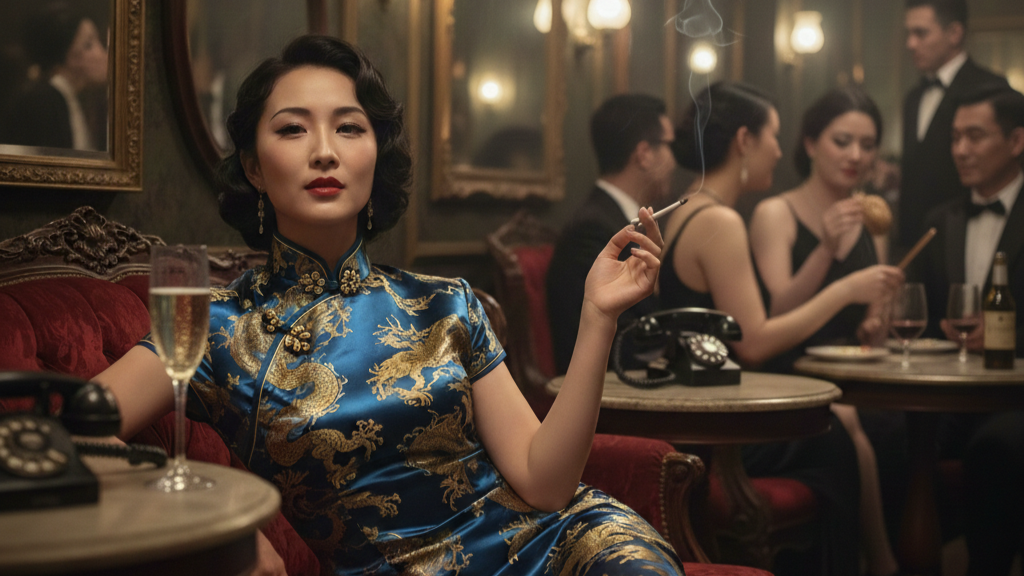
Shanghai’s erotic nostalgia does not shout. It smolders. It drifts through cigarette smoke and silk fabric, through the soft click of heels on parquet floors and the low hum of jazz that never quite belonged to China yet somehow felt perfect there. “Old Shanghai” — shorthand for the city’s 1920s–40s golden age — has become one of Asia’s most persistent aesthetic fantasies, endlessly recycled in fashion, nightlife, photography, and branding. At its core sits a particular erotic charge: not nudity or excess, but suggestion, restraint, and a carefully curated decadence rooted in cheongsams, cabaret imagery, and colonial-era glamour.
The visual grammar was forged in a city that sold modernity as spectacle. Shanghai before 1949 marketed itself as the “Paris of the East,” a treaty-port metropolis where Chinese elites, foreign capital, cinema, advertising, and nightlife fused into a new urban sensibility known as haipai (海派, Shanghai style). Haipai was never purely Chinese nor fully Western. It thrived on mixture: silk cheongsams tailored with Western cuts, jazz bands playing under crystal chandeliers, Chinese women posed like Hollywood stars while advertising cigarettes and face cream. This hybridity is precisely what makes Old Shanghai so reusable today. It offers eroticism without explicit sex, luxury without overt vulgarity, and rebellion without politics.
The cheongsam, or qipao (旗袍), sits at the center of this fantasy. In 1930s Shanghai, it became the uniform of the modern urban woman: sleek, body-skimming, high-collared, often slit just enough to reveal movement rather than flesh. Contemporary retellings exaggerate this symbolism. The cheongsam is endlessly photographed as a garment of controlled seduction, its eroticism lying in what it outlines rather than what it exposes. Fashion brands and stylists return to it again and again because it reads instantly as “retro Shanghai,” even when stripped of historical context.
Much of today’s imagery borrows directly from yuefenpai (月份牌) calendar posters, the mass-market advertising art of the era. These posters depicted glamorous women with porcelain skin, carefully waved hair, and ambiguous smiles, often lounging indoors with mirrors, telephones, or cigarettes. Their appeal was aspirational and lightly flirtatious — women as objects of desire, but also as consumers, modern and autonomous. When contemporary bars wallpaper their walls with reproductions or when photographers recreate the look for editorials, they are tapping into a ready-made erotic language: coy eyes, tilted heads, silk textures, and domestic intimacy turned into spectacle.
Nightlife aesthetics draw heavily on Shanghai’s legendary cabaret culture, particularly venues like the Paramount Ballroom (百乐门). Built in 1933, the Paramount embodied urban excess: art deco curves, dance floors packed with socialites, and taxi-dance culture where women were paid to dance with male patrons. In today’s imagination, these details collapse into a generalized cabaret mood — red velvet, mirrored ceilings, brass railings, slow jazz — reproduced in bars, hotel lounges, and themed parties from Shanghai to Singapore. The historical realities of gendered labor and sexual commerce fade, replaced by an atmosphere of refined danger.
Cinema has reinforced this erotic nostalgia. Films that linger on cheongsams, interior spaces, and restrained longing — even when not set in Shanghai — have shaped how East Asian glamour is eroticized globally. Slow pacing, repeated costume changes, tight framing, and melancholy soundtracks transform fabric and posture into sexual tension. These cinematic cues bleed into nightlife design and fashion campaigns, where desire is suggested through mood rather than action.
What makes Old Shanghai especially potent is what it erases. Colonial hierarchies, political repression, class inequality, and the exploitation underpinning the entertainment economy rarely appear in the glossy revival. The sex workers, dance hostesses, and working women who sustained the glamour are flattened into anonymous silhouettes. Nostalgia turns decadence into décor, safely detached from discomfort. This selective memory allows the aesthetic to travel easily, stripped of guilt and ready for consumption.
Today, Old Shanghai erotic nostalgia functions as a portable fantasy. A cheongsam-clad hostess, a jazz trio, a cigarette-holder prop, an art deco bar — the formula is instantly legible. It offers a vision of Asian sexuality that feels luxurious, controlled, and cosmopolitan, an antidote to both puritanism and explicitness. The result is an aesthetic that continues to seduce precisely because it never fully reveals itself, lingering instead in silk shadows and half-remembered music.
Spicy Auntie has another embarrassing confession to make. I am weak for Old Shanghai kitsch. Put me in a dim bar with red velvet curtains, a jazz trio pretending it’s 1936, and a hostess in a perfectly tailored cheongsam, and my critical faculties immediately start fighting my pleasure receptors. I know exactly what is being sold to me — and yet, like so many of us, I keep buying the fantasy.
Because Old Shanghai nostalgia is erotic in a very specific, very manipulative way. It doesn’t shout sex. It whispers it. It promises sophistication, danger, and desire without ever forcing anyone to undress. This is not the clumsy male gaze of neon strip clubs. This is silk brushing against skin. This is posture, lighting, and the deliberate pause before a cigarette is raised to the lips. It is sex rebranded as taste.
I’ve seen this aesthetic recycled everywhere: hotel lounges that call themselves “salons,” speakeasies with fake opium-den décor, fashion shoots where young women are dressed like calendar girls from a century ago and told to look “soft but distant.” The cheongsam does most of the work. It doesn’t expose. It outlines. It disciplines the body into something elegant, controlled, and quietly available. It tells a story about femininity that feels empowering on the surface but is still very carefully curated for consumption.
What bothers Auntie — and also fascinates her — is how much gets erased in the process. The real Old Shanghai was built on exploitation: women paid to dance, smile, drink, flatter; colonial hierarchies that decided who could be glamorous and who stayed invisible; an entire economy of desire that depended on women’s labor and men’s money. Today, all of that is airbrushed into a vibe. Sex work becomes “cabaret.” Inequality becomes “decadence.” History becomes wallpaper.
And yet. And yet. I understand the appeal. In a region still allergic to open conversations about sex, Old Shanghai offers a safe erotic language. It allows Asian sexuality to be glamorous rather than crude, powerful rather than desperate. It lets people flirt with taboo while pretending it’s all just culture, darling.
So yes, Auntie rolls her eyes at yet another “1930s Shanghai night” with fake jazz and overpriced cocktails. But she also notices who feels seen in these spaces — women, queer people, those who don’t want loud masculinity or pornified desire. Old Shanghai nostalgia endures because it gives us permission to want things quietly. And in Asia, that restraint can be its own kind of rebellion.