


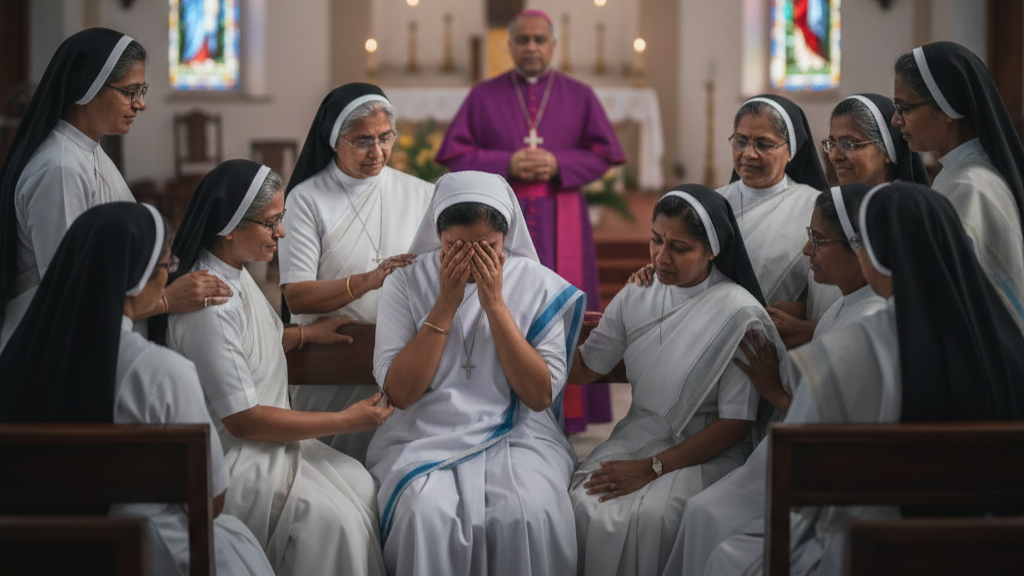
When a nun in India bravely stepped forward in 2018 to accuse a sitting Catholic bishop of raping her repeatedly, the country’s national conversation about power, consent, and institutional accountability suddenly exploded into the open, forcing a reckoning that still ripples through courts and civil society in 2026. The Bishop Franco Mulakkal rape case—a story that cuts across religion, law, and gendered power dynamics—has become more than a church scandal; it is a lens on how Indian society treats survivors of sexual assault, particularly when the accused holds enormous social and organisational authority.
Franco Mulakkal, born in Kerala in 1964 and once the bishop of the Diocese of Jalandhar (जालंधर के सूबा) in northern India, was arrested in Kerala in 2018 after the complainant, a senior nun from the Missionaries of Jesus, filed a First Information Report alleging that he sexually abused her on multiple occasions between 2014 and 2016. What made the case extraordinary in the Indian context was not only the identity of the accused—a high-ranking figure within the Catholic hierarchy—but the staggering courage it took for a vow-bound nun to break the silence that surrounds sexual violence within cloistered institutions. For many, her act of speaking up challenged the deep currents of pāramparik (traditional) authority and patriarchy that often shields powerful men from scrutiny.
At the heart of the Mulakkal case lies an uncomfortable but urgent question: how does the law interpret consent when the relationship between complainant and accused is defined by stark power imbalances? Under Indian law, consent must be an unambiguous, voluntary agreement to participate in sexual activity—expressed through words or gestures—an idea codified in Section 375 of the Indian Penal Code. The courts are also meant to recognise when someone in an authoritative position, such as a religious superior, makes genuine consent nearly impossible. Yet the trial that began in the Additional Sessions Court of Kottayam concluded in January 2022 with an acquittal, presiding that the prosecution had failed to prove beyond reasonable doubt that the bishop had raped the nun.
To many advocates and observers, this outcome was not simply a legal judgement, but a stark illustration of how shakti (power) can warp the trajectory of justice. In sexual assault cases across India—from state legislator indictments to the Unnao and Dileep cases discussed widely in the press—the narrative often shifts to question the credibility of the complainant or to recuperate the reputation of the accused, especially when they are influential men. In the Mulakkal story, this phenomenon played out vividly. The survivor faced not only a trial in court but a de facto trial by society: whispers of dosh (blame), isolation from her own religious community, and aggressive attempts to discredit her truth. She was branded a liar, accused of scheming, and at times treated as the moral culprit for daring to expose a man of God.
While Bishop Mulakkal resigned from his post in 2023 and now holds the honorary title of Bishop Emeritus—living in a retreat centre and continuing some religious activities as though unaffected by the trial—the nun remains at the centre of a fresh legal fight. Her appeal against the acquittal is pending in the Kerala High Court, and recent developments include the appointment of a special public prosecutor to re-examine the trial court’s judgment, with senior advocates asserting that “injustice” was done to the victim.
This battle, long and draining, has taken a toll on those who stood with the survivor. Several nuns who protested on her behalf were ostracised and eventually left religious life, taking up secular jobs and losing their place within the community they once served. Yet the story is far from just about ecclesiastical politics or institutional disarray; it is about the lived reality of consent in a world where voices of authority can drown out voices of pain. In Hindi, samarth (powerful) often overshadows the powerless, and in cases of sexual violence, that imbalance can be fatal to justice unless the legal system and society at large grapple honestly with who gets to be heard and believed.
As the Franco Mulakkal case continues to unfold in 2026, it stands as a stark reminder of how deeply entrenched hierarchies—whether religious, social, or patriarchal—shape the contours of justice in India. And for many survivors watching from the margins, the case offers both a cautionary tale and a beacon: that speaking up may be costly, but it is essential for change to take root.
Auntie has lived long enough, and seen enough men in robes, uniforms, and tailored suits, to know this truth: power is the most effective aphrodisiac—and the most reliable alibi. When I read about the Bishop Franco case, I didn’t see a “complex legal matter.” I saw a depressingly familiar script, one that plays out whenever a woman dares to name abuse committed by a powerful man wrapped in moral authority.
Let’s be honest. This was never just a trial in a courtroom. It was a trial conducted in church corridors, WhatsApp groups, family dining tables, and polite society—where the accused was granted dignity, doubt, and divine benefit, while the survivor was stripped of credibility, community, and peace. Auntie has watched this movie before. Different costumes, same ending.
People keep asking whether the nun “consented.” Consent? When obedience is drilled into your bones as a spiritual duty? When your abuser controls your posting, your evaluations, your future, your God? That’s not consent; that’s coercion with incense. But patriarchal societies—especially religious ones—love to pretend power doesn’t count if the man looks holy enough.
What truly enrages Auntie is not only the acquittal, but the social absolution. The bishop retires quietly, retains respect, keeps his titles, his followers, his comfortable life. The nun? She keeps her trauma, her exile, her endless appeal process, and the sneers of people who whisper that she “destroyed the Church.” Funny how institutions are always more fragile than women’s bodies.
And don’t get me started on the chorus of “false cases are ruining men’s lives.” Auntie would like to gently—no, firmly—remind everyone that the price of speaking up in India is still astronomical. Women lose families, jobs, reputations, sanity. Nuns lose their entire universe. No one signs up for that ride for fun.
What this case exposed is something deeper and uglier: society’s instinctive loyalty to hierarchy. We trust men with power more than women with pain. We interrogate survivors harder than institutions. We demand perfect victims and saintly behaviour, while granting flawed men endless second chances.
Yet, even in this mess, Auntie sees something stubbornly hopeful. The nun spoke. Other nuns stood beside her. Feminists refused silence. The appeal continues. The story didn’t disappear. And every time we talk about consent and power in the same sentence, the old walls crack a little more.
Auntie doesn’t need saints. She needs accountability. And she’s not done being angry—because anger, unlike obedience, is how change actually begins.