


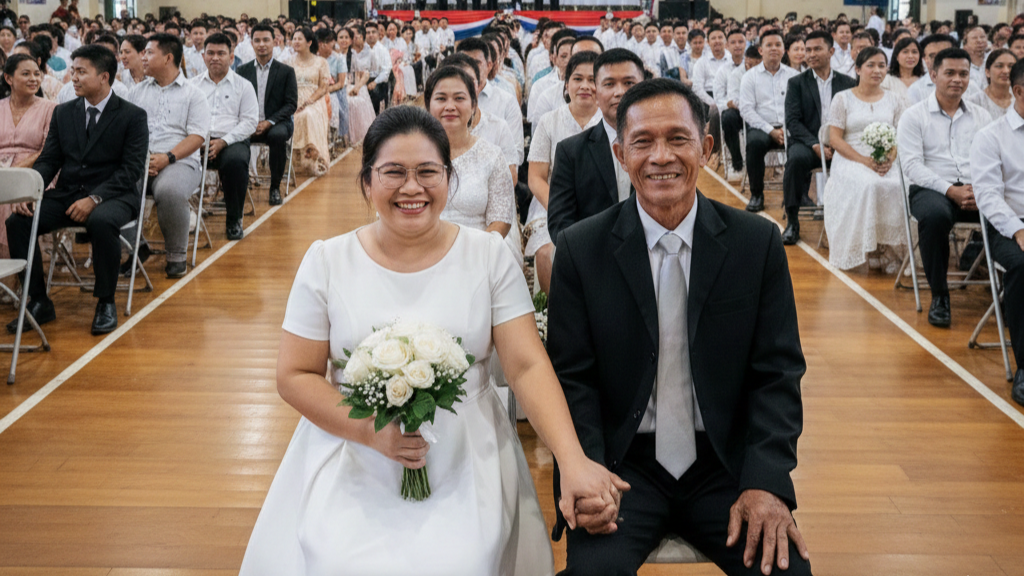
On Valentine’s Day in the Philippines, love doesn’t always arrive in a horse-drawn carriage or under a canopy of imported flowers. Sometimes it shows up in a basketball court, a city hall atrium, or a public plaza filled with plastic chairs, paper flowers, and dozens—sometimes hundreds—of couples saying “I do” at the same time. These are mass weddings, free or heavily subsidized ceremonies organized by local governments and community partners, and they have quietly become one of the country’s most enduring, practical, and emotionally charged rituals of modern Filipino life.
Mass weddings in the Philippines are usually civil ceremonies, officiated by mayors or judges, though some include religious elements when churches are involved. They are most common in February, especially around Valentine’s Day, when local governments announce schedules and open registration for couples who want to marry without the crushing cost of a traditional celebration. In a country where weddings are deeply symbolic but also famously expensive—often involving extended families, lavish receptions, and months of saving—mass weddings offer a way to formalize love without debt, shame, or delay.
The couples who sign up are rarely starry-eyed newlyweds straight out of a rom-com. Many have lived together for years, raising children without being legally married, a situation often referred to quietly as live-in or nagsasama (cohabiting). Some are older couples who postponed marriage because of money, family obligations, or migration. Others are parents who want to legitimize their children’s status, securing legal rights to inheritance, benefits, and paperwork in a country where documents matter deeply. There are also widows and widowers remarrying, overseas Filipino workers finally home at the right moment, and couples who simply want a wedding that feels communal rather than performative.
Local governments play a central role. City halls and municipal offices handle the logistics, from processing marriage licenses to organizing the mandatory pre-marriage counseling and family planning seminars required under Philippine law. For couples, this removes one of the biggest barriers to marriage: bureaucracy. Birth certificates, CENOMARs (Certificates of No Marriage), IDs, and community tax certificates can be intimidating and costly to assemble. In mass weddings, officials often guide couples through the process step by step, sometimes waiving fees entirely. The ceremony itself is usually free, with some cities even providing simple gowns, barong Tagalog, rings, bouquets, and a group photo—small gestures that carry enormous emotional weight.
Culturally, mass weddings tap into a deeply Filipino sense of bayanihan (communal solidarity). Marriage here is rarely imagined as a purely private affair; it is a public declaration that binds families, clans, and neighborhoods. In a mass wedding, that collective spirit is literal. Couples wait together, rehearse together, and walk down improvised aisles side by side. There is laughter when veils tangle, tears when vows are spoken in unison, and applause that rolls across the crowd like a wave. For many participants, the absence of luxury does not diminish the moment. On the contrary, it intensifies it. The ceremony feels honest, grounded, and shared.
There is also an unspoken moral dimension. Local officials often frame mass weddings as a way of strengthening families and promoting disiplina (social responsibility). In speeches, mayors talk about stability, legality, and dignity. Critics sometimes read this as moralizing, especially in a country where divorce remains illegal and marriage is often idealized as a solution to social problems. Yet for many couples, the motivation is less ideological than practical. Marriage brings legal protection, social recognition, and peace of mind. It transforms a relationship that may have existed in a legal gray zone into one fully recognized by the state.
What mass weddings do particularly well is strip marriage down to its essentials. Without elaborate receptions or guest lists, the focus shifts back to consent, commitment, and community. Relatives still attend, cheering and crying, but expectations are lower and generosity flows in different ways—shared food, borrowed clothes, collective pride. In a society where hiya (shame) can prevent couples from marrying without “doing it properly,” mass weddings offer an alternative that feels respectable rather than lacking.
As economic pressures rise and traditional wedding costs climb ever higher, mass weddings are likely to remain a fixture of Philippine life. They are not a rejection of romance but a reinterpretation of it, one rooted in realism, mutual support, and public care. In a single afternoon, dozens of couples leave as mag-asawa (husband and wife), carrying not just a marriage certificate but the quiet knowledge that their love was witnessed, affirmed, and made official together.
Spicy Auntie has attended more weddings than she can count, from beachfront affairs with barefoot violinists to hotel ballrooms where the cake alone probably cost more than Auntie’s first apartment. And yet, the weddings that stay with her—the ones that quietly squeeze the heart—are the mass weddings. Rows of couples in borrowed finery, nervous smiles, cheap bouquets, real promises. No champagne towers. No drone footage. Just people finally making things official because life, at last, allowed it.
Let’s be honest. In the Philippines, marriage has been turned into an endurance sport. You’re supposed to prove your love with debt, feed the entire barangay, and perform happiness at a level worthy of Instagram immortality. For couples who don’t have that kind of money—or who already spent it raising kids, caring for parents, or surviving precarious work—mass weddings are a small rebellion against the idea that love must be expensive to be valid. Auntie respects that deeply.
What Auntie loves most is who shows up. Not the 23-year-olds fresh out of a prenup shoot, but the couples who’ve already lived a whole life together. The nagsasama pairs who’ve shared rent, rice, illness, and children without the protection of paperwork. The women who carried the family while waiting for the “right time” that never quite came. The men who finally admit that oo, it matters—if only so their kids don’t have to explain themselves on every government form for the rest of their lives. These are not fairy-tale romances. These are survival romances.
Of course, Auntie also sees the contradictions. The speeches about “strengthening families” in a country that still refuses divorce. The gentle pressure to legalize relationships as if legality equals morality. Auntie rolls her eyes at that part. Love doesn’t become real because a mayor says so. But rights do. Security does. Protection does. And when the state refuses to modernize family law, people will take whatever practical door is open.
There’s something radical, too, about saying yes in public without spectacle. No bride pretending she’s not exhausted. No family feuds over seating plans. Just collective joy, a bit of chaos, and the humbling realization that everyone here is doing their best with what they have. Auntie has seen richer weddings with poorer marriages. Let’s not kid ourselves.
Mass weddings remind us that romance doesn’t have to sparkle to be meaningful. Sometimes it just needs a chair, a form stamped in triplicate, and someone beside you who’s already proven they’ll stay. Auntie raises her plastic cup of orange juice to that kind of love—quiet, practical, and stubbornly hopeful in a country that makes commitment both sacred and absurd.