


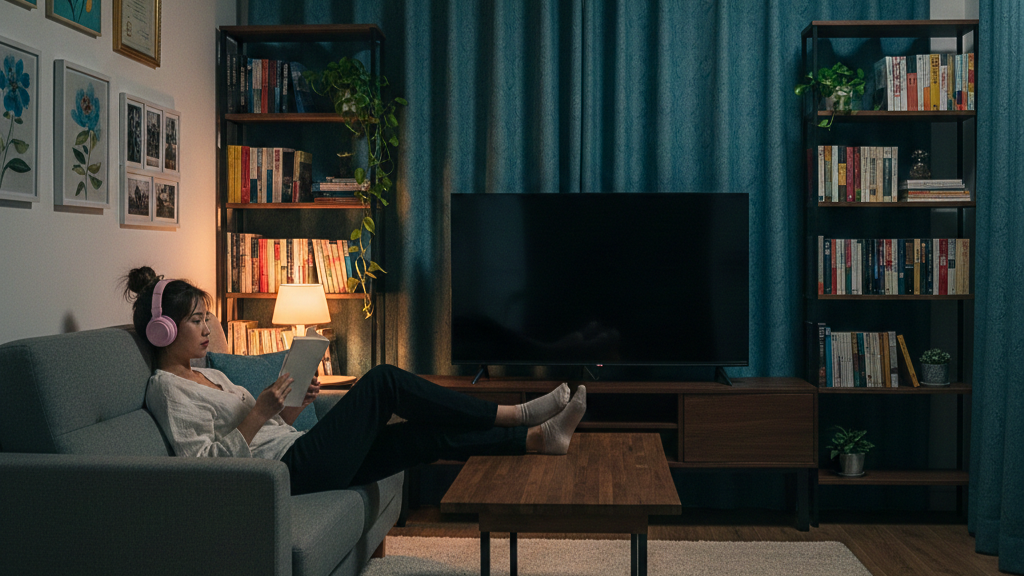
Living alone in China was once treated as a temporary failure of the life script, something you did between leaving your parents’ home and forming a “proper” family of your own. Today, it is fast becoming a defining feature of urban Chinese life. Single-person households are rising sharply, and behind the statistics lies a quieter social revolution, led disproportionately by young women who are choosing solitude not as exile, but as strategy.
In megacities such as Shanghai and Beijing, living alone has gone mainstream. Small studio apartments, once associated with migrant labor or divorce, are now marketed as symbols of taste and independence. For many women in their twenties and thirties, solo living is the physical expression of a deeper shift in values: a move away from compulsory marriage and toward what they describe as zìyóu (自由, freedom), zìwǒ (自我, the self), and kòngjiān (空间, personal space).
Marriage in China has been declining for a decade, but women’s attitudes have changed particularly fast. Many urban women openly reject the traditional expectation to marry early and “settle down” before their thirties. Online, they sometimes reclaim the once-derogatory label shèngnǚ (剩女, “leftover women”) with irony or defiance. Offline, they vote with their leases. Living alone allows them to delay or avoid marriage without constant family surveillance, especially for those who move far from their hometowns to work in first-tier cities.
Economic independence plays a central role. More women are university-educated, employed in white-collar or creative industries, and able to pay rent on their own. While housing costs remain punishing, many say the trade-off is worth it. Sharing an apartment with parents or extended family often comes with expectations around caregiving, obedience, and marriage timelines. Living alone, by contrast, offers what one Shanghai professional described as “emotional rent control”: fewer arguments, fewer compromises, fewer daily negotiations over how a woman should live.
Solo living is also a response to gendered realities inside relationships. Many women cite reluctance to enter marriages that still assume unequal domestic labor and emotional work. The phrase bù xiǎng dāng bǎomǔ (不想当保姆, “I don’t want to be a nanny”) appears frequently in interviews and social media posts. For these women, living alone is not anti-romance but anti-inequality. They may date, casually or seriously, but insist on keeping their own space as a form of insurance against sliding into traditional roles.
At the same time, living alone carries anxieties that are also deeply gendered. Women are more likely to worry about safety, illness, and emergencies. Viral discussions around apps designed to check whether users have failed to respond for an extended period reflect a real fear of chūshì (出事, something going wrong) without anyone noticing. This anxiety is not irrational. It grows out of urban anonymity, long working hours, and the erosion of neighborhood networks that once provided informal care. Yet many women say the fear does not outweigh the psychological relief of having a home that is fully their own.
Loneliness is another recurring theme, but it is often described in complex terms. Some women speak of gūdú (孤独, loneliness) as a manageable condition, even a productive one, rather than a crisis. Living alone allows them to rest, to curate their social lives, and to withdraw from constant performance. In contrast to the crowded family apartments of previous generations, solitude becomes a form of recovery. As one Beijing woman put it online, “I’m not lonely, I’m just not being watched.”
Generational tension is never far away. Parents often see solo living as a sign of instability or selfishness, especially for daughters. Family pressure intensifies during holidays, when questions about marriage and childbirth resurface with ritual regularity. Yet many women quietly persist, framing their choices as temporary while building lives that look increasingly permanent. The language they use matters. They describe themselves not as single but as dúshēnghuó (独生活, living independently), a subtle but telling shift.
The rise of solo households among women is also reshaping consumption and culture. Media, property developers, and lifestyle brands increasingly target the “single woman living alone” as a desirable demographic: independent, discerning, and willing to spend on comfort and safety. This commercial embrace does not erase structural pressures, but it does normalize a once-marginal way of living.
What emerges from China’s solo-living boom is not a rejection of family so much as a renegotiation of it. For many women, living alone is a pause, a buffer, or a long-term alternative to a system that still asks them to give more than they receive. It is a quiet, rented-by-the-month form of resistance, unfolding behind closed apartment doors. And as the number of those doors multiplies, so does the sense that in urban China, living alone is no longer a failure to belong, but one of the most telling signs of belonging to a new era.
Auntie has been watching this for years, long before it became a “trend” with charts and worried think-pieces. The first time a young Chinese woman told me, very calmly, that she preferred living alone to marriage, she didn’t sound rebellious or bitter. She sounded relieved. Like someone who had finally closed a door and discovered the room was quiet.
Let’s be honest. In much of Asia, and especially in China, women are not afraid of being alone. They are afraid of being exhausted. Exhausted by emotional labor, by family supervision, by being permanently auditioned for the role of obedient daughter, suitable wife, future mother, unpaid household manager. Living alone is not loneliness; it is an escape hatch.
When Auntie visits friends in Shanghai or Beijing, the apartments are small but sacred. A single plant on the windowsill. One mug, chosen carefully. A sofa that no one else dictates. This is not selfishness. This is survival with aesthetics. When you grow up with parents checking your phone, relatives counting your birthdays, and colleagues asking when you will marry as if it were a project deadline, silence becomes a luxury good.
People keep asking, “But aren’t these women lonely?” Some are. So what? Loneliness is not fatal. Bad marriages are. Women know this. They’ve watched their mothers negotiate marriages that promised security and delivered burnout. They’ve watched female colleagues disappear into domestic double shifts. Living alone is not a rejection of love; it’s a refusal of unfair contracts.
What really scares society is not women being alone. It’s women being unmonitored. No husband reporting to the parents. No mother-in-law auditing the fridge. No one timing how long she stays out at night. A woman alone in her own apartment is a woman who answers to herself, and that, my friends, is the true social disruption.
Of course there are anxieties. Safety. Emergencies. The dark joke of “what if something happens and no one notices?” But here’s the uncomfortable truth: women have always managed risk. We’ve done it inside families, inside marriages, inside rooms full of people. Solitude just makes the risks visible instead of pretending they don’t exist.
What I admire most is how quietly this revolution is happening. No marches. No slogans. Just leases signed, keys turned, doors closed. A woman cooking dinner for one, not as a consolation prize, but as a deliberate choice. Auntie calls that power with a rice cooker.
So no, this isn’t a crisis of family values. It’s a correction. Women aren’t opting out of society. They’re opting out of unpaid labor, constant judgment, and lives that shrink instead of expand. And honestly? About time.