


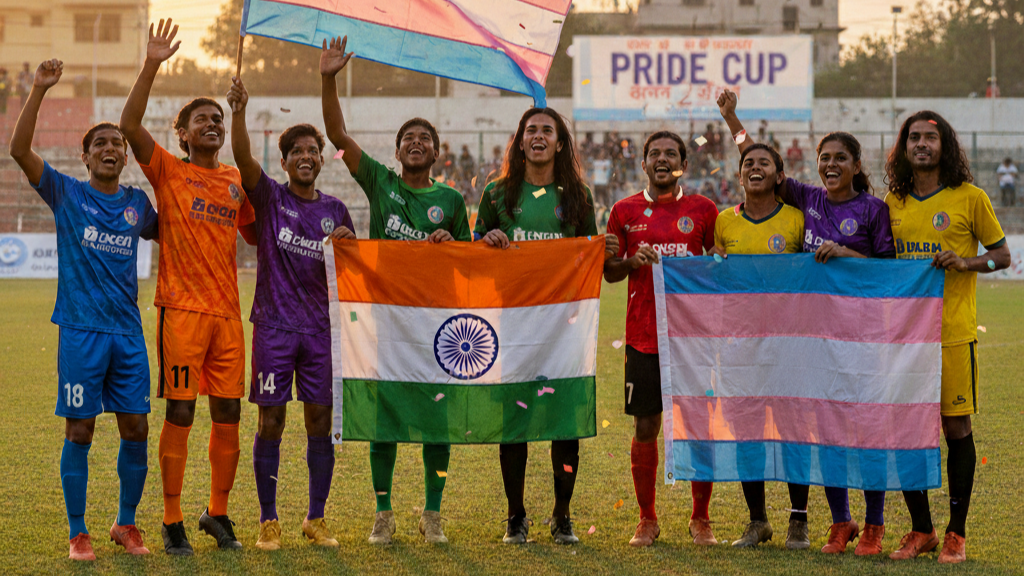
On a dusty football ground in eastern India, where cheers echo louder than whistles and floodlights struggle against the evening haze, a quiet sporting revolution is taking shape. Transgender athletes are carving out space in Indian sport through alternative leagues, community tournaments, and queer collectives, challenging decades of exclusion with every pass and sprint. In a country obsessed with khel (sport) yet deeply anxious about gender nonconformity, these grassroots initiatives are turning playing fields into sites of pehchaan (identity), dignity, and resistance.
For most trans people in India, mainstream sport has long been a closed door. From school teams to district trials, rigid male–female binaries govern uniforms, changing rooms, and eligibility rules. Even after the 2014 Supreme Court judgment recognizing transgender people as a third gender, everyday sporting life remained largely inaccessible. Selection committees were unsure, federations silent, and prejudice routine. Many trans children simply stopped playing. Alternative leagues did not emerge from idealism, but from majboori (necessity).
That reality makes the launch of the Jamshedpur Super League so significant. Held in Jharkhand and featuring seven teams with around seventy transgender players, this five-a-side football league was the first of its kind in the country. Teams travelled from nearby towns and industrial settlements, many players stepping onto a formal pitch for the first time in their lives. Here, respect was earned through stamina and teamwork, not gender conformity. Players spoke openly about how being judged for their football skills, rather than their bodies, felt like reclaiming izzat (dignity) that society routinely denies them.
Football, however, is only one part of a wider movement. In Raipur, Chhattisgarh, a National Transgender Sports Meet brought together athletes from across India for multi-sport competitions including athletics and volleyball. These events blend sport with celebration, combining races with music, community rituals, and speeches on rights. For participants who often survive on precarious livelihoods, the meet offered rare collective joy. Winning mattered, but so did visibility—being seen not as objects of pity, but as disciplined, competitive athletes.
Grassroots initiatives have also flourished in urban India. In Pune, queer-inclusive sports clubs organize regular football and badminton sessions that welcome transgender participants without intrusive questions. These are not professional leagues, but they function as safe spaces where players rebuild confidence lost to years of mockery or exclusion. Many trans athletes describe these weekly games as sukoon (relief), moments where the body is valued for movement rather than scrutinized for difference.
In the northeast, where football culture runs deep, trans-led teams have quietly pushed boundaries. In Manipur, an all-trans football team formed through a local sports collective has competed in informal tournaments and friendly matches. Though outside official federations, the team’s existence alone challenges deeply rooted assumptions about who belongs on the pitch. For players there, football is both escape and assertion—a way of saying hum bhi khel sakte hain (we can play too).
These alternative leagues expose the gap between policy rhetoric and lived reality. India’s sports policies increasingly speak the language of inclusion, yet offer little concrete guidance on transgender participation. Without clear rules, officials default to exclusion, citing “fairness” without evidence. In this vacuum, community leagues have become laboratories of possibility, demonstrating that inclusion is not chaos but organization grounded in mutual respect.
The limitations are real. Funding is scarce, facilities basic, and pathways into elite sport remain largely blocked. Medical support, sponsorships, and long-term security are often absent. Yet the social impact extends far beyond medals. When local crowds gather to watch trans teams play, sport becomes a form of public education. Neighbours see athletes rather than stereotypes. Young trans people watching from the sidelines glimpse futures that include khelna (playing), not just survival.
Sport in India has always been about more than recreation. It signals discipline, citizenship, and belonging. By creating their own leagues and tournaments, trans athletes are insisting that they, too, are part of this story. Each match is an act of dikhavat (visibility), quietly unsettling the idea that gender diversity exists only on society’s margins. These alternative leagues may never command television contracts, but they are achieving something more radical. They are redefining who gets to play, who gets to be seen, and whose bodies are allowed to compete. In a nation that lives and breathes sport, that shift—local, stubborn, and collective—may be the most meaningful victory of all.
Let me confess something upfront: I am deeply suspicious of anything in India that calls itself “inclusive” and comes with a glossy policy document. I have read enough frameworks to wallpaper a small apartment, and somehow the people most in need of inclusion never seem to fit neatly between Page 14 and Page 27. So when trans athletes stop waiting for permission and build their own leagues, my instinct is not concern—it is applause. Loud, auntie-style applause.
Because here’s the truth nobody in Indian sport wants to say out loud: most trans people were never allowed to play. Not as children, not as teenagers, not as adults. School playgrounds were early training grounds for humiliation, not teamwork. Coaches didn’t need to say “you don’t belong here”—the sniggers, the stares, the locker-room silences did the job efficiently. By adulthood, many trans people had already learned the lesson society wanted to teach: your body is a problem, keep it off the field.
So when I hear about trans football leagues, queer sports clubs, and community tournaments popping up across India, I don’t see “alternative sports”. I see a correction. A delayed but necessary repair job. Sport, after all, is where societies decide whose bodies are strong, disciplined, respectable—and whose are not. Denying trans people access to sport was never about fairness; it was about control.
What I love about these trans-led leagues is their refusal to beg for legitimacy. They are not waiting for federations to catch up or for committees to finish arguing about chromosomes over chai. They are playing now. On dusty grounds, with borrowed kits, uneven pitches, and very real joy. And joy, let me tell you, is deeply political when it belongs to people who were told they did not deserve it.
Are these leagues underfunded? Of course. Are they ignored by mainstream sports media? Naturally. But every match chips away at the lie that trans bodies are fragile, dangerous, or “confusing”. Watching trans athletes run, collide, sweat, lose, win—so utterly, boringly athletic—forces society to confront its own nonsense.
And to those who wring their hands and say, “But what about fairness?”, I have a simple auntie reply: fairness for whom? For the people who already have stadiums, sponsors, and generational access to sport? Or for those who had to build a pitch just to be allowed to exist on it?
These leagues are not asking to be inspirational mascots. They are demanding space. They are saying: we were always here, we just weren’t invited. Now we’ve arrived anyway—with boots on, jerseys tucked in, and absolutely no intention of leaving the field quietly.
Frankly, Indian sport could learn a thing or two from them.