


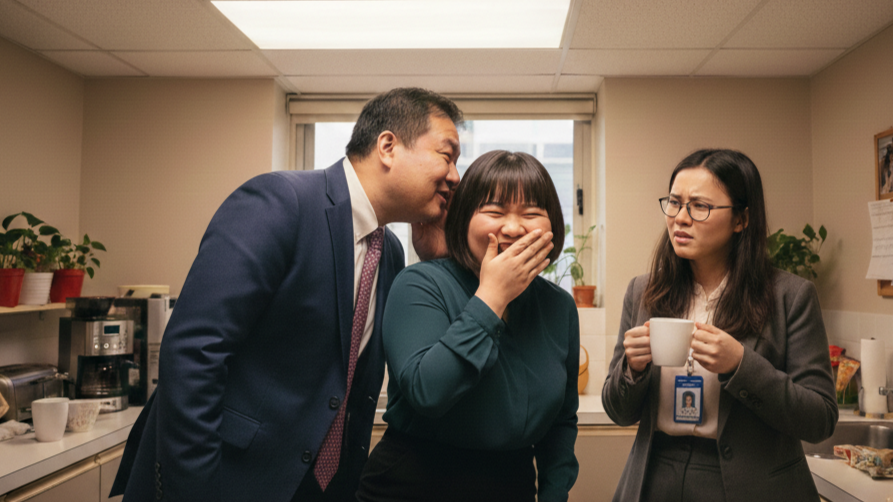
If you don’t speak Cantonese, flirting in Hong Kong sounds almost aggressively innocent. People ask if you’ve eaten, whether you’re tired, if you’re free later, if you want to “come up and sit for a bit.” No body parts are named. No desire is declared. No proposition is made. And yet, somehow, everyone involved knows exactly what is being negotiated.
That is the quiet genius of Cantonese flirting. It is a language trained by density, surveillance, family proximity, and social risk to say everything without ever saying it. Desire, in this linguistic ecosystem, doesn’t shout. It coughs politely and waits to see if the other person coughs back.
Cantonese is uniquely good at this because it is not just a language of words, but of tone, timing, and implication. A sentence can be semantically boring and erotically loaded at the same time. “Are you tired?” can mean genuine concern, polite filler, or a soft invitation to intimacy, depending on who says it, when, and with which sentence-ending particle gently attached like an afterthought. Outsiders hear the dictionary meaning. Insiders hear the weather shift.
Food is the safest entry point. Asking whether someone has eaten, whether something is “sweet,” whether it is “edible,” or whether one should “try a taste” allows flirtation to masquerade as appetite. This isn’t accidental. In a culture where open sexual speech has long been policed by family expectations and moral conservatism, hunger becomes the most respectable metaphor for desire. You can always claim you were talking about dinner.
Space, in a city where privacy is rare and housing is cramped, carries similar weight. “Come up and sit for a bit” is perhaps the most famous Cantonese non-invitation invitation. No sex is mentioned. No promise is made. But the phrase exists precisely because everyone understands that going upstairs together, late, is not about furniture appreciation. Crucially, it also preserves deniability. If challenged, one can always insist that sitting was, in fact, the original plan.
Work language does the same job. People ask if you are “free,” whether you want to “help a bit,” or joke about “working overtime.” Sex becomes effort, collaboration, or scheduling. This framing is especially common in digital flirting, where screenshots last forever and plausible innocence is a survival skill. Nothing ruins the mood faster than evidence.
The real power, however, lies in Cantonese sentence-ending particles. These tiny sounds—untranslatable and impossible to fake—carry flirtation more effectively than any explicit word. A single particle can turn a neutral sentence into teasing, mock innocence, soft insistence, or playful provocation. Remove it, and the sentence collapses back into politeness. Add it, and the door opens a crack.
Gender and class matter here. Women, especially, have historically used coded flirtation as both invitation and shield. Suggestion without declaration allows interest without exposure, desire without reputational damage. Men, for their part, learn to read tone and timing because misreading them is socially costly. Among queer communities, the coding becomes even more intricate, layered with camp irony, English insertions, and shared subcultural references that further exclude the uninitiated.
This is why Mandarin speakers often miss Cantonese flirtation entirely. Mandarin has fewer particles, less tonal density in casual speech, and a more direct relationship between words and intent. Translate the sentence and you kill the meaning. The erotic charge lives in what is not said, and in the shared understanding that not saying is the point.
There is also a political dimension to this linguistic softness. Cantonese erotic code evolved in an environment of constant observation—by parents, neighbors, employers, and now algorithms. It teaches people how to desire without leaving a paper trail. How to negotiate intimacy while retaining the ability to retreat. How to be bold in a whisper.
So when Cantonese flirting sounds innocent, believe it. It is innocent in vocabulary, polite in grammar, and respectable on the surface. But underneath, it is precise, strategic, and often daring. It doesn’t ask for permission. It waits to see if you already understand.
And if you don’t? Don’t worry. It was never meant for you anyway.
I understand a little Cantonese. Not enough to argue with taxi drivers or survive a family dinner without sweating, but enough to recognize when a perfectly innocent sentence is absolutely not innocent at all. And honestly? That’s where the fun begins.
The first thing you learn, if you’re paying attention, is that Cantonese doesn’t flirt the way English does. There is no dramatic declaration, no cinematic confession, no verbal stripping down to desire. Instead, there is atmosphere. Timing. A casual question that lands just a little too softly. A sentence-ending particle doing more work than an entire paragraph in another language. You either hear it—or you don’t.
I enjoy Cantonese innuendos precisely because they don’t perform for outsiders. They are not there to impress, provoke, or shock. They are there to test. To see whether you’re tuned into the same frequency. To offer connection without exposure. To retreat without embarrassment if the signal isn’t returned. It’s flirting designed by people who live close to their families, closer to their neighbors, and under constant social observation. Desire had to learn discretion to survive.
Food talk is my favorite gateway drug. Asking whether someone has eaten, whether something is sweet, whether you should “try a little”—all of it sounds domesticated, even boring, until you hear it in the right context. Then you realize hunger is doing double duty. It feeds the body, yes, but it also feeds curiosity, closeness, and that delicious moment of ambiguity where nobody has to admit anything yet.
What really delights me, though, are the particles. Those tiny sounds at the end of sentences that make Cantonese so famously difficult and so dangerously precise. They are flirtation with plausible deniability built in. Remove the particle and the sentence collapses back into politeness. Add it, and suddenly there’s a raised eyebrow you never actually saw. As a woman, I respect a language that allows interest without self-sacrifice.
In Hong Kong, this way of speaking feels almost ethical. It respects boundaries while gently leaning against them. It assumes intelligence on both sides. It doesn’t rush. It doesn’t demand. It invites you to notice.
So yes, I enjoy Cantonese innuendos. Not because they are “dirty,” but because they are clever. Because they trust the listener. Because they remind us that desire doesn’t need volume to be powerful. Sometimes all it needs is a soft tone, a shared context, and the confidence to leave things beautifully unsaid.