


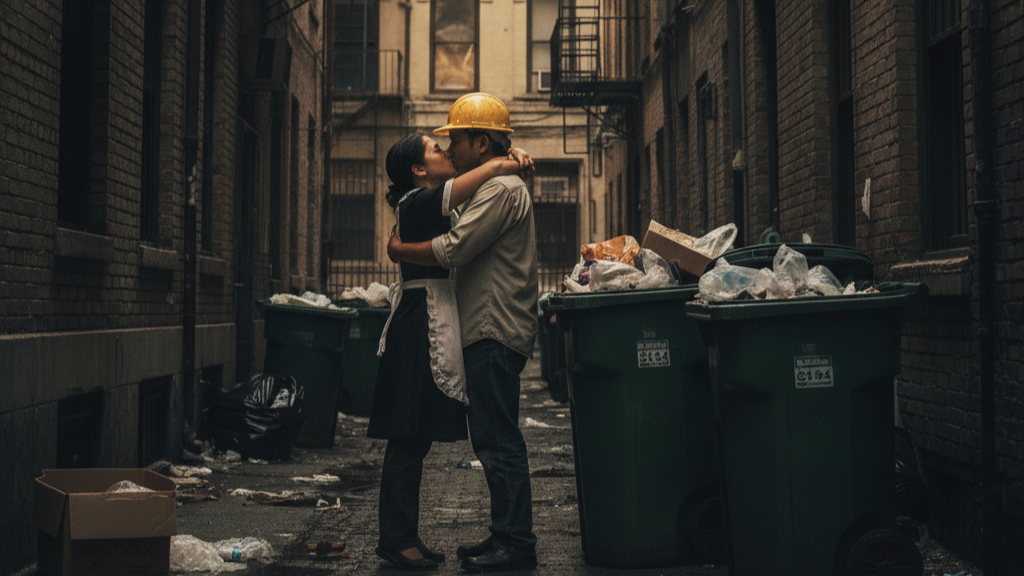
“Love on a Sunday schedule” is not a metaphor in Hong Kong. For many Filipina and Indonesian domestic workers, it is a precise description of how intimacy is rationed, planned, and squeezed into the narrow cracks of a system that leaves almost no private time at all. Romance, flirting, break-ups, and even grief are compressed into public spaces and smartphone screens, shaped by the city’s mandatory live-in employment rule and by employers who often control not just working hours but movement, sleep, and social life.
Most weeks follow a familiar rhythm. From Monday to Saturday, workers live inside their employer’s home, often sleeping in shared spaces or windowless “helper rooms,” with little physical or emotional privacy. Evenings may be technically “off,” but they are rarely free in any meaningful sense: chores spill over, curfews are imposed, or workers are simply too exhausted to go out. That leaves Sunday—the legally mandated rest day—as the single window where life briefly expands beyond the household. On that one day, tens of thousands of women spill into the city’s open spaces, especially in Central, Causeway Bay, and Mong Kok, transforming underpasses, footbridges, parks, and plazas into temporary living rooms.
In these improvised Sunday worlds, relationships are born. Friends introduce friends. Someone brings a cousin’s classmate from back home who now works in another district. Music plays from portable speakers. Food is shared on flattened cardboard. Laughter and gossip flow easily, but so do quiet confessions. A new boyfriend might be revealed. A long-distance relationship might be declared over. These spaces are public, noisy, and crowded, yet they offer something workers lack the rest of the week: the ability to speak freely, sit without being watched by an employer, and be seen as more than labor.
Romantic partners are often other migrant workers—Filipino or Indonesian men working in construction, cleaning, or kitchens, or fellow domestic workers who are also living under tight constraints. Privacy is negotiated through creativity rather than walls. A walk along the harbor, a shared earphone on the MTR, a few minutes on a stairwell, a corner of a park slightly away from the main group. For some couples, intimacy remains emotional rather than physical for months, sustained by conversation rather than touch. For others, hotel rooms are pooled and paid for collectively, a carefully budgeted expense that carries both excitement and risk.
Phones are the other essential infrastructure of love. Messaging apps bridge the six days of enforced separation. Voice notes are sent late at night from bathrooms or staircases, whispered so as not to wake children or alert employers. Video calls connect Hong Kong kitchens to bedrooms in Manila, Cebu, Java, or Lombok, allowing relationships to exist across borders and time zones. Emojis, stickers, and shared playlists become substitutes for presence. At the same time, phones can be a source of anxiety: some employers confiscate devices during working hours, check messages, or forbid usage altogether, turning digital intimacy into something furtive and fragile.
The lack of private time also reshapes how relationships end. Break-ups do not happen behind closed doors, because there are no doors to close. Tears are wiped away in public toilets or under footbridges before returning, composed, to an employer’s home where emotional collapse is not an option. There is no sick leave for heartbreak, no space to lie in bed all day, no room to avoid questions. On Monday morning, uniforms are put back on and life resumes as if nothing has happened.
What looks from the outside like casual Sunday leisure is, in fact, a compressed emotional economy. One day must carry friendship, romance, solidarity, healing, and planning for the future. Love grows fast, burns bright, and sometimes breaks abruptly under that pressure. Yet it persists. In the absence of private bedrooms, domestic workers have built relationships out of concrete floors, park benches, and glowing phone screens—proof that intimacy adapts even under extreme constraint, but also a reminder of how much effort it takes to love when almost every hour belongs to someone else.
Spicy Auntie has spent enough Sundays in Central to know that what looks like a picnic is actually an underground university of survival. Cardboard mats, shared rice, plastic bags tied just so—this is not leisure, sweetheart, this is logistics. This is what happens when a city decides that tens of thousands of women deserve one day a week to be human, and then acts surprised when they squeeze entire emotional lives into it.
“Love on a Sunday schedule” sounds cute until you realize how brutal the timetable is. Imagine if your whole romantic life—flirting, arguing, forgiving, breaking up, crying, starting again—had to fit between breakfast dishes and a 9 p.m. curfew. Imagine falling in love in public, in a crowd, under CCTV cameras, while sitting on concrete that smells faintly of last night’s rain and takeaway noodles. That’s not Instagram romance. That’s emotional parkour.
And don’t let anyone tell you these women are naïve or reckless. If anything, they are hyper-rational. They know exactly what is at stake. A boyfriend is not just a boyfriend; he’s a risk calculation. Will he respect your boundaries? Will he disappear if you get pregnant? Will he help or vanish when things get complicated? Love is weighed against visas, contracts, remittances, and the terrifying arithmetic of the two-week rule. Auntie calls that advanced economics.
Phones, of course, are the real bedrooms. Love lives in voice notes whispered from bathrooms, in emojis sent at 1 a.m., in video calls balanced on detergent bottles. When employers say, “Why are they always on their phones?” Auntie wants to reply: because that rectangle of light is the only place their life belongs to them. You took the room. You took the time. The phone is what’s left.
And then there’s heartbreak. Breakups without doors. Crying without silence. No space to fall apart, because Monday always comes and someone’s breakfast still needs cooking. Auntie has seen women wipe their eyes, straighten their T-shirts, and walk back to the MTR like soldiers returning to base. If resilience were paid by the hour, these women would own half of Hong Kong.
So yes, Sunday love looks messy, loud, improvised. It is. But it’s also tender, disciplined, and fiercely intentional. When you only get one day, you don’t waste it. You love hard, fast, and in full view of the world—not because you want to, but because the system leaves you no other choice. And Auntie says this: any city that depends so deeply on women’s care while denying them private lives should stop moralizing and start apologizing.