


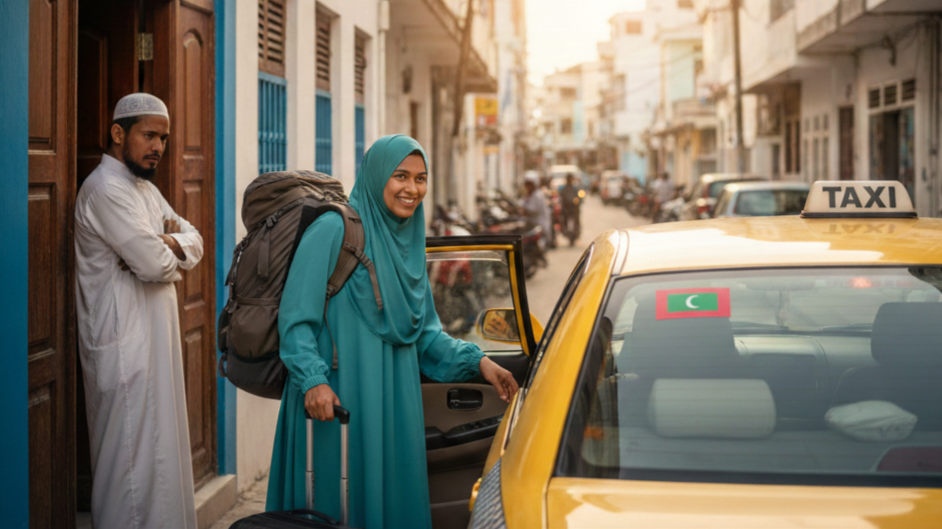
In the global imagination, the Maldives is a postcard fantasy of turquoise lagoons, honeymoon villas, and carefully staged romance. Yet beneath this glossy surface lies one of the most quietly radical marital cultures in the Muslim world. Long before Instagram weddings and luxury resorts, the Maldives developed a system of marriage, divorce, and remarriage that treats intimacy as practical, reversible, and surprisingly women-centered. For decades, the country has recorded one of the world’s highest divorce rates, not as a sign of social breakdown but as evidence of a deeply rooted cultural logic in which marriage is a flexible social contract rather than a lifelong moral test.
In Maldivian society, marriage (nikāh, Islamic marriage contract) has traditionally been entered into early and exited without dramatic fallout. Divorce is legally straightforward under Islamic law, whether initiated by men through ṭalāq or by women through khulaʿ (wife-initiated divorce). What makes the Maldives unusual is not the existence of divorce but its normalization. A failed marriage rarely defines a person’s moral worth, especially for women. In a region where divorce often marks women for life, Maldivian women routinely remarry without stigma, sometimes several times over a lifetime.
This pattern is especially visible on the inhabited outer islands, where communities are small, social networks dense, and life intensely communal. Historically, serial marriage was not hidden or shameful but simply part of adult life. A woman marrying three or four times did not signal instability; it signaled adaptability. Many unions were short, formed in youth, dissolved as people moved for fishing work, education, or later tourism jobs, and replaced by new partnerships better suited to changing circumstances. Children from dissolved marriages were absorbed into extended family networks, often remaining close to the mother’s kin, which reduced pressure to maintain unhappy unions “for the sake of the family.”
This pragmatism is partly structural. Maldivian households have long displayed matrilocal tendencies, with couples living near or with the woman’s family, giving women a safety net when marriages end. Women’s participation in paid labor—today through tourism, government jobs, retail, and services, and earlier through local trade—has further reduced economic dependence on husbands. Divorce, in this context, does not automatically mean social or financial ruin.
What makes this marital flexibility particularly striking is how it coexists with a public culture of strict Islamic morality. Outside marriage, sexual behavior is tightly policed. Premarital and extramarital sex remain criminalized, and women’s bodies are heavily regulated through dress codes and moral surveillance, especially on inhabited islands as opposed to resort zones. Virginity, female modesty, and public respectability are emphasized rhetorically, even as the same society quietly accepts frequent marriage turnover.
This tension produces one of the Maldives’ central gender paradoxes. Women exercise notable agency within marriage but far less outside it. A Maldivian woman may initiate divorce with relative ease, but she cannot openly reject marriage as an institution. Sexual autonomy is tolerated only once sanctified by nikāh, and moral legitimacy is continuously renegotiated through remarriage. In this sense, marriage becomes both a constraint and a tool: restrictive in theory, empowering in practice.
Urbanization and religious conservatism are now reshaping these dynamics. In Malé, the crowded capital, rising living costs and conservative religious influences have made divorce more publicly contested, while social media amplifies moral judgment. Yet the underlying norms persist. Divorce remains common, remarriage remains easy, and women continue to play a decisive role in ending unions that no longer serve them.
Against the backdrop of a tourism economy that sells romance, nudity, and escape to foreigners while enforcing modesty on locals, Maldivian marriage culture exposes the gap between appearance and reality. The Maldives is not a society of eternal love stories but one of negotiated intimacy, where marriage can end without shame, start again without scandal, and quietly center women’s choices in ways that challenge both Western fantasies and regional stereotypes.
Spicy Auntie has a confession to make: every time some earnest foreign commentator clutches their pearls about the Maldives’ “shockingly high divorce rate,” I roll my eyes so hard I risk spraining something. Divorce, my dears, is not a moral apocalypse. Sometimes it is simply a woman saying, “No, thank you, this is no longer working,” and walking away without asking permission from society, the state, or a panel of unqualified uncles.
What fascinates me about the Maldives is not the number of divorces but the absence of melodrama around them. In much of Asia—and let’s be honest, in most of the world—marriage is treated like a one-way street with no exits, especially for women. You enter young, you endure quietly, and if you leave, you pay forever. Shame, gossip, economic punishment, social exile: the full package. In the Maldives, somehow, that script never fully took hold. Marriage ends, people move on, life continues. Imagine that.
And yes, I see the paradox. Public morality is tight, Islamic language is everywhere, women’s bodies are constantly monitored, and sex outside marriage is still criminalized. Yet inside marriage, women have room to maneuver. They initiate divorce. They remarry. They refuse to stay miserable just to maintain appearances. That’s not chaos—that’s pragmatism. That’s understanding marriage as a contract between adults, not a sacred trap.
Of course, this freedom is not revolutionary feminism. Let’s not romanticize it. Women’s agency exists only if it passes through nikāh. You can leave a husband, but you can’t openly leave marriage itself. Sexual autonomy is tolerated only when stamped, signed, and religiously approved. Step outside that frame, and the system bares its teeth very quickly. So no, this isn’t liberation. It’s negotiation. Constant, exhausting negotiation.
Still, compared to societies that glorify lifelong suffering in the name of “family values,” I find something refreshingly honest here. A culture that quietly admits people change. That love fades. That compatibility is not guaranteed. That staying married at all costs is not a virtue if the cost is your sanity.
And the real irony? While the state sells fantasy romance, bikinis, and honeymoon sex to tourists, Maldivian women practice a much less marketable but far more radical idea: relationships should be reversible. Paradise, it turns out, isn’t eternal love. It’s the freedom to say “enough” and start again—without shame.