


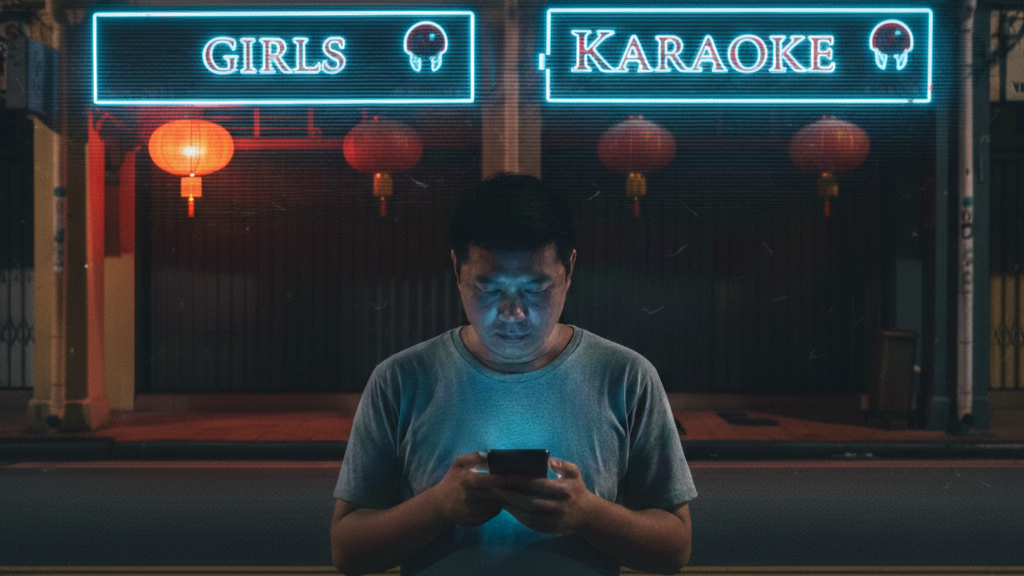
The neon still flickers in Geylang’s alleys, Singapore’s traditional red-light streets, but it no longer tells the whole story. The city’s most intimate economy has been quietly rerouted from lorongs to links, from doorways to devices. Today, the most active red-light districts are no longer mapped by streets or addresses. They live inside encrypted apps, behind disappearing handles and private channels, where a forwarded message replaces the familiar glow of a sign.
For decades, Singapore managed prostitution with a peculiar mix of tolerance and control. Certain brothels were licensed. Health screenings were routine. The geography was legible: a handful of lanes—especially in Geylang—where everyone knew what happened and where authorities could see it too. At its peak, the district hosted roughly a hundred licensed brothels, operating under tight rules. Visibility was part of the system. It created friction, boundaries, and a sense—however imperfect—of order.
But order is expensive in a city where space is scarce and surveillance is dense. As rents climbed, regulations tightened, and online advertising came under sustained pressure, sex work began migrating into the same digital shadows as many other informal economies. By 2019, Singaporean authorities had blocked at least 202 vice-related websites, a figure frequently cited in parliamentary and media reporting. The open web grew hostile. Encrypted messaging apps, by contrast, offered resilience.
Telegram and similar platforms became the new streets. Channels functioned like directories, pinned posts like shopfronts. Handles replaced door numbers; menus circulated as images or short videos. Bookings were confirmed in seconds, locations revealed only at the last moment. A rented flat for the night, a short-stay room, an HDB unit temporarily sublet. If an account vanished, another appeared by morning. Where once the city’s red-light map was static, now it is fluid, constantly redrawn by code.
Exact numbers are elusive—by design—but outreach workers and researchers agree the digital shift is substantial. A recent public-health estimate places the total number of people engaged in sex work in Singapore at around 16,000, spanning licensed brothels, entertainment venues, escorting, and online-mediated arrangements. While only a fraction operate exclusively through encrypted apps, the online segment is widely seen as the fastest-growing, particularly among younger workers and migrant women seeking discretion and mobility.
The language of this digital market is deliberately opaque. Ads rarely use explicit terms. Instead, they rely on euphemisms and shorthand: “massage,” “companionship,” “freelance,” “short time,” “full service,” or simply emojis—cherries, flames, clocks. Prices are hinted at rather than stated. Nationalities, body types, and services are coded. This linguistic fog is not just marketing; it is legal strategy, designed to keep conversations ambiguous and accounts defensible.
This shift was not accidental. Singapore’s legal framework tolerates prostitution itself while criminalising many surrounding activities, especially third-party facilitation and organised brothel-keeping. Fixed premises are legible—and therefore vulnerable. Pop-up operations coordinated via encrypted chats are not. Roles blur: who is an organiser, who is merely reposting information, who is just chatting? The line between coordination and conversation thins, and proof becomes harder to assemble.
For sex workers, the consequences are mixed. Digital mediation offers autonomy and speed. There are fewer visible intermediaries, less exposure to street-level harassment, and greater control over schedules and clients. At the same time, isolation increases. In the regulated system, health screenings and outreach were geographically anchored. When work moves into private flats and encrypted chats, access to clinics, NGOs, and peer support becomes more fragile. Safety shifts from institutional routines to individual judgment, negotiated in real time through a screen.
Clients, too, have adapted quickly. Discretion is the selling point. No need to be seen entering a known building, no need to linger under neon lights. A phone buzzes, a location drops, and the transaction fits neatly into the rhythms of a hyper-efficient city. What looks like convenience is also a form of urban erasure. The activity has not disappeared; it has simply become harder to see.
This invisibility creates a new moral comfort. When the red-light district was physical, it demanded acknowledgment. It was part of the city’s landscape, provoking debates about regulation, health, and hypocrisy. In its digital form, the trade becomes easier to ignore. There is no street to clean up, no sign to take down, no boundary to redraw. The problem seems smaller because it is quieter.
Yet the city has not become more virtuous—only more virtual. The same dynamics of demand, labour, and risk persist, now accelerated by technology. Singapore, often praised for its ability to manage social complexity, is discovering the limits of spatial control in an encrypted age. You can zone a neighbourhood, but you cannot zone a chat.
The neon will still glow in some streets, comforting in its familiarity. But the real red-light districts—quieter, faster, and far harder to govern—now exist inside phones. The city’s oldest trade has learned a new language, and it speaks in encrypted whispers.
I’ve lived long enough in Asian cities to know that when something “disappears,” it usually hasn’t gone away. It has just learned how to hide better. Singapore’s red-light districts going digital don’t shock me at all. If anything, I’m surprised it took this long. In a city that tracks litter, queues, and chewing gum with near-religious devotion, of course sex would eventually slip into the one place that still feels private: your phone.
What amuses me—darkly—is the fantasy that encryption somehow makes this cleaner. Safer. More modern. As if swapping neon signs for Telegram channels magically removes power imbalances, money pressures, or the old gender scripts that have been running this show since before Stamford Raffles unpacked his luggage. Please. The same transactions are happening, just without the courtesy of a visible address.
I’m old-fashioned enough to remember when feminists argued—correctly—that visibility mattered. When sex work was geographically contained, at least there were clinics nearby, NGOs knew where to go, and women could find one another without a password. Now everything is “freelance,” “independent,” “DM for details.” It sounds empowering until you realise how alone that can be. Autonomy is lovely, but solidarity is harder to encrypt.
And let’s talk about language. I have read enough “companionship” menus to know that euphemism is doing some very heavy lifting. When a market has to speak in emojis and code words, it’s not because everyone’s shy. It’s because ambiguity protects those with more power—platforms, organisers, clients—far more than those doing the actual labour. Vagueness has always been patriarchy’s favourite legal strategy.
Singapore, to its credit, has never pretended to be morally pure. Its approach to sex has been pragmatic, sometimes brutally so. But digitalisation breaks the old social contract. You can regulate a street. You can inspect a building. You can’t regulate a chat group that dissolves overnight and reappears under a new name before breakfast. Control becomes performative, while risk quietly slides downhill.
What worries me most is not that sex work is online. Sex work has always followed technology. What worries me is the comforting illusion this gives the rest of society. If you don’t see the red-light district, you don’t have to think about labour rights, migrant women, health access, or who pays the price when things go wrong. Out of sight becomes out of conscience.
So no, Auntie is not clutching her pearls over encrypted sex. I’m clutching my reading glasses and squinting at what this says about us. We’ve built a city so obsessed with order that even desire has learned to whisper. And when desire whispers, accountability often goes silent.
The neon hasn’t gone out. It’s just been replaced by a blinking notification. And somehow, that feels far more dangerous than a street you can actually walk down.