


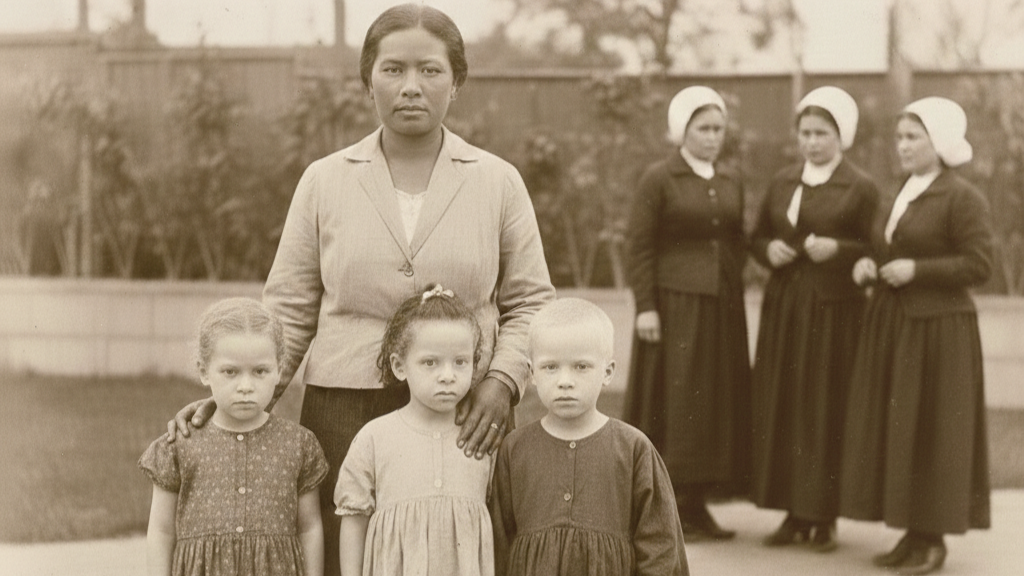
In the long history of the Dutch East Indies, few figures sit more uncomfortably at the intersection of intimacy, power, and empire than the nyai—local women who became companions, de facto wives, or concubines of European, mostly Dutch, men. These relationships were once common and often quietly foundational to colonial life, yet they were rarely granted dignity, security, or legitimacy. They produced households, children, and hybrid cultures, but also deep vulnerability, cultural fracture, and long shadows that extended well beyond the colonial period.
For much of the seventeenth to nineteenth centuries, the colonial population was overwhelmingly male. European women were few, postings were long, and everyday life in towns, plantations, and military outposts depended on local labor and local knowledge. Within this context, relationships between European men and local women became widespread. The word nyai itself was elastic. It could refer to a housekeeper, a sexual partner, a long-term companion, or something very close to a wife in daily practice. What it almost never implied, however, was legal equality.
Despite running households, managing servants, raising children, and acting as linguistic and cultural mediators, most nyai occupied a precarious legal position. They were not wives under colonial law, even when unions lasted many years. Their security depended almost entirely on the goodwill of the European man. A nyai could be dismissed abruptly—if her partner was transferred, decided to marry a European woman, or sought social advancement within colonial society. Property rights were minimal, inheritance claims were weak or nonexistent, and formal protection was rare. Intimacy did not translate into rights.
Local societies responded to these women in complex and often contradictory ways. In some communities, nyai relationships were stigmatized, associated with moral transgression, loss of status, or collaboration with colonial power. Gossip and social isolation were common, particularly when relationships ended and women were left without support. Yet in other contexts, especially where such unions were frequent, they were met with pragmatic acceptance. For some families, becoming a nyai meant access to food security, relative safety, and social mobility otherwise unavailable under colonial conditions. Many women navigated these arrangements with agency, skill, and strategic awareness, even as the structural odds were stacked against them.
Within European colonial society, attitudes hardened over time. In earlier periods, concubinage was largely tolerated as a practical solution in a male-dominated colonial world. By the late nineteenth and early twentieth centuries, however, colonial authorities and elites increasingly framed sexuality and domestic life as matters of racial order and moral governance. Scholars such as Ann Laura Stoler have shown how fears of racial mixing and “degeneracy” transformed private relationships into political problems. As more Dutch women arrived in the colony, pressure mounted on European men to abandon nyai households and conform to “respectable” European family norms. The nyai, once normalized, became symbols of moral anxiety and racial disorder.
Even when relationships were emotionally stable, they were shaped by deep cultural fault lines. Religion, language, child-rearing practices, and expectations of gender roles could clash within households. Many nyai carried the burden of translating European domestic ideals into local realities, often absorbing blame when things went wrong. The greatest rupture, however, came when relationships ended. European men could leave—legally, socially, and geographically. Local women rarely could. The imbalance was most painfully exposed when children were involved.
Children born of these unions formed the core of what later became known as the Indo-European or Indisch community. Their lives were profoundly shaped by legal recognition. If a European father formally acknowledged a child, that child could be classified as European under colonial law, gaining access to education, employment, and legal protections denied to most indigenous people. If he did not, the child often remained legally indigenous and socially invisible to the colonial system. Colonial officials even spoke casually of unrecognized children “disappearing into the kampung,” as if erasure were a bureaucratic footnote.
Recognition did not guarantee equality. Even legally European Indo children often occupied an uneasy middle ground—privileged compared to indigenous populations, yet excluded from full acceptance by white colonial elites. Skin color, language, manners, and perceived “European-ness” shaped their life chances. Many were pushed into Dutch-language schooling and cultural assimilation, sometimes at the cost of separation from their mothers and maternal communities. Others grew up embedded in local worlds, carrying European surnames that offered little real protection.
The story of the nyai is not a footnote to colonial history; it is one of its emotional and social foundations. These women sustained households, produced future generations, and bridged cultures, even as colonial law and society worked systematically to deny them recognition. Their children embodied the contradictions of empire—simultaneously evidence of intimacy and instruments of racial hierarchy. To understand the Dutch East Indies without them is to miss how colonial power operated not only through armies and laws, but through bedrooms, kitchens, and families, leaving legacies that still shape identities today.
Spicy Auntie sighs every time someone calls the nyai a “mistress,” because that word is far too tidy for something that was anything but. Mistress suggests romance, consent neatly packaged, maybe even a bit of glamour. What it does not suggest is a system where one party could leave with a suitcase and a pension, and the other was left with nothing but memories, children, and a reputation that followed her like a curse.
Let’s be clear: many of these women were not naïve girls seduced by charm and gin. They were strategic, observant, and often painfully realistic. They understood power long before colonial theorists wrote books about it. They cooked the meals, ran the households, translated worlds, raised children who belonged to two civilizations and fully to neither. They held families together that colonial law refused to recognize. That is not passivity. That is labor—emotional, cultural, reproductive—performed under conditions where walking away was rarely an option.
Colonial society loved the nyai when she was useful and invisible. She was tolerated as long as she kept the house quiet, the man comfortable, and the boundaries intact. The moment European respectability arrived—usually in the form of a white wife stepping off a boat—the nyai became an embarrassment, a moral failure, a stain to be erased. Empire has always been very good at using women and even better at disowning them.
And the children—oh, the children carried the real bill. Too European for the kampung, too brown for the salons, shuffled through schools, classifications, and paperwork that decided their worth with bureaucratic coldness. Recognized, they were “almost Dutch.” Unrecognized, they were conveniently forgotten. Colonialism did not just conquer land; it engineered family separation long before modern borders perfected the trick.
What irritates Spicy Auntie most is how often these stories are still told with a tone of nostalgia, as if the nyai were a colorful detail of a vanished era. No. They were women navigating a system rigged against them, making choices inside cages politely called households. Their experiences explain far more about colonial power than any governor’s memoir.
So here is Auntie’s modest demand: stop romanticizing colonial intimacy. Call it what it was—unequal, conditional, and extractive. Remember the nyai not as footnotes or scandals, but as women whose lives expose the lie at the heart of empire: that domination ever came without intimacy, and intimacy ever came without cost.