


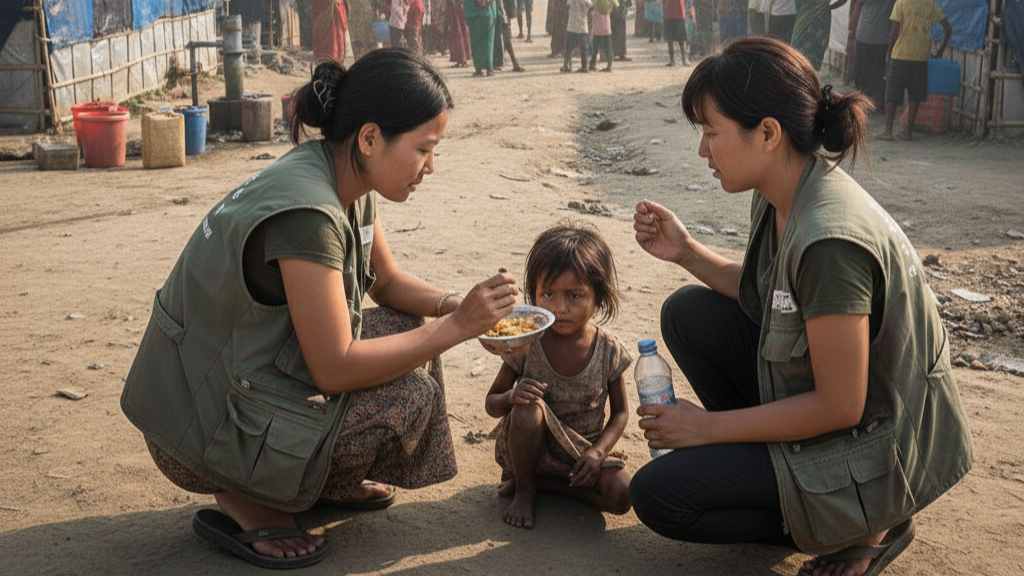
In January 2026, Oxfam in Asia released a major new research report that directly challenges how humanitarian aid is designed, funded and led across the region. Titled “Roadmap for Feminist Local Humanitarian Leadership”, the report argues that despite years of talk about “localization” and “gender inclusion,” humanitarian responses in Asia remain deeply shaped by unequal power relations—between international and local actors, between men and women, and between those who control resources and those who live with the consequences of crisis
At the heart of the report is a blunt diagnosis: humanitarian systems continue to privilege international organizations, large institutions and male-dominated leadership structures, while treating local civil society organizations—especially feminist women’s rights organizations—as subcontractors rather than leaders. This imbalance is not accidental. It is rooted in colonial legacies, patriarchal norms and funding systems that prioritize visibility, scale and technical compliance over lived experience, contextual knowledge and long-term social transformation.
The roadmap sets out Oxfam Asia’s vision for a different humanitarian future between 2025 and 2030—one that is explicitly feminist, intersectional and locally led. Feminist local humanitarian leadership, as defined in the report, is not simply about adding women to existing systems. It is about redistributing power so that crisis-affected people, feminist organizations and local responders shape decisions, control resources and define priorities. Gender is not treated as a “cross-cutting issue” to be checked off, but as a central lens through which humanitarian action must be designed, delivered and evaluated.
Drawing on extensive consultations with partners across Asia, the report shows how crises consistently affect people differently depending on gender, age, class, disability, ethnicity, caste and sexual orientation. Yet humanitarian responses often remain gender-blind, focused on material aid while ignoring the power dynamics that determine who can access that aid and at what cost. Feminist and gender-focused organizations are frequently the first responders in emergencies—providing support for survivors of gender-based violence, sexual and reproductive health services, psychosocial care and community protection—yet their work is routinely undervalued and underfunded.
One of the report’s most striking findings concerns funding. Despite global commitments to gender equality, less than one percent of humanitarian funding reaches feminist and women’s rights organizations. Even within Oxfam’s own humanitarian portfolio, funding allocated to women-led and feminist organizations remains extremely low, in part because of weak tracking systems and inconsistent definitions. The report highlights how rigid donor requirements, short-term project cycles and burdensome reporting obligations systematically disadvantage small, local feminist actors, while larger, male-led organizations continue to dominate funding pipelines.
To address these failures, the roadmap is organized around four interlinked pillars. The first calls for local actors—especially feminist women’s rights organizations and crisis-affected communities—to be recognized as responders, leaders and equal partners. This means moving away from top-down partnerships toward co-creation, shared decision-making and genuine accountability. The second pillar focuses on resourcing, demanding not only more funding for gender-transformative work, but better-quality funding: flexible, multi-year, and inclusive of core operational costs and safety needs.
The third pillar emphasizes collective leadership and advocacy. The report documents how local organizations are often excluded from regional and international decision-making spaces, with INGOs acting as gatekeepers to visibility and influence. Feminist organizations, in particular, face political risks, backlash and even threats for challenging entrenched power structures. Oxfam argues that international actors must use their access and influence to amplify local feminist agendas rather than competing with them for recognition.
The final pillar centers accountability. Feminist local humanitarian leadership cannot exist without mechanisms that allow crisis-affected people and local organizations to challenge decisions, report harm and influence change without fear of retaliation. The report stresses that accountability is not just about complaints systems, but about shifting who defines success, whose knowledge counts and who is trusted to lead.
Ultimately, the roadmap is both a critique and a commitment. It acknowledges that Oxfam itself operates within the same unequal system it seeks to transform, and that adopting a feminist approach requires confronting uncomfortable truths about power, privilege and institutional behavior. By laying out concrete goals, indicators and action areas, the report positions feminist local humanitarian leadership not as an abstract ideal, but as a practical necessity if humanitarian action in Asia is to become more just, effective and accountable.
In an era of overlapping crises, shrinking civic space and growing backlash against gender equality, Oxfam’s roadmap makes one thing clear: humanitarian aid cannot remain business as usual. If responses are to truly serve those most affected by crisis, leadership must shift decisively toward the women, communities and local organizations who have long been doing the work—often without recognition, protection or adequate support.
After thirty years of working in and around humanitarian aid — as staff, consultant, partner, donor, observer, occasional troublemaker — and even more years of being a feminist, I read Oxfam Asia’s roadmap with a familiar mix of relief, anger, and weary recognition. Relief, because finally someone is saying the quiet part out loud. Anger, because it took this long. Recognition, because every page mirrors what women on the ground have been saying for decades, often while being politely ignored.
Let’s be honest. Humanitarian aid is still largely led by men, especially at the top — the boards, the donors’ tables, the glossy global panels. But it is kept alive by women. Women who organize shelters overnight. Women who negotiate access with armed men. Women who take survivors of violence to clinics that barely function. Women who translate, soothe, document, counsel, distribute, and clean up. Women who are told they are “too political” when they name patriarchy, and “too emotional” when they name harm.
This system was never neutral. It was built with colonial logic, masculine hero narratives, and a deep discomfort with power-sharing. So when feminist organizations demand not just funding, but control; not just consultation, but leadership; not just gender boxes ticked, but power redistributed — the system resists. It calls them risky. It calls them unscalable. It calls them “capacity gaps.” Funny how those gaps disappear when the same work is repackaged by a large international organization with a male country director and a slick logo.
Will aid work change anytime soon? If I’m brutally honest — probably not fast enough. Too many incentives reward the status quo. Too many men still mistake authority for leadership. Too many institutions benefit from women’s unpaid labor, emotional endurance, and political silence. Feminist organizations are still expected to save lives on project grants, while others build careers on overheads and conferences.
And yet — here’s the part where Spicy Auntie allows herself a cautious smile — the very fact that this debate is finally happening matters. Naming the problem matters. Writing it down matters. Putting timelines, indicators, and uncomfortable truths into an official roadmap matters. It creates friction. It gives language to what many women already know in their bones. It gives younger feminists something to point to when they are told to be patient, grateful, or quiet.
Change in humanitarian aid has always come from pressure, not goodwill. From women refusing to disappear. From local groups insisting they are not “implementers” but leaders. From feminists who stay, fight, and sometimes burn out — but still speak. This roadmap won’t dismantle patriarchy overnight. But it cracks the door open. And once that door is open, sisters, we know how to push.