


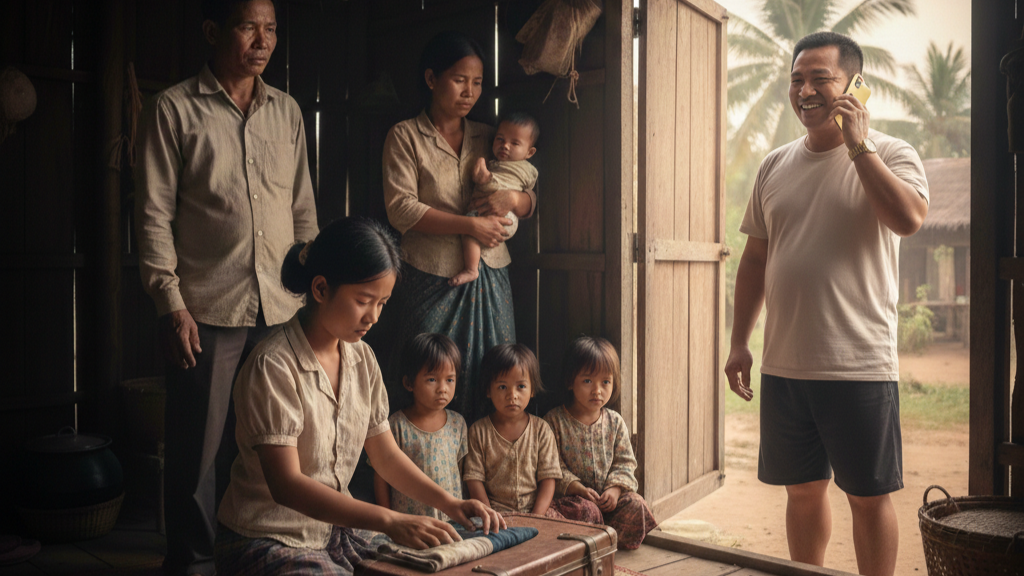
In Cambodia’s poorest provinces, stories circulate quietly about girls who “married” Chinese men and disappeared. Sometimes they left with a neighbour, sometimes with a distant relative, sometimes with a broker promising work, comfort, or a better future. What awaited many of them in China, however, was not marriage in any meaningful sense of the word, but a form of confinement shaped by poverty, deception, and profound isolation.
Most of the Cambodian girls and young women who end up in these cross-border marriages come from rural households struggling with debt, land loss, or unstable agricultural incomes. Recruiters deliberately target those with little schooling and limited exposure beyond their village. The offer is rarely framed bluntly as marriage. Instead, it is wrapped in ambiguity: a job at first, a “chance to meet someone,” a temporary arrangement that will help the family. By the time the women realise marriage is expected, they are often already across the border, dependent on strangers for food, shelter, and translation.
Once in China, many describe an immediate shift in power. Phones and documents are commonly taken “for safekeeping.” Movement outside the house may be restricted, especially in rural areas where foreign women stand out. Some women are locked inside; others are allowed out only with supervision. Even where physical confinement is absent, dependency functions as a cage. Without language skills, money, or knowledge of their location, leaving becomes nearly impossible.
Language shock is one of the most underestimated aspects of these situations. Khmer and Mandarin are mutually unintelligible, and in many cases the husband’s family speaks only a local dialect. Everyday tasks—buying food, asking for help, understanding rules—become impossible without mediation. This isolation deepens dependence on the husband’s family and cuts women off from outside assistance. Cultural expectations compound the shock. Many women are expected to be obedient daughters-in-law, to perform heavy domestic labour, and to accept strict hierarchies without question.
Pressure to become pregnant is frequently reported. Pregnancy is treated as proof that the transaction was successful and as a way to bind the woman permanently to the household. Once a child is involved, the woman’s options narrow sharply. Children born from these unions may face complicated registration processes, especially if the marriage was never legally recognised. For mothers without valid residency status, accessing healthcare or schooling for their children can be fraught, and custody becomes a powerful tool of control. Some women who try to leave are told they must abandon their child or face legal consequences they do not understand.
Not all of these marriages are violent, and it is important to avoid a single narrative. A small number of women report relatively stable arrangements. But across survivor testimonies and NGO investigations, the same vulnerabilities recur: lack of consent informed by deception, severe imbalance of power, and an environment where abuse can occur without meaningful recourse. The idea that a bride has been “paid for” shapes behaviour, turning intimacy into obligation and disagreement into disobedience.
So why do so many women return to Cambodia? For some, the answer is simple: survival. Abuse, confinement, and despair push them to flee when an opportunity arises. Others return because the promised economic improvement never materialised. Rural poverty exists on both sides of the border, and many find themselves working endlessly with no control over money or decisions. Homesickness also plays a powerful role. The psychological toll of isolation, silence, and dislocation can be crushing, especially for very young women.
Returns often happen through fragile channels. A woman may secretly contact family back home, an NGO, a journalist, or eventually Cambodian officials. In some cases, police crackdowns in China or bilateral interventions enable repatriation. Yet return is not always a happy ending. Back in Cambodia, women may face stigma for a “failed” marriage or suspicion that they willingly participated. Those who return with children encounter additional barriers, from documentation issues to social judgement.
What emerges from these stories is not simply a tale of international demand for brides, but a deeply Cambodian story of structural vulnerability. Poverty, limited education, weak labour opportunities for women, and uneven enforcement of anti-trafficking laws create conditions where deception thrives. The girls who leave are not reckless; they are making constrained choices in constrained lives.
Understanding their experiences in China—control, cultural isolation, reproductive pressure, and legal limbo—matters because it exposes the real cost of ignoring rural women’s vulnerability at home. As long as economic desperation remains a recruitment tool, and as long as returnees are met with stigma rather than support, the cycle will continue quietly, one girl at a time, moving from a Cambodian village to a locked room far from home.
Spicy Auntie has a question for everyone clutching their pearls about “foreign brides” and “marriage markets”: when did desperation become consent?
Let’s stop pretending this is some exotic love story powered by fate, globalization, or lonely hearts. What’s happening to poor Cambodian girls sent to China is not romance. It’s economics wearing a wedding dress. It’s poverty wrapped in paperwork. It’s patriarchy outsourcing its dirty work across borders.
These girls are not scrolling dating apps in Phnom Penh thinking, Ah yes, rural Anhui sounds dreamy. They are being recruited because they are young, poor, undereducated, and raised in families where a daughter’s body is sometimes the only negotiable asset left. When someone offers an escape—work, money, “a good husband”—hope fills the gaps that information should occupy. And traffickers know this very well.
Once in China, the fantasy collapses fast. No language. No friends. No phone. No freedom. You are suddenly someone’s wife because someone paid for you. You are told to be grateful. You are told to produce a baby quickly, as proof that the transaction worked. Love is optional. Obedience is not.
And let’s talk about the children, because they are always the silent hostages in this story. Babies born into legal limbo, mothers trapped by motherhood, families using custody like a padlock. Nothing binds a woman faster than a child she might never be allowed to take home.
So yes, many women run. They escape. They beg embassies. They whisper to NGOs. They climb out windows, literally and metaphorically. And when they return to Cambodia, bruised and empty-handed, society often greets them with suspicion instead of support. Why did you go? What did you expect? As if poverty comes with a crystal ball.
Spicy Auntie is tired of hearing that this is inevitable, that demographics made it happen, that “it’s complicated.” It’s not that complicated. When women are poor and men feel entitled, markets appear. When daughters are undervalued and borders are porous, brokers thrive. When returnees are shamed instead of protected, the cycle continues.
If Cambodia wants this to stop, it’s not enough to arrest a few traffickers after the fact. Girls need real options before the offer comes. Education. Jobs. Safety nets. And when women come back—alone, or with children—they need protection, not gossip.
Because the real scandal here is not that these girls left. It’s that leaving felt like the best option they had.