


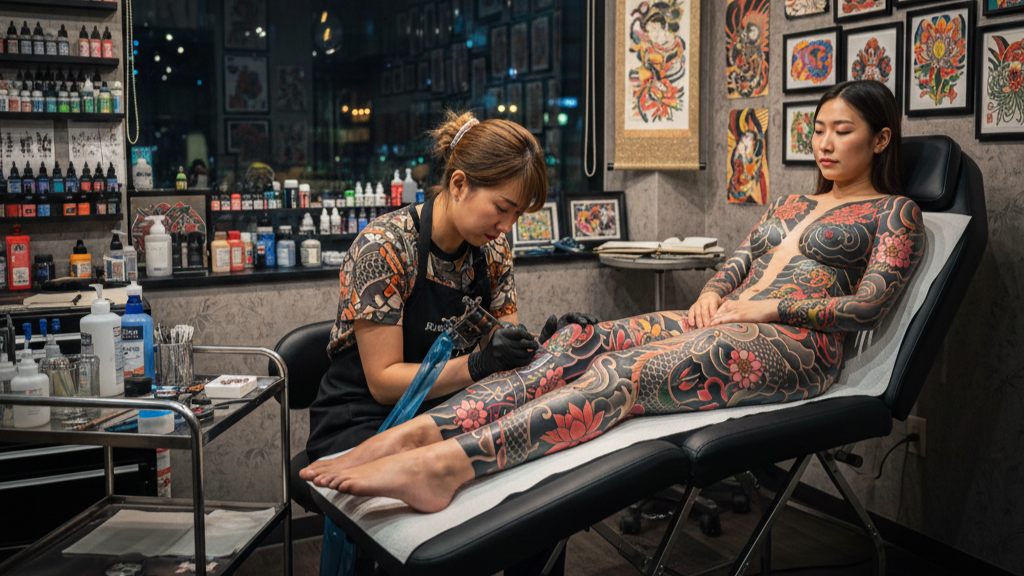
For centuries, the art of tattooing female bodies in Japan has existed in a space that is at once intimate and political, admired and condemned, deeply aesthetic yet socially risky. Long before tattoos became shorthand for rebellion or criminality, women’s skin was already a canvas carrying meaning, memory, and social belonging. To understand tattooing on women in Japan today, one has to move backwards through layers of history where gender, secrecy, and beauty were tightly entangled.
One of the earliest and clearest female-centered tattoo traditions belongs to Ainu women in northern Japan. Among the Ainu, women were tattooed around the mouth, on hands and arms, in patterns believed to offer spiritual protection, mark adulthood, and ensure a woman’s safe passage into the afterlife. Tattooing was a rite of passage, not an act of transgression, and the work itself was often carried out by women. When the modern Japanese state later outlawed these practices in the late nineteenth century, Ainu women’s tattoos became one of the first examples of how female bodily expression through ink could be criminalized in the name of “civilization.”
On the Japanese mainland, tattooing evolved along a different but equally gendered path. By the Edo period, decorative tattooing—known as irezumi (入れ墨) or horimono (彫物)—had developed into a sophisticated visual art inspired by woodblock prints, folklore, and popular literature. Full-body compositions flowed with muscle and bone, designed to move when the body moved. Although much of the surviving imagery and documentation centers on men, women were never absent from this world. What differed was visibility. For women, tattoos were more often designed to remain hidden beneath kimono and later Western clothing, shaping a tradition where intimacy mattered more than public display.
This gave rise to the idea of kakushibori (隠し彫り), literally “hidden tattoos.” These were small or medium-sized designs placed on inner arms, thighs, ribs, or other areas invisible in daily life. Kakushibori carried erotic, emotional, or symbolic meanings meant for a lover or for the woman herself. In a society that prized female modesty, the hidden tattoo allowed women to reclaim a private form of agency over their bodies without openly defying social norms. Even today, many Japanese women who choose tattoos are strategic about placement, balancing self-expression with the realities of work, family, and public scrutiny.
Technique plays a central role in how tattooing is understood as art rather than mere decoration. Traditional Japanese tattooing is often done by tebori (手彫り), a hand-poked method using needles mounted on wooden or metal rods. Tebori is slower and more physically demanding than machine tattooing, but it produces soft gradations and a distinctive depth of color prized by purists. Learning tebori requires years of apprenticeship, discipline, and submission to a master, reinforcing tattooing’s status as a craft passed down through lineage rather than a commercial service.
For women, entering this world as artists has historically been difficult. Tattoo studios were male-dominated spaces, and the broader taboo surrounding tattoos discouraged women from both receiving and practicing the art. Yet some women have carved out space within this tradition. Artists like Horiren 1st (初代 彫蓮) became internationally known not only for mastering tebori, but for doing so while openly challenging the idea that tattooing was unsuitable for women. Their visibility matters because it reframes tattooing female bodies not as exploitation or deviance, but as collaboration between artist and subject.
Despite artistic legitimacy, social stigma remains powerful. Tattoos in Japan are still widely associated with yakuza imagery, and this association spills into everyday discrimination. Women with visible tattoos may be denied entry to onsen and sentō (public baths), face pressure in conservative workplaces, or be judged as irresponsible or sexually deviant. As a result, many women manage their tattoos carefully, covering them at work or choosing designs that align with aesthetics perceived as “delicate” or “feminine,” such as flowers, animals, or mythological figures associated with protection rather than aggression.
At the same time, attitudes are shifting. Younger generations increasingly frame tattoos as fashion, self-care, or identity rather than defiance. Social media has played a major role in normalizing tattooed female bodies, while international tourism has forced some institutions to relax blanket tattoo bans. A crucial legal turning point came when Japan’s courts clarified that tattooing is not a medical act, removing the threat of prosecution that had long hung over tattoo artists. This decision quietly legitimized the profession and opened space for more women to enter it.
Today, tattooing female bodies in Japan sits at the intersection of heritage and resistance. Whether it draws on Ainu tradition, Edo-era horimono aesthetics, or contemporary minimalist styles, the act of tattooing a woman’s body still carries weight. It is never just decoration. It is a negotiation with history, with social control, and with the enduring idea that women’s bodies are public property. In choosing ink—hidden or visible—Japanese women continue a long, uneasy, and deeply artistic conversation with the culture that surrounds them.
Spicy Auntie here, lighting a metaphorical cigarette and rolling her eyes very slowly.
Japan loves beauty. Japan loves craft. Japan worships precision, patience, and tradition. And yet—somehow—Japan still panics when a woman decides to put that beauty, craft, and tradition directly onto her own skin. Make it make sense.
Let’s be honest: tattoos on women in Japan are not shocking because of crime, hygiene, or “tradition.” They are shocking because they disrupt control. A tattooed female body is a body that has chosen itself. And that, dear readers, is what really makes people uncomfortable.
For centuries, women’s bodies here have been regulated through layers of fabric, etiquette, silence, and shame. The kimono covered the skin, the workplace polices appearance, the bathhouse inspects bodies at the door. Tattoos—especially the ones meant to stay hidden—have always slipped through those cracks. Kakushibori was never about being rebellious; it was about having something that belonged only to you. A secret. An inside joke with your own flesh.
Now fast-forward to modern Japan, where women are told they can “be anything,” as long as they don’t look like it. Be independent, but not too visible. Be creative, but not disruptive. Be yourself, but please erase the evidence before entering the onsen.
And the irony? Japanese tattooing is world-famous. Tebori is revered abroad as high art. Foreigners fly in, lie still for hours, and post reverent photos online. Meanwhile, Japanese women with smaller, subtler tattoos are still told they’re “dirty,” “unprofessional,” or “troublesome.” Apparently, ink becomes art only after it passes through immigration.
Let’s talk about the women who tattoo other women. That’s where things get really threatening. A woman mastering a male-dominated craft, engraving stories onto female bodies with skill, patience, and consent? That’s not just art—that’s autonomy squared. No wonder the gatekeepers get nervous.
Spicy Auntie has seen this before. Societies rarely fear tattoos. They fear women who refuse invisibility. They fear bodies that don’t ask permission. They fear permanence in a culture that prefers women to be endlessly adaptable, erasable, compliant.
So here’s my advice to Japan: if you can revere lacquer, ceramics, calligraphy, and swords, you can survive a woman with ink on her arm. If you can sell “Cool Japan” to the world, you can handle a flower, a dragon, or a line of poetry under someone’s blouse.
And to tattooed women in Japan—hidden or visible—Auntie sees you. Your skin remembers what society tries to forget: that your body is not public property, not a workplace issue, not a moral debate. It is a canvas. And you are the artist.