


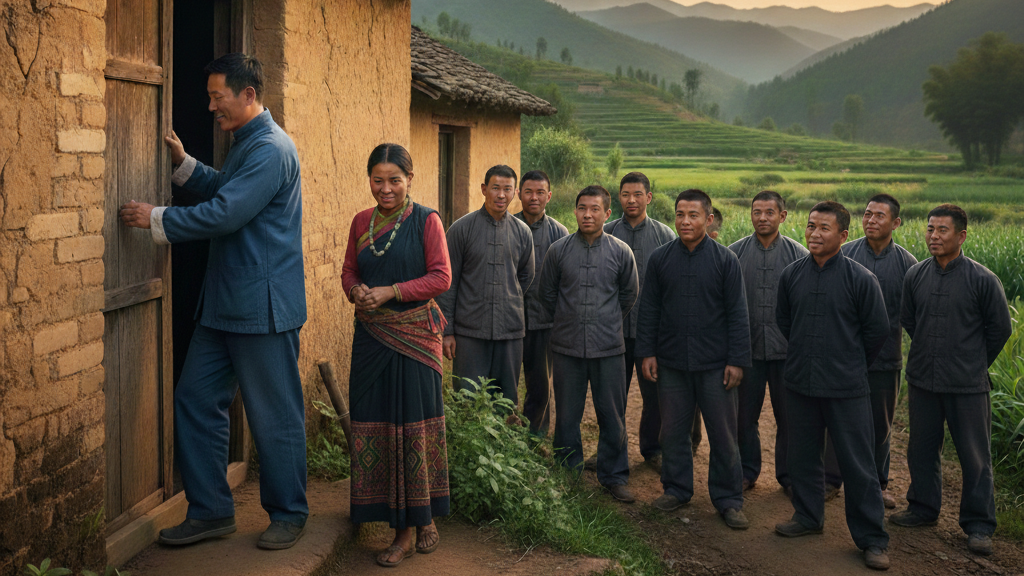
In the villages of northern China and the crowded backstreets of Kathmandu, a quiet, uneasy marketplace has been growing—one driven by China’s army of unmarried men, the so-called sheng nan (剩男, “leftover men”), and by poor Nepalese women who are being pitched, promised, and sometimes sold as brides. It is a story of demographic imbalance colliding with poverty, patriarchy, and a globalized matchmaking economy, and it has become one of Asia’s most disturbing cross-border marriage trends.
China’s marriage squeeze is not new. Decades of son preference, sex-selective abortion, and the one-child policy left the country with tens of millions more men than women. In rural provinces especially, men who fail to secure a wife are derisively called guang gun (光棍, “bare branches”), a term that suggests a family tree that will never grow. In a society where marriage is still treated as a moral duty and a social credential, being a guang gun is not just lonely—it is humiliating, economically damaging, and sometimes politically risky, because large populations of unmarried men have long been viewed as socially unstable.
At the same time, Chinese women are delaying marriage, migrating to cities, demanding higher bride prices (caili, 彩礼), and increasingly rejecting rural husbands. This has left poor men in places like Henan, Anhui, Gansu, and Sichuan with almost no options inside China. Into this void has stepped a shadowy transnational matchmaking industry that now reaches into Nepal.
Nepal sits at a fragile intersection of poverty, migration, and gender inequality. Thousands of young women from rural districts already leave for the Gulf, India, or Kathmandu to work in factories, massage parlours, restaurants, or domestic service. Brokers have discovered that they can now sell a new dream: a Chinese husband, a house, a visa, and an escape from poverty. On Facebook, WeChat, TikTok, and encrypted apps, women are advertised like products—smiling photos, height, age, “good temperament,” and sometimes even skin tone listed for potential Chinese buyers.
On the surface, some of these marriages are legal. Nepal allows foreigners to marry Nepalese citizens, and China provides spouse visas for foreign wives. When a couple genuinely meets, consents, registers their marriage, and applies for the proper documents, nothing about a Chinese man marrying a Nepalese woman is inherently illegal. Love across borders is not a crime.
But the reality of this market is often far uglier. In many cases, women are recruited by local middlemen who promise jobs or modeling work in Kathmandu, then steer them toward Chinese “husbands.” The men, often desperate and socially isolated, pay large sums—sometimes the equivalent of US$10,000 to US$20,000—to brokers who arrange introductions, visas, housing, and rapid marriages. The language used inside these networks is chillingly transactional: women are spoken of as shangpin (商品, “products”), while men are customers.
For Nepalese authorities, this has set off alarm bells. Police have raided apartments in Kathmandu where young women were living under the supervision of Chinese men or agents, sometimes on tourist visas. In several cases, the men were deported for immigration violations, while investigations continued into whether the women had been trafficked, deceived, or coerced. Nepalese NGOs working on human trafficking say that many of these women had little understanding of where they were going, what kind of marriage awaited them, or what legal rights they would have in China.
The danger for women is not just physical. Once in China, a foreign bride can become completely dependent on her husband and his family. If her documents are taken, if she does not speak Mandarin, if she is isolated in a rural village, escape becomes almost impossible. Some women report being pressured into unpaid labor, locked inside homes, or threatened with being sold again if they disobey.
Yet the tragedy is double-sided. Many of the men are not villains but victims of a system that has left them behind. They are poor farmers, factory workers, or migrant laborers who cannot afford the soaring bride prices demanded by Chinese families. To them, a Nepalese bride offered by a broker looks like their last chance at dignity, family, and social acceptance. The industry feeds on this despair.
What emerges is a brutal equation: China’s surplus men plus Nepal’s surplus poverty equals a new marriage trade. It is powered by technology, by regional inequality, and by a stubborn belief that a woman is a solution to a man’s loneliness. Behind every WeChat ad for a “Nepal bride” and every police raid in Kathmandu lies a deeper failure: of gender justice, of social policy, and of the idea that marriage should be bought rather than chosen. As long as millions of men are treated as disposable branches and millions of women are treated as exportable goods, this market will keep growing, quietly stitching together two very different kinds of desperation across the Himalayas.
Spicy Auntie has been around Asia long enough to know when something smells off, and honey, this whole “Nepal brides for China’s leftover men” business stinks like a fish market at noon. They dress it up in soft words like matchmaking, international romance, and cultural exchange, but let’s call it what it often is: a transnational shopping mall for lonely men and poor women, with patriarchy running the cash register.
I know the sheng nan (剩男, “leftover men”) story very well. China built this crisis with its own hands—decades of son worship, forced population control, and the idea that a woman’s value is to marry and reproduce. Now the bill has come due. Millions of men can’t find partners, and instead of asking hard questions about why women don’t want these marriages, society is busy looking for new bodies to plug into the gap. So what do they do? They go shopping abroad.
Enter Nepal, one of Asia’s most exploited crossroads for women. Poor, rural, undereducated, and already pushed into migration for survival, Nepalese girls are now being sold a fairy tale: a Chinese husband, a house, a future. What they’re often getting is surveillance, dependency, and sometimes outright captivity. These brokers don’t talk about love; they talk about prices, packages, and delivery. That’s not romance, darling, that’s logistics.
And don’t get me wrong—some of these marriages are real. People fall in love across borders all the time. But this system isn’t built on Tinder or poetry. It’s built on desperation on both sides, and desperation is the favorite playground of traffickers and patriarchs. When a man pays a broker to “arrange” a wife, he’s not entering a relationship; he’s buying leverage over another human being.
What really makes Auntie furious is how women are expected to solve men’s loneliness. Not therapy. Not social reform. Not teaching boys that women are not owed to them. No—import a wife. As if a Nepalese woman is a government subsidy for China’s demographic mistakes.
And the women? They carry all the risk. They cross borders, lose their language, their legal protection, their support networks. If a marriage turns abusive, where do they go? Who will help them in a Chinese village where nobody speaks Nepali and their passport is locked in a drawer?
This isn’t about East versus South Asia. It’s about a system that treats women as movable property and men as entitled consumers. Until Asia learns that a wife is not a solution to social failure, this ugly little bride market will keep expanding, one transaction at a time. And Spicy Auntie will keep calling it out, because silence is what lets this business thrive.