


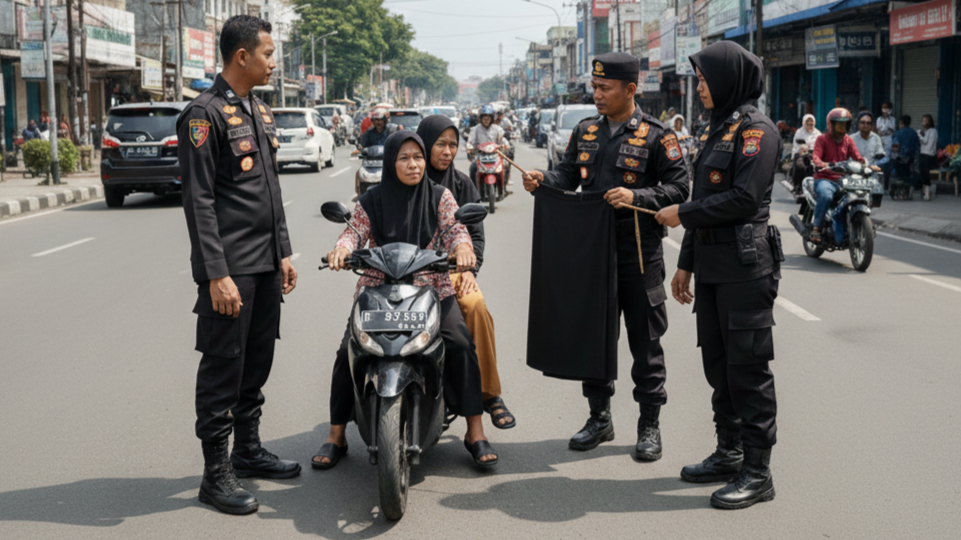
In the aura of Banda Aceh’s sultry streets at night, where the call to salat (prayer) drifts from mosque to mosque, the Wilayatul Hisbah — Aceh’s infamous Sharia patrols — carve out their own rhythms of authority. In this only Indonesian province with Islamic criminal law firmly embedded in its legal DNA, the qanun jinayat (Islamic criminal bylaws) are not just texts in a legal code; they shape the very texture of daily life for girls, women and gay people, from how they dress to where they walk and with whom. Echoing across local and international media, Aceh’s morality police continue to make headlines and stir controversy — precisely because what they patrol are not distant “crimes,” but intimate, socially charged moments that disproportionately involve female bodies and behavior.
To outsiders, these patrols might seem like characters out of a surreal drama: groups of black-beret-wearing officers — men and women — conducting raids and nighttime sweeps in search of moral transgressions. An operasi penyakit masyarakat (“public sickness operation”) in 2018 saw national police and WH team up to raid hair salons where transgender women worked, force employees to strip and have their heads shaved, and detain them for days — a moment decried by human rights groups as degrading and contrary to human dignity.
Yet the patrols are also woven into the everyday routines of girls in Aceh. A striking account captured by ABC News in Lhokseumawe described a teenage couple sitting quietly under a tree — merely “khalwat” in local parlance, meaning being alone together — and the boy fleeing while the girl is stopped and lectured by officers about proper conduct and where she should sit next time. That scene — at once pedestrian and charged — reflects how enforcement operates less on the basis of violence than on the basis of social policing: telling women how to walk, how to sit, and how to dress in ways that fit aurat (the Islamic standard of modesty).
Under qanun such as Qanun Aceh No. 6 of 2014, a range of behaviors really are illegal — khalwat (being alone with someone of the opposite sex who is not a mahram relative), ikhtilath (intimacy outside marriage), zina (adultery), gambling and alcohol consumption — with penalties including fines, imprisonment, and caning. Because these laws hinge on interpretations of behavior and conduct rather than clear criminal harms like theft or violence, women’s dress and conduct are often interpreted through subjective lenses and enforcement practices. A Human Rights Watch report found that on their face Sharia dress requirements are gender-neutral but in practice impose heavier burdens on women, with officers and even neighbors empowered to report and intervene.
Girls and women in Aceh move through this framework with caution. Women must wear jilbab (headscarves) and loose-fitting clothes in public; breaches are likely to be noted by WH patrols, whose presence in markets, restaurants, and around nightspots is ordinary. Local activists have pointed out that this system intensifies a broader gendered moral scrutiny: women are often the visible face of enforcement simply because clothes and public presence are easier to police on female bodies.
At the same time, Acehnese women do not exist outside their own cultural frameworks. For many, local norms around modesty, community honor (kehormatan), and religious piety are deeply embedded social values; the emphasis on syariah is in part an expression of that identity. For a girl walking home after ngaji (Qur’an study), or a young woman sipping teh tarik at a late café, the encounter with WH can be a negotiation between personal agency and collective expectations — a negotiation that many describe not in terms of legalism but in terms of social belonging and spiritual discipline.
Still, critics argue that the Whitaker-style morality enforcement often lacks mechanisms to ensure fairness and gender sensitivity. With laws that call for women enforcing punishments on women to avoid ikhtilat during caning, and WH’s broad supervisory role over morality, local women’s NGOs have called for more gender-responsive approaches to make policies protective rather than exclusive.
In Aceh’s evolving public sphere, the WH patrols are more than law enforcers — they are cultural brokers at the crossroads of religion, youth culture, and women’s autonomy. For girls and women navigating these streets after dusk, every step feels like a sentence — one negotiated as much in local bahasa as in the codebooks of qanun they enforce.
I’ve walked those streets in Banda Aceh. Hot, loud, humid, full of teenagers flirting over iced coffee and aunties gossiping under the neon lights. I’ve watched girls adjust their jilbab (headscarves) nervously when a black-uniformed Wilayatul Hisbah patrol slows down. You don’t need to be guilty to feel hunted. You just need to be female.
Let’s be clear about what Aceh’s Sharia police really do. They don’t “protect morality.” They discipline women’s visibility. They police who gets to sit, laugh, walk, flirt, or even exist in public space without permission. A boy runs when a patrol arrives. A girl stays. A boy gets forgotten. A girl gets lectured, recorded, shamed. That asymmetry is not accidental. It is the whole system.
Acehnese officials love to use words like pembinaan (guidance) and dakwah (moral instruction). Cute. But when guidance involves surrounding a teenage girl in a park and interrogating her about why she is sitting with a boy, it’s not education. It’s intimidation. When “moral raids” target young women’s clothes, bodies, and friendships, it’s not religion. It’s social control dressed up as piety.
What makes Aceh especially brutal is not just the law — it’s the constant uncertainty. You don’t know when your jeans are too tight, your scarf too loose, your smile too inviting, your presence too visible. You don’t know when sitting on a motorbike with someone will become khalwat (illicit closeness). You don’t know when a neighbor will decide you are too free and call the patrols. That kind of surveillance rewires a girl’s brain. It teaches her that her body is a problem to be managed, not a life to be lived.
And let’s talk about caning. Public punishment is not about justice. It is theater. It is a message sent to every girl watching: step out of line and your humiliation will be public, permanent, unforgettable. You can say “it applies to men too” until the call to prayer comes home. Women are the ones who carry honor in this system, and honor is always enforced on women’s backs.
I know Aceh has its history. I know sharia was negotiated after war and trauma. I know many Acehnese women are devout and choose modesty. But choice means nothing when it is enforced by patrols with clipboards and handcuffs.
Girls in Aceh are not asking to abandon faith. They are asking to breathe.
And until Aceh lets its daughters walk without fear of being stopped, judged, or punished for existing, this isn’t Islamic law.
It’s gendered surveillance.
And Auntie doesn’t bow to that.