


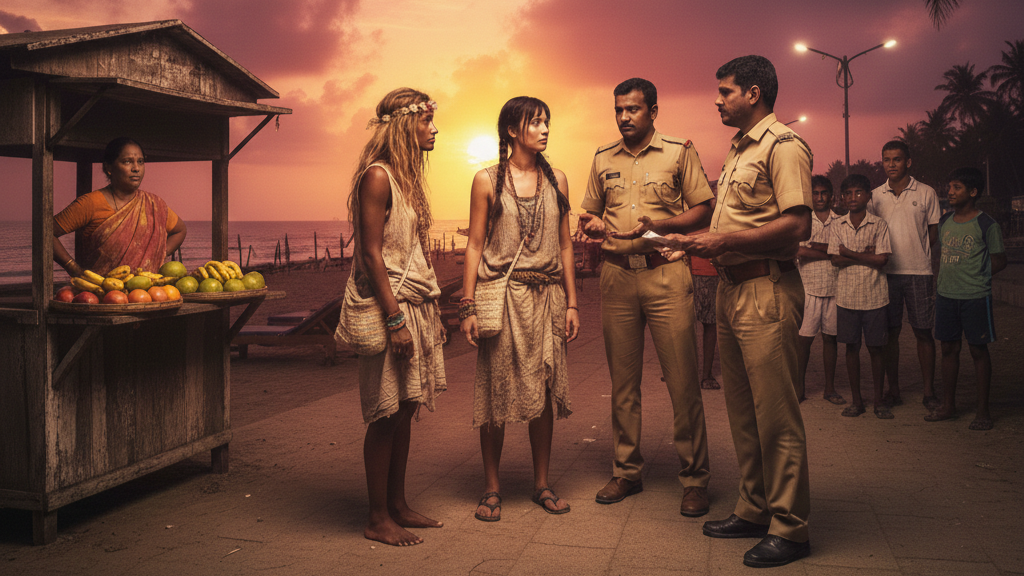
On Goa’s beaches, among the palm trees, tattoo studios, yoga shalas and psychedelic cafés, lives a generation of women who should not exist on paper. They were born to foreign hippies who arrived in Goa in the 1970s, 80s and 90s chasing spiritual freedom, drugs, music and cheap tropical living. Their mothers were German, Israeli, Russian, French or British. Their fathers were often other backpackers, DJs, dealers or drifters who disappeared. These daughters grew up barefoot on Anjuna and Arambol, speaking a mix of Konkani, English, Hebrew and Russian, but many of them have no passport, no nationality, and no legal identity. Locals call them the “hippie kids,” but among themselves they call each other something closer to ghosts.
Goa’s hippie migration was not a holiday wave. It was a settlement. Thousands of foreigners stayed, formed communes, had children with each other or with local women, and raised those children outside Indian institutions. They rejected schools, paperwork and governments as part of their anti-system philosophy. Births happened at home. Names were never registered. Fathers were not acknowledged. When embassies asked for documents, parents avoided them. Freedom was more important than legality. For their daughters, that freedom became a cage.
Many of these women are now in their twenties and thirties. They grew up in paradise but discovered adulthood requires a passport. Without one, they cannot leave India. They cannot legally work. They cannot open bank accounts. They cannot enroll in universities. Some have no Indian Aadhaar, no voter ID, no recognized nationality anywhere. They are not refugees, not migrants, not citizens — just bodies in a legal vacuum.
As women, this statelessness becomes brutally gendered. Without documents, their labor options collapse into Goa’s informal economies: dance, yoga, tattooing, fire shows, DJing, beach performances, and — very often — sex work. Tourists and party-goers assume they are foreign and therefore sexually available. Indian men approach them with the expectation of “free love.” Police treat them as illegal migrants. Pimps treat them as profitable because they cannot go to the authorities.
Many of them do not call what they do prostitution. They say they are “hostesses,” “companions,” “dancers,” or “models.” But the reality is survival sex in a tourism economy built on fantasy.
These women look foreign, sound foreign, but are rooted in Goa. They know every back road and beach. They were raised in drum circles and flea markets, not embassies. Their mothers taught them meditation and herbal medicine, not citizenship law. Now they must negotiate a world that requires visas they never had.
Some try to regularize their status through Indian courts, but the process is Kafkaesque. India does not recognize jus soli (birthright citizenship) for most of them, and their parents never registered their births with their home countries. To Germany, Israel, or Russia, they do not exist. To India, they are foreigners without proof. A few NGOs in Goa quietly try to help, but the numbers are overwhelming. Every year, more hippie daughters age into adulthood and fall through the cracks.
The psychological toll is enormous. Many suffer depression, anxiety, and addiction. Relationships are unstable. Pregnancy is terrifying because their children may inherit the same statelessness. Love becomes dangerous when you have no legal ground to stand on. And yet, these women are among the most culturally Goan people alive. They celebrate local festivals, speak Konkani, know the monsoon rhythms and temple calendars. They are as much children of Goa as anyone — but the law refuses to see them.
The hippie dream promised liberation from borders, families, patriarchy and bureaucracy. For their daughters, it delivered something much darker: a life without rights. What was once a rebellion against capitalism has become a pipeline into feminized poverty and sexual vulnerability. Goa still sells the image of eternal freedom. But hidden behind the trance music and sunset selfies is a generation of women who paid the price for other people’s utopias — women born into paradise, but trapped there forever.
Spicy Auntie has been hanging around Goa since before Instagram discovered it. I’ve danced at Anjuna full-moon parties, sat on dusty porches with women rolling joints, and listened to stories that never make it into glossy travel magazines. And let me tell you something: if you really want to understand Goa, don’t look at the beaches — look at the women who were born there and can’t leave.
The hippie daughters are not a myth. They are not some bohemian fairy tale. They are women who grew up in a fantasy created by Western adults who wanted to escape rules, taxes, and responsibility. Their parents came for “freedom,” but they forgot one tiny detail: children don’t get to choose whether they need passports.
So these girls grew up barefoot and beautiful, fluent in three languages, raised on incense and reggae, but without a single piece of paper that proves they exist. No birth certificate. No citizenship. No right to work. No right to travel. No right to complain.
And what happens when you’re a young woman in a tourist sex economy with no legal status?
You become available. Available to men who think you’re a free-spirited foreigner. Available to cops who know you can’t file a complaint, and to pimps who know you can’t walk into a police station.
Available to a system that treats undocumented female bodies like a public resource.
The hippie generation loved to talk about love and liberation. But look at the gender math. The men got adventure. The women got babies. And those babies grew up to become adult women trapped inside a paperwork black hole.
These daughters did not choose this life. They didn’t choose to be “stateless.” They didn’t choose to survive on fire dancing, tattoos, yoga tips, and sometimes sex work. They chose survival, because that’s all that was left to choose.
What makes me angry is not just their invisibility — it’s the hypocrisy. Goa makes billions selling the idea of freedom. But these women, who are the most authentic children of that so-called freedom, are treated like illegal stains on the postcard.
Spicy Auntie says this clearly: if you came here to “drop out,” your daughters are still paying the bill. And it’s a bill written on their bodies.
Paradise is cheap. Paperwork is power. And in Goa, too many women have neither.