


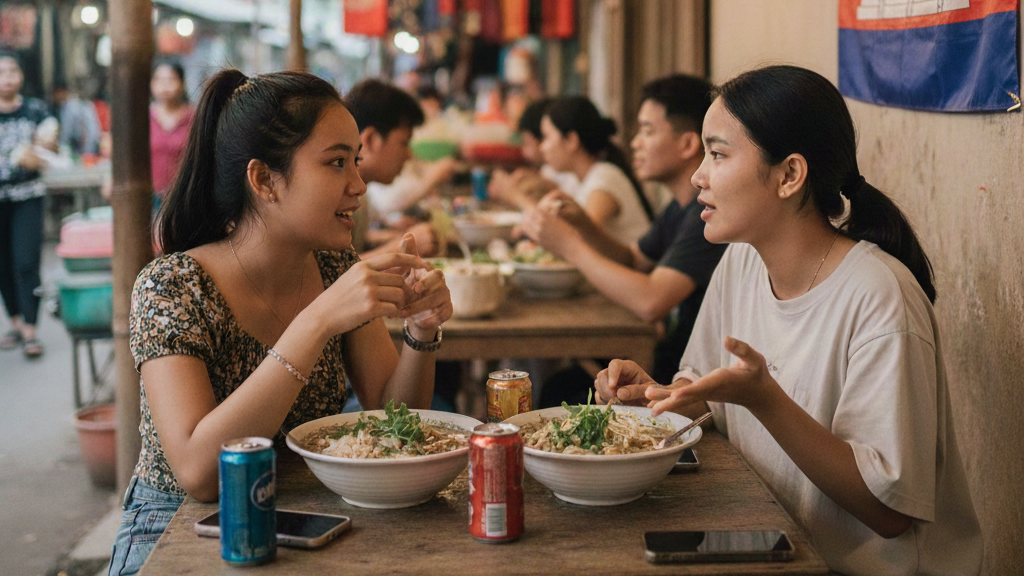
For Cambodian girls and young women growing up in today’s cities—especially Phnom Penh, Siem Reap, Battambang, and provincial capitals—virginity remains one of the most quietly powerful ideas shaping their lives. It is rarely discussed openly, often denied as “old-fashioned,” and yet constantly present as a shadow rule governing relationships, reputation, and family harmony. Unlike in some neighboring countries where public debates about sexual freedom are increasingly visible, Cambodia’s conversation about virginity unfolds mostly in whispers, jokes, warnings, and coded advice.
Formally, many young Cambodian women say virginity should not matter. Exposure to social media, Korean dramas, Thai influencers, global feminism, and sex-positive health messaging has reshaped how girls talk among themselves. In private chats, virginity is often dismissed as a myth tied to misunderstanding the female body, particularly the fixation on the hymen. Sex, many argue, should be about love, trust, consent, and emotional readiness—not a physical “proof.” Among educated urban girls, especially university students, this framing is increasingly common.
But public belief and private calculation are not the same thing. In practice, virginity in Cambodia is still deeply entangled with ideas of female respectability, marriageability, and family honor. The moral code traditionally taught to girls—rooted in expectations of obedience, modesty, and sexual restraint—has not disappeared. It has simply become less explicit. Parents may no longer lecture openly about virginity, but warnings are embedded in phrases about “protecting yourself,” “not ruining your future,” or “thinking of your family.” The message is understood.
This produces a distinctive form of sexual caution. Many Cambodian girls navigate relationships with intense secrecy. Dating is hidden from parents. Sexual experience, if it happens, is rarely disclosed honestly to family members and often selectively disclosed to partners. Social media becomes a high-risk space: photos, captions, and locations are curated to avoid gossip or moral judgment. The fear is not just parental disapproval, but reputational damage that can travel quickly through social networks, workplaces, or neighborhoods.
Gender double standards are widely recognized and frequently resented. Young women commonly point out that boys are allowed curiosity and experimentation, while girls are expected to remain “clean.” A man’s sexual past is often treated as irrelevant or even impressive; a woman’s can be weaponized against her in arguments, breakups, or marriage negotiations. This double standard is not always enforced loudly, but it is deeply internalized, shaping how girls assess risk long before they assess desire.
Economic and social dependence reinforce this dynamic. Many urban Cambodian girls still rely on family support well into adulthood, especially during university or early employment. Housing independence is rare, wages are low, and marriage remains a key route to social security. In this context, virginity becomes less a personal belief than a bargaining chip—something to protect because others may demand it later. Even girls who reject virginity as a moral concept often feel compelled to manage it as a social asset.
Religion adds another layer, though often indirectly. Buddhist values emphasizing female modesty and self-restraint blend with cultural expectations rather than explicit religious rules. Unlike strict legal or doctrinal enforcement, the pressure is social: the fear of shame, gossip, and being labeled “not a good girl.” Virginity is less about sin than about status.
What is changing, however, is how Cambodian girls talk to each other. Peer conversations are increasingly honest, supportive, and pragmatic. Advice centers on contraception, emotional safety, and how to recognize controlling behavior. There is growing skepticism toward men who demand virginity while offering no commitment or respect in return. Many young women articulate a clear sense of injustice: if virginity matters so much, why does it only matter for us?
The result is a generation living between two moral systems. Outwardly, many Cambodian girls still perform modesty and restraint. Inwardly, they question the logic, fairness, and cost of those expectations. Virginity has not vanished from Cambodian society, but its meaning is shifting. It is no longer a sacred ideal universally embraced, nor a rule easily enforced. Instead, it has become a site of negotiation—between desire and duty, modernity and survival, silence and self-definition.
For Cambodia’s urban young women, the real struggle is not about whether virginity matters. It is about how much of their future should be shaped by a standard that asks them to carry far more than their share.
Spicy Auntie here, leaning back in her red chair with a chili-pepper necklace clinking, watching another generation of Cambodian girls being handed the same dusty script their mothers were given, just wrapped in better Wi-Fi. Virginity, darling, is still treated like a fragile porcelain teacup—one crack and suddenly everyone says you’re “ruined.” Funny how that teacup only ever belongs to girls.
I’ve been in Phnom Penh long enough to see how this works. The girls know the theory. They’ve read the posts, watched the TikToks, heard the feminist lines about hymens not being doors and sex not being a moral scoreboard. They believe it, mostly. And yet, when it comes to their own lives, they whisper. They hide boyfriends. They erase messages. They lie to their parents, and sometimes to themselves, because reputation in Cambodia is a currency you cannot afford to lose.
Here’s the cruel little trick society plays: it tells girls they are free now, modern now, empowered now—but it keeps the punishment system exactly the same. Lose your virginity and nothing changes for boys. For girls? Suddenly you are risky, suspicious, less “wife material.” Even the sweetest, softest, most progressive man may quietly want a woman with “no past,” while proudly dragging his own behind him like a suitcase full of ex-girlfriends.
And let me say this clearly, in my Auntie voice: that is not tradition. That is hypocrisy wearing incense.
Cambodian girls are not stupid. They see it. They joke about it. They complain about it in group chats at 1 a.m. They know virginity is being used as leverage—by families, by lovers, by a whole marriage market that still wants women to arrive unmarked, like unopened goods. So they do what women have always done when systems are unfair: they adapt. They become careful, clever, discreet. They protect their hearts, their bodies, and their futures as best they can in a world that wants to judge them for all three.
What breaks my heart is not that girls are having sex. What breaks my heart is that so many feel they must be afraid of it. Afraid of being seen. Afraid of being talked about. Afraid that one intimate choice will follow them like a shadow forever.
So here’s my wish for Cambodia’s daughters: may you get to decide what your body means, not your neighbors, not your aunties, not some boyfriend with fragile pride. Virginity is not your value. You are not a glass cup. You are a whole, complicated, magnificent human being—and you deserve love, pleasure, and respect in any order you choose.