


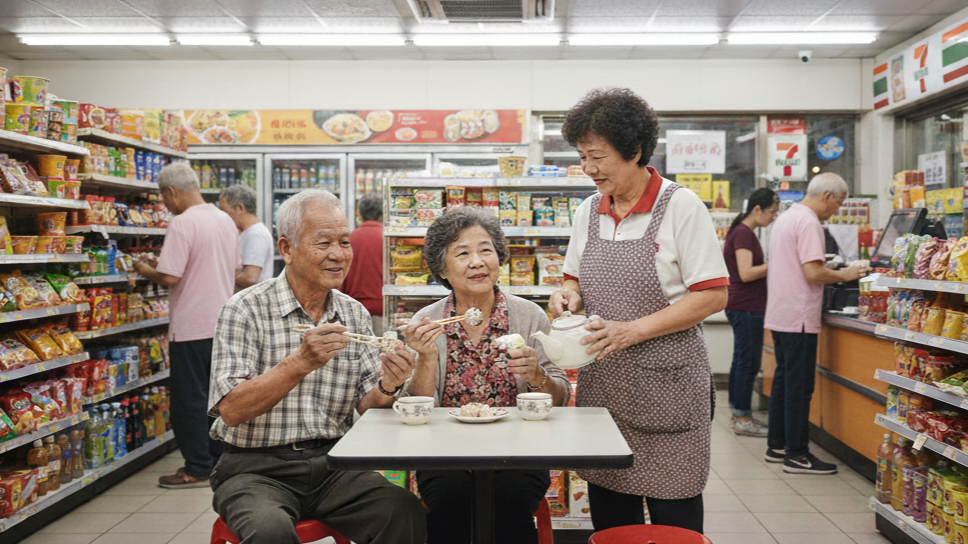
Taiwan’s transformation into a super-aged society isn’t just a statistic — it’s a seismic shift reshaping everyday life, culture, and the very rhythm of the island’s future. In 2025, for the first time in its history, more than one in five Taiwanese residents was age 65 or older, crossing the World Health Organization’s threshold for a super-aged society — where 20 % or more of the population is 65+ — a milestone few nations reach so quickly.
At the end of December 2025, government data showed Taiwan’s total population stood at roughly 23.3 million, with 4.67 million seniors, or 20.06 %, aged 65 and older. Meanwhile, children under 14 comprised just about 11.5 % of the population. This demographic reality — high longevity paired with a record-low birth rate of around 107,800 newborns in 2025 — signals deep structural change: Taiwan isn’t just aging (老化 society — lǎo huà shè huì); it is becoming gray at an unprecedented pace.
Why does this matter so much? The answer lies in how age shapes the fabric of society. In Mandarin, the term “高齡社會” (gāo líng shè huì) refers to an aged society, and “超高齡社會” (chāo gāo líng shè huì) refers to a super-aged society. These aren’t abstract labels: they reflect changing family roles, economic pressures on health care and pensions, and even shifts in how cities and neighbourhoods are designed. Taiwan entered its first defined stage of aging back in 1993 when people 65+ made up 7 % of the population. It became an aged society in 2018 at 14 %. Now, just seven years later, it has crossed the 20 % barrier into super-aged status — one of the fastest transitions in the world.
The cultural context makes this demographic shift particularly poignant. Traditional East Asian values like 孝順 (xiàoshùn) — filial piety, the deep-rooted expectation that children care for their elders — are woven into Taiwan’s social fabric. Historically, Taiwanese families lived in extended households where grandparents played key roles in family life and childcare. But today, rapid urbanization and shifting societal norms mean many young adults move to cities for work, leaving aging parents in rural towns or living alone in cities like Taipei, Kaohsiung, and Tainan — which now report varying senior proportions.
These demographic trends aren’t just numbers; they reverberate through daily life and policy. An aging workforce affects everything from productivity to consumer markets, while 子女 (zǐ nǚ) — children — often face the challenge of balancing careers with elder caregiving. Taiwan’s government has responded with programs aimed at 健康老化 (healthy ageing) and 長照 (long-term care) support, but resources and infrastructure are constantly under strain. Hospitals, community centres, and pension systems are feeling the pressure — a familiar story for other East Asian societies such as Japan and South Korea, which have already confronted similar ageing dynamics.
Yet Taiwan’s situation has its own texture. Many communities have mobilized 社區互助 (community support) networks where neighbours coordinate care and elder companions — echoing 鄰里精神 (neighbourhood spirit). Multigenerational housing has evolved into a diversified mosaic of living arrangements, as extended families mingle with singles, 新住民 (new immigrants), and ageing couples. Moreover, the rise in migrant caregivers — known locally as 外勞 (wàiláo) — highlights how cross-cultural labor flows intersect with aging challenges, especially as more foreign workers help fill gaps in elder care.
Looking ahead, some analysts suggest that by 2034 nearly half the population might be age 50 or older, compounding pressures on healthcare, housing, and the economy. Yet there is also innovation — from rural 長者學習班 (senior learning clubs) to city-wide initiatives that integrate technology with elder-friendly design. Taiwanese culture, renowned for its resilience and adaptability, continues to weave respect for elders with solutions tailored to 21st-century realities.
In Taiwan today, living longer should be a source of pride and purpose — not merely a demographic statistic. As the island navigates its journey, how it honors its elders while nurturing the next generation will define not just its future, but a new model for aging societies everywhere.
Spicy Auntie here, stirring the silver soup and finding it a little too thin for comfort. Everyone is suddenly whispering about Taiwan becoming “super-aged,” as if one morning the island woke up wrinkled and wearing compression socks. Darling, ageing didn’t sneak in through the back door. It marched in years ago, politely, with a gift of longevity, and nobody bothered to plan where it would sit.
Here’s the truth nobody likes to say out loud: Taiwan didn’t just get old, it got lonely. When a society has more grandparents than grandchildren, something fundamental changes. Streets feel quieter, playgrounds emptier, and the future suddenly sounds like the soft tick of a hospital clock. In Mandarin they call it 超高齡社會 (chāo gāo líng shè huì), which sounds very official and very calm, but behind those neat characters is a whole generation wondering who will hold their hand when they can no longer hold a smartphone.
I see it every time I walk through an East Asian city. Elderly couples shuffling into 7-Elevens for dinner, one rice ball, one tea, sharing because it’s cheaper and because conversation has become their most precious luxury. Filial piety, 孝順 (xiàoshùn), is still preached, but love can’t be outsourced to an app, and adult children can’t magically appear in two places at once. Taiwan’s young people are working insane hours, drowning in housing prices, and quietly choosing not to have kids because survival already feels like a full-time job.
And let’s talk about women, because it’s always women who end up carrying the emotional and physical weight of ageing societies. Wives, daughters, daughters-in-law — the unpaid care economy humming away in the background like a tired old fridge. Migrant caregivers come in, bless them, holding up a system that pretends it isn’t dependent on their invisible labor. Meanwhile, politicians hold press conferences and call it “a demographic challenge,” as if loneliness were a spreadsheet error.
But here’s the spicy part: a super-aged society doesn’t have to be a sad one. It could be a sexy one. Imagine a Taiwan where elders aren’t parked in front of televisions but dancing, flirting, studying, loving, living. Where ageing means becoming more interesting, not more disposable. Where intergenerational housing, shared kitchens, and community cafés replace sterile isolation. Where we stop pretending that youth is the only thing worth investing in.
So no, I’m not afraid of super-aged Taiwan. I’m afraid of a society that grows old without growing kinder, braver, and more imaginative. Ageing is inevitable, darling. Indifference is not.