


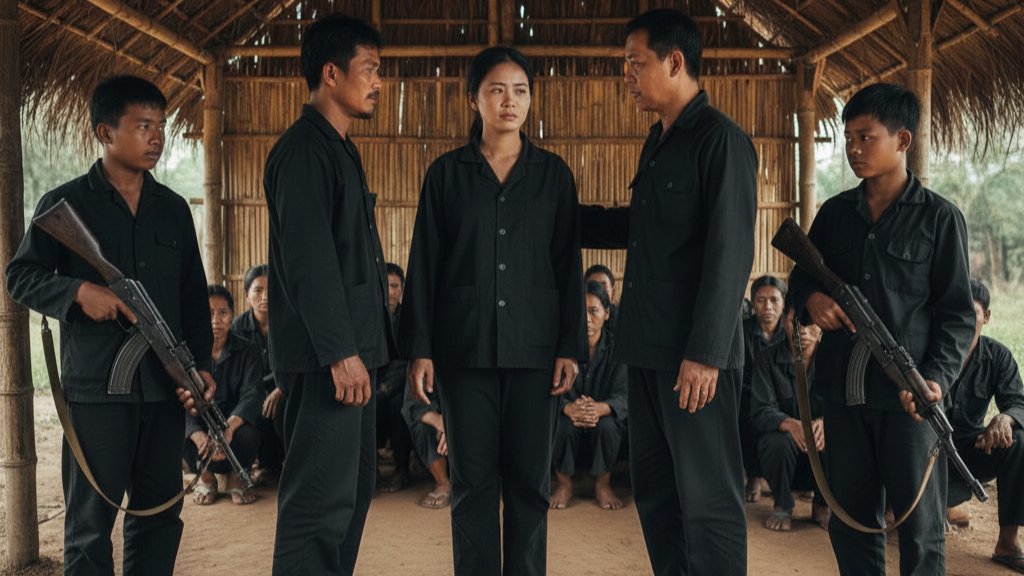
In the killing fields of Democratic Kampuchea, love was not merely discouraged—it was reorganized, commanded, and often violently imposed. Forced marriage under the Khmer Rouge remains one of the least visible yet most devastating forms of mass abuse in Cambodia’s modern history, entwining sexual violence, ideological control, and lifelong trauma. Between 1975 and 1979, thousands of young men and women were ordered to marry strangers in ceremonies stripped of joy, family, or consent, turning one of Khmer culture’s most sacred social bonds into a tool of terror and obedience.
Under the rule of Khmer Rouge, marriage became the business of Angkar (អង្គការ, “the Organization”), the shadowy authority that governed every aspect of life. Traditional courtship, parental involvement, astrology, and Buddhist rituals were dismissed as bourgeois relics. Instead, cadres summoned selected men and women—often exhausted teenage laborers—to mass weddings held after long workdays. Survivors recall being lined up, sometimes dozens of couples at once, told simply to agree. “They said, ‘Angkar has chosen for you. You must marry tonight,’” one woman later testified. “I had never spoken to the man beside me. I was too afraid to look at his face.”
Refusal was rarely an option. To resist Angkar was to invite punishment, re-education, or worse. Many survivors describe saying “yes” out of fear rather than consent. “I thought if I said no, I would disappear,” another survivor recalled in court testimony decades later. “So I bowed my head and followed the order.” The Khmer phrase kar plich chet (ការបង្ខិតបង្ខំ, “coercion”) is now frequently used by survivors to describe these unions, though at the time there was no language to resist what felt absolute.
The violence did not end with the ceremony. Many couples were explicitly instructed to consummate the marriage, sometimes under threat, sometimes under surveillance. Several women told the tribunal that guards checked whether couples slept together, asking blunt questions the next morning. “They said we had to prove loyalty by becoming husband and wife,” one woman testified. “I cried the whole night. I did not want him, but I was more afraid of Angkar.” For many, forced marriage became inseparable from rape, though survivors often struggled for years to name it as such, given the regime’s claim that sex was a patriotic duty.
Men, too, were victims of this system, compelled into marriages they did not choose, expected to perform sexually on command, and punished if deemed uncooperative. Yet women bore the heaviest burden, facing pregnancy, childbirth without medical care, and lifelong stigma. Some children born of these unions grew up sensing the silence surrounding their parents’ relationship, a silence shaped by shame, grief, and unresolved trauma.
What makes forced marriage under the Khmer Rouge particularly haunting is its afterlife. When the regime collapsed in 1979, survivors were left to navigate marriages forged in terror. Some stayed together out of necessity, habit, or shared survival. Others separated quietly, without language or legal mechanisms to explain why the marriage had never truly existed. “We lived together, but there was no love,” one survivor later said. “Only survival. Even now, my body remembers that fear.”
It was not until decades later that these experiences were formally recognized as crimes. At the Extraordinary Chambers in the Courts of Cambodia, forced marriage and the sexual violence associated with it were prosecuted as crimes against humanity. For many survivors, testifying was the first time they spoke aloud about what had happened. “I carried this pain inside me for forty years,” one woman told the judges. “I want the world to know this was not marriage.”
Today, forced marriage under the Khmer Rouge is increasingly understood not as a private tragedy but as a deliberate political strategy: an attempt to control reproduction, loyalty, and intimacy by breaking the Khmer family from within. In a culture where marriage once symbolized harmony between families, ancestors, and community, Angkar transformed it into an instrument of domination. Remembering these stories is not only about justice for survivors; it is about reclaiming the meaning of consent, dignity, and love from a period when even the most intimate human choices were stolen by fear.
Spicy Auntie here. Sit down. We need to talk about something that still makes my chest tighten every time I hear survivors speak.
Forced marriage under the Khmer Rouge wasn’t some tragic “byproduct of war.” It was policy. Planned. Organized. Executed with clipboards, whistles, and threats. And yes, I’m going to say it plainly: it was state-sanctioned sexual violence wrapped in the costume of marriage.
I have sat with Cambodian women—now grandmothers—who still cannot say the word “husband” without pausing. They tell you they were “married,” but their eyes tell a different story. No choice. No courtship. No aunties negotiating gifts, no monks, no blessings. Just Angkar pointing a finger and saying: you, you, tonight. Smile or disappear.
And let’s destroy one lie right now: this wasn’t about tradition. Khmer culture values marriage deeply—too deeply for this cruelty to be mistaken as custom. This was about control. About breaking family bonds so loyalty flowed upward, not sideways. About teaching young bodies that even desire belonged to the state.
What stays with me is how long the silence lasted. After 1979, Cambodia was busy surviving. There was no language for marital rape. No space to say, “I was married but violated.” Many women stayed with the men they were forced to marry because leaving felt dangerous, shameful, or impossible. Trauma doesn’t politely pack its bags when a regime collapses.
And let’s be clear: men suffered too. Forced into marriages they didn’t choose, expected to perform intimacy on command, punished if they hesitated. But women paid a heavier price—pregnancy, childbirth without care, lifelong stigma, bodies that learned fear instead of tenderness.
When the tribunal finally named forced marriage as a crime against humanity, it wasn’t just a legal moment. It was linguistic liberation. Survivors could finally say: this was not love, this was not duty, this was violence. Naming matters. Naming cracks open silence.
I get angry when people say, “Why dig up the past?” Because the past isn’t buried. It’s living in bodies, in marriages that began with terror, in children born into silence, in a society still learning how to talk about consent. Forced marriage under the Khmer Rouge teaches us something brutal and essential: when the state controls intimacy, the damage lasts generations.
So no, this isn’t just Cambodian history. It’s a warning. Anytime power tells you who to love, when to marry, or how to use your body “for the greater good,” run. Or fight. Or both.
Spicy Auntie out—but not done talking.