


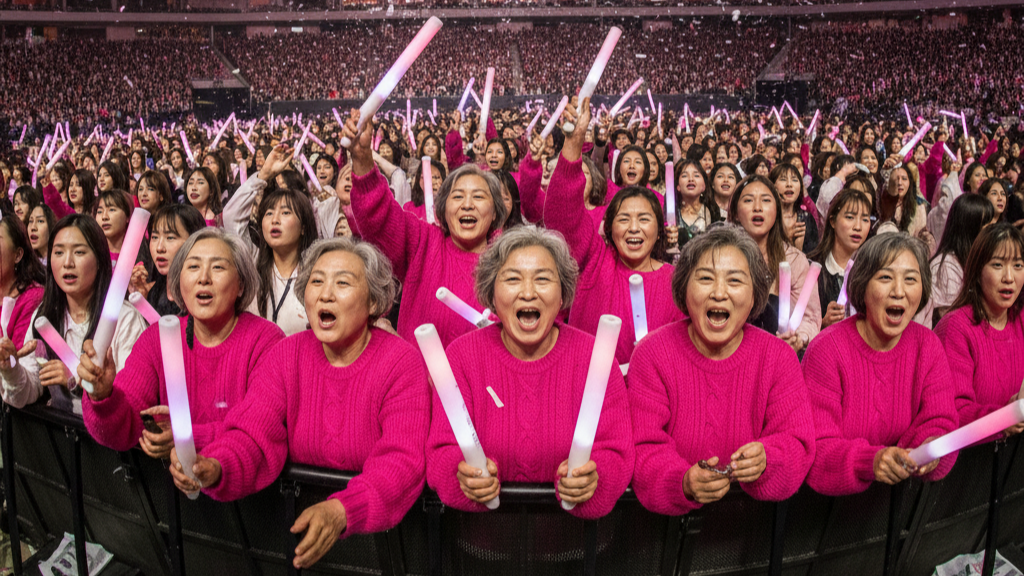
South Korea’s loudest fans are not teenage girls—they are women in their 40s, 50s, and 60s, waving banners, buying subway ads, and filling stadiums with unapologetic joy. Often dismissed as 아줌마 팬 (ajumma paen, “auntie fans”) or softened into 누나 팬 (noona paen, “older sister fans”), older female fans are quietly rewriting the rules of Korean pop culture, proving that passion, desire, and spending power do not expire with age.
The face most often associated with this shift is Lim Young-woong, the soft-spoken star of Korea’s trot revival whose fandom, 영웅시대 (Yeong-ung sidae, “Hero Generation”), is dominated by middle-aged and older women. Recent concerts and televised appearances have again shown seas of coordinated scarves and light sticks, fans traveling in chartered buses, and audiences that look nothing like the stereotype of pop hysteria. Business and culture reporters have repeatedly noted that his sold-out shows, premium ticket prices, and relentless advertising presence are powered by women who spent decades prioritizing families and careers before deciding—often for the first time—to spend freely on themselves.
Language matters here. Noona suggests warmth and intimacy; ajumma can carry a sting, implying someone loud, unfashionable, or socially excessive. Yet many fans reclaim the term with defiance. “They call us ajummas, but we are the ones filling the seats,” one woman in her 50s said in a line echoed across Korean media. In a society that expects women’s public enthusiasm to shrink with age, fandom becomes an act of resistance as much as devotion.
What sets older female fandom apart is not only its size but its structure. These women do not merely attend concerts; they organize campaigns with military precision. Subway stations bloom with birthday ads, buses roll through Seoul wrapped in LED praise, and cafés host fan-funded events timed to album releases or TV appearances. “Buying an ad isn’t about showing off—it’s our way of saying thank you in public,” a fan organizer explained. Younger fans dominate hashtags, but older fans insist on occupying physical space. “A subway ad feels permanent,” another said. “It says this support is serious.”
Streaming, often assumed to belong to the young, has also been absorbed into older fandom culture. Fan cafés circulate step-by-step guides explaining platforms, devices, and viewing schedules. For retirees or women whose children have grown, streaming offers routine and collective purpose. “Streaming gave my day structure after retirement,” one longtime fan said. “Learning how to stream made me feel younger—I was proud of myself.” This is fandom as 진지한 여가 (jinjihan yeoga, “serious leisure”)—time-consuming, skill-based, and deeply social.
Donation culture is where older fans most clearly distinguish themselves. Many fandoms emphasize 기부 문화 (gibu munhwa, donation culture), contributing under an idol’s name to hospitals, disaster relief, or child welfare organizations. This is partly strategic: in a culture quick to shame older women’s enthusiasm, charity reframes fandom as socially valuable. “We don’t just consume—we give back,” is a familiar refrain. “Charity turns love into something useful.” It also aligns with lives shaped by caregiving, where affection is expressed through provision.
Travel may be the most emotionally charged aspect of all. Group trips to concerts and broadcasts are described as transformative, even liberating. “This is the first time I travel just for myself,” one woman said. “I raised children for decades—now I follow my own schedule.” On these journeys, age hierarchies soften. Women who feel invisible in everyday life become visible, vocal, and central. “On those trips, age disappears,” another fan reflected. “It feels like a school excursion we never had.”
While trot fandom makes the phenomenon impossible to ignore, similar patterns appear around veteran actors and audition-show winners such as those emerging from Mr Trot, whose broadcasts routinely draw massive middle-aged audiences. Korean media over the past year has increasingly framed these women as a “silver market” with real influence—one capable of shaping programming decisions, advertising strategies, and even venue choices. Stadiums once reserved for sports now fill with women who had never attended a concert before fandom gave them a reason.
At heart, the rise of ajumma and noona fans is not really about idols. It is about permission—permission to feel excitement, devotion, and desire without apology. “I’m not embarrassing,” one fan said simply. “I’m happy.” In a country where men can follow football clubs for life without comment, the visibility of older female fans forces an uncomfortable but necessary question: why should women ever be expected to stop loving loudly?
Yes! The revenge of the Korean aunties! Finally, a plot twist I can fully get behind—and trust me, Auntie has watched enough K-dramas to know a satisfying reversal when she sees one.
For decades, Korean women were told to quiet down with age. Be practical. Be invisible. Be grateful. Raise the kids, support the husband, keep your feelings tidy and your desires well hidden, preferably behind beige cardigans and sensible shoes. And now? Now those same women are waving banners in stadiums, buying subway ads that cost more than their first apartments, and screaming lyrics louder than teenagers with better Wi-Fi.
People call them ajumma fans with a smirk, as if joy after forty is a clerical error. But look closer. These aunties are organized. Strategic. Relentless. They don’t just love quietly—they fund, promote, stream, donate, travel, coordinate. They don’t trend for five minutes and disappear. They build empires with group chats, spreadsheets, and matching scarves.
This is not hysteria. This is delayed gratification.
These women waited. They waited through unpaid emotional labor, through marriages that aged them faster than wine, through careers where they were indispensable but invisible. And now that life has finally loosened its grip, they are spending their time, money, and devotion exactly where they want. Not on husbands who never noticed. Not on bosses who never promoted. On something that gives them pleasure, community, and a reason to wake up excited.
And oh, how society hates that.
A man follows a football club until death and it’s called loyalty. A woman follows a singer in her 50s and it’s called embarrassing. Funny how that works. When aunties scream, it’s “cringe.” When they cry, it’s “too much.” When they organize donations and charities, suddenly everyone wants to call it “respectable fandom.” As if women need moral permission to enjoy themselves.
What I love most? These aunties are not asking to be cool. They are not begging for youth’s approval. They are not pretending this is ironic. They are serious. They are happy. They are loud. They are seen.
This is not just fandom—it’s reclamation. Reclaiming desire without apology. Reclaiming public space. Reclaiming the right to be ridiculous, romantic, devoted, excessive.
So yes, let them take over the stadiums. Let them plaster the subways with love letters. Let them travel in noisy buses and scream until their throats hurt. Let them love loudly, visibly, expensively.
Because the real scandal isn’t Korean aunties enjoying themselves.
The real scandal is how long it took them to be allowed to.