


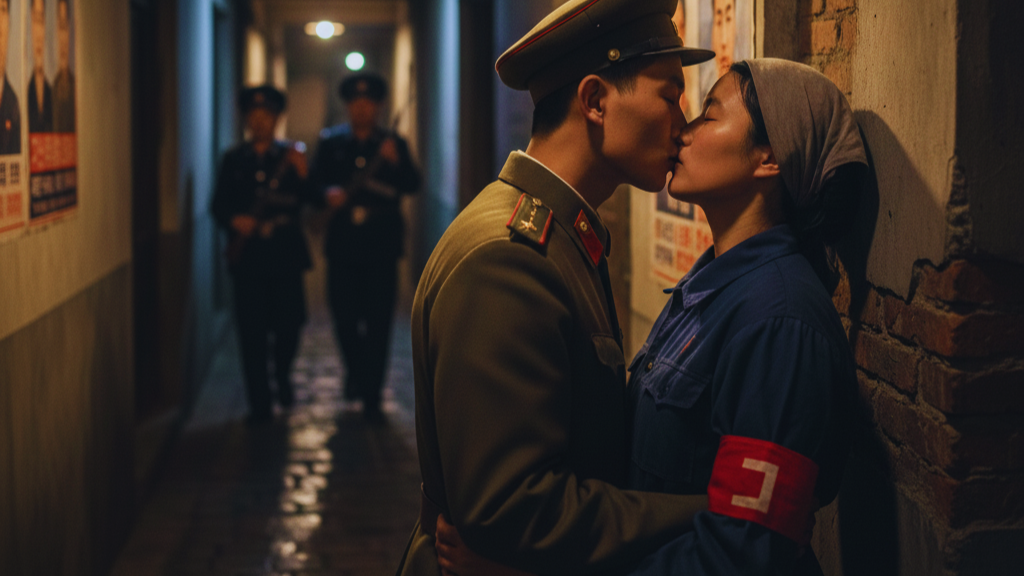
Sex in North Korea exists in a narrow corridor between silence and control, where intimacy is not simply private but political, and desire is expected to serve the state before the self. In a country where ideology regulates haircuts, music, and wedding ceremonies, sex-related norms are shaped less by religion or tradition than by the demands of a rigid socialist morality. Dating, premarital relationships, homosexuality, and sexual expression are all filtered through a single lens: whether they reinforce or threaten the “socialist lifestyle” (사회주의적 생활양식, sahoejuui-jeok saenghwal yangsik).
Officially, romantic relationships are treated as a potential disruption to discipline and productivity, especially among students, soldiers, and factory workers. Dating is not framed as a normal phase of youth but as a distraction that can weaken collective focus. In schools and workplaces, romantic involvement has long been discouraged and, when discovered, punished through criticism sessions, warnings, or administrative sanctions. Public displays of affection are rare not because of shyness but because visibility invites scrutiny. Love, when tolerated, is meant to move efficiently toward marriage, ideally at a socially approved age and with institutional approval.
Marriage itself is presented as a civic duty rather than a personal milestone. The state promotes heterosexual marriage as the foundation of socialist family life, with official family law setting minimum marriage ages and framing the household as a unit of production, loyalty, and reproduction. In recent years, authorities have gone further, policing not only who marries whom, but how. Under laws targeting “non-socialist” behavior, even wedding styles influenced by South Korean dramas—white gowns, elaborate photo shoots, romantic music—are being criticized as “exotic” or “decadent” (퇴폐적, toepaejeok), suggesting that love must look socialist as well as feel socialist.
Premarital sex occupies an ambiguous but dangerous space. While no widely accessible statute explicitly criminalizes sex before marriage, unwed pregnancy and cohabitation are heavily stigmatized and often punished indirectly. Women, in particular, bear the brunt of this moral enforcement, facing social shaming, workplace penalties, or worse if their sexual lives fall outside the approved narrative. In a system where morality is enforced through broad and flexible charges like “anti-socialist behavior” (반사회주의적 행위, ban-sahoejuui-jeok haengwi), the absence of a clear law does not mean safety. It means uncertainty.
Homosexuality is even more invisible. North Korean law does not publicly articulate a clear ban on same-sex relations, but it also offers no recognition, protection, or language for LGBTQ lives. Same-sex relationships are absent from official discourse, and marriage is strictly heterosexual in practice. In such an environment, queerness is not debated; it is erased. People suspected of same-sex relationships can be targeted under obscenity laws, moral offenses, or ideological violations, making sexuality itself a potential security issue rather than an identity.
Sexual expression outside reproduction and marriage is explicitly criminalized when it takes material form. The regime’s campaign against “reactionary ideology and culture” has banned pornographic videos, images, and recordings outright. Possession or distribution of such material is framed not merely as moral corruption but as ideological treason, especially when linked to foreign media. South Korean films, dramas, and pop culture—often saturated with romance and sexual suggestion—are treated as especially dangerous, accused of rotting youth values and weakening loyalty to the state.
Culturally, this severe moral framework draws less from Confucian modesty than from revolutionary discipline. Traditional Korean values around restraint and family hierarchy are selectively invoked, but always subordinated to loyalty to the leadership and the collective. Sex is not sinful in a religious sense; it is suspect when it becomes individualistic, pleasurable, or expressive. Desire that points inward rather than upward—to the Party, the nation, the leader—is treated as a form of dissent.
Yet beneath the official silence, realities are shifting. Defector testimonies and outside reporting suggest that marketization, mobile phones, and smuggled media have altered how young North Koreans think about love and sex. Still, officially, the message remains stark. In North Korea, sex is acceptable only when it is disciplined, reproductive, and invisible. Anything else—romance for romance’s sake, queer desire, erotic curiosity—exists not just outside the law, but outside the story the state allows itself to tell.
Spicy Auntie here, pouring tea and side-eye at the same time, because if there is one thing authoritarian systems fear more than dissent, it’s desire that doesn’t ask permission. North Korea’s rules about sex aren’t really about sex. They’re about control—over bodies, over time, over imagination. When a state wants to manage how you fall in love, who you touch, and what fantasies you’re allowed to have, that’s not morality. That’s ownership.
Let’s be clear: nobody wakes up thinking, “Ah yes, today I will overthrow the revolution by holding hands.” But in Pyongyang logic, intimacy is suspicious. Dating is framed as a distraction. Pleasure is treated like an infection. Love is acceptable only if it marches in step, gets married on cue, produces children on schedule, and never looks sideways at anything foreign, queer, or inconveniently joyful. Romance must be efficient. Sex must be silent. Desire must be invisible.
What always strikes me is how profoundly unsexy this obsession with “socialist morality” is. The state wants sex stripped of curiosity, experimentation, or choice. No flirting that lingers. No bodies that wander. No identities that don’t fit into a neat man-woman-marriage box. And homosexuality? Not even condemned loudly—just erased, which is often worse. Silence can be the most violent policy of all.
Women, of course, pay the highest price. When premarital sex becomes a moral stain rather than a shared experience, it’s women who are shamed, punished, or quietly disappeared from opportunity. When unwed pregnancy is treated as a social failure, it’s women who carry the consequences—in their bodies, reputations, and futures. Patriarchy doesn’t need religion to thrive. Give it a uniform and a slogan, and it will do just fine.
And then there’s porn. Banned not because it objectifies bodies—oh no—but because it reminds people that pleasure can exist without the state’s approval. That’s the real threat. Not nudity. Not sex. But the idea that desire can be personal, messy, selfish, and still human.
Here’s the thing Auntie knows, whether you live in Seoul, Phnom Penh, or Pyongyang: you can police behavior, but you cannot fully police longing. People will still fall in love in whispers. They will still desire in the dark. They will still imagine lives larger than the ones assigned to them.
Sex, when freely chosen, is not a danger to society. It’s a reminder that bodies belong to themselves. And that, my dears, is exactly why authoritarian systems are so afraid of it.