


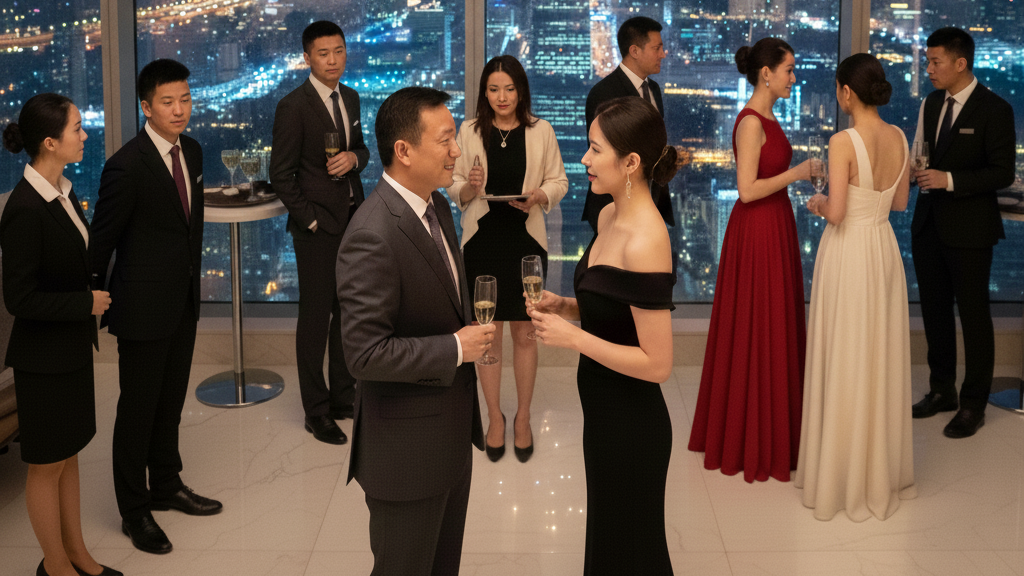
Behind closed doors in five-star hotels, private clubs and discreet restaurants, a very specific kind of dating scene is thriving in urban China: high-class matchmaking events where wealth is verified, beauty is curated, and romance unfolds under the careful supervision of professional brokers. Often described bluntly as gatherings for “rich men and pretty women,” these elite mixers and audition-style blind date sessions have become a striking feature of China’s contemporary marriage market, blending old ideas about status with new forms of spectacle, screening and social pressure.
At first glance, these events look like refined cocktail parties. Men in tailored suits exchange polite smiles with women in elegant dresses, champagne glasses clink softly, and conversations revolve around travel, education and lifestyle. But entry into the room has already required far more than charm. For elite wealth-verified mixers, proof of assets is the real ticket. Organisers routinely ask male participants to submit documentation showing ownership of companies, properties, investment portfolios or bank balances reaching tens of millions of yuan. This process reflects a deeply rooted belief in men dang hu dui (门当户对, “matching social and economic status”), a traditional idea that marriage should unite families of comparable standing. In today’s urban China, that logic has been streamlined into spreadsheets and background checks.
One of the most frequently cited examples is Beijing-based Dachao Matchmaking, which specialises in high-net-worth singles. Its events typically attract entrepreneurs, investors and senior executives, many of them self-made and acutely aware of the value of time. Women, who often attend for free, are selected through interviews that quietly assess age, appearance, education and family background. While organisers insist they are facilitating serious long-term relationships, the gendered criteria are hard to ignore: men’s worth is measured largely in assets, women’s in youth, attractiveness and social polish. This asymmetry mirrors persistent expectations embedded in the phrase nan zhu wai, nü zhu nei (男主外,女主内, “men handle the outside world, women the inside”), even as participants themselves are often highly educated and professionally accomplished.
If wealth-verified mixers are controlled and discreet, high-profile blind date sessions take the same logic and turn it into a competitive performance. These events, staged periodically in cities such as Wuhan, operate more like auditions than parties. Thousands of women may apply online, submitting photos, personal profiles and videos, only for a few dozen to be shortlisted after rounds of screening. The final stage often unfolds on a stage or in front of panels, where participants introduce themselves, demonstrate talents or answer questions designed to showcase personality and poise. Men, whose applications emphasise net worth, business success and qingjia (清家, a “clean” marital and legal status), observe, select and sometimes interact directly.
The spectacle element is central. These sessions draw attention precisely because they dramatise what is usually private: the evaluation of marriageability. In some past iterations, reports of women presenting certificates or documents to underscore their “purity” sparked public outrage, exposing how deeply chun (纯, “purity”) and youth can still be coded as female virtues in certain elite spaces. Critics argue that such events commodify intimacy and reinforce rigid hierarchies, turning dating into a marketplace where money and looks are traded with unsettling efficiency.
Yet the popularity of these formats cannot be separated from broader demographic anxieties. China’s declining marriage rates, widening wealth gaps and intense urban competition have created a climate in which many families and individuals seek to minimise risk. Marriage, traditionally seen as a foundation of social stability, becomes a strategic decision. For wealthy men, elite matchmaking promises access to partners who meet socially approved ideals without the unpredictability of dating apps. For women, especially those from less affluent backgrounds, these events can appear as rare gateways into a higher socioeconomic stratum, despite the obvious power imbalance.
Language itself reveals these tensions. Terms like shengnü (剩女, “leftover women”) still circulate to stigmatise unmarried women over 30, while unmarried wealthy men are often framed as youzhi dan shen (优质单身, “high-quality singles”). High-end matchmaking events quietly capitalise on these narratives, offering solutions that seem efficient, curated and socially endorsed.
Public reaction remains divided. Some see these gatherings as a pragmatic response to reality, no different from elite alumni networks or executive headhunters. Others view them as symptoms of a society increasingly comfortable with ranking human value. Social media discussions frequently oscillate between fascination and discomfort, praising the transparency of expectations while condemning the blunt transactionalism.
What is clear is that these events sit at the intersection of tradition and modernity. They echo parental matchmaking practices once carried out in parks and living rooms, yet they are shaped by contemporary obsessions with data, verification and performance. In a country where marriage has long been entwined with family duty, class mobility and moral worth, elite matchmaking has simply adapted to the times, packaging centuries-old assumptions in glossy invitations and exclusive guest lists.
Whether these rooms produce lasting love or merely reinforce social divides is harder to measure. Organisers proudly cite marriages that began under chandeliers and stage lights. But beyond individual success stories, these high-class matchmaking events offer a revealing window into how desire, money and status continue to negotiate their uneasy relationship in modern China.
Sad. That’s the first word that comes to mind. Not angry-sad, not shocked-sad—just that quiet, sinking sadness you feel when you realise how efficiently a system can polish something deeply dehumanising until it looks respectable.
I read about these high-end matchmaking events and all I can think of is a beautifully lit auction room. Soft music, good wine, polite smiles. No shouting, no crude gestures. Just careful inspection. Weight, age, skin, education, obedience coded as “elegance.” On the other side of the room: balance sheets, property deeds, company registrations, net worth verified and stamped. Everyone pretending this is romance.
In my grandmother’s village, cows were traded the same way. Quietly. Respectfully. No one called it cruel. It was “practical.” Useful. Necessary. You examined teeth, posture, fertility. You didn’t hate the animal; you simply assessed its value. That’s the feeling I can’t shake here—except now the market is air-conditioned, and the cattle have university degrees.
And before anyone jumps in with “but everyone consents,” let’s be honest. Consent exists inside structures. When women are taught that youth is their currency and men that money is their moral worth, choice becomes very narrow. You don’t walk into these rooms free; you walk in already priced.
What unsettles me most is not the money. China has always understood status. Marriage has never been just about love; it’s about family, stability, men dang hu dui—matching doors, matching households. Fine. Let’s not pretend the past was romantic. What’s different now is the efficiency. Algorithms replaced aunties. Auditions replaced introductions. Desire has been streamlined.
Women are filtered for softness, men for hardness. Beauty must be gentle, non-threatening, optimised for display. Wealth must be solid, proven, unquestionable. Together they form the perfect transaction: money buys reassurance, beauty buys legitimacy. Love, if it shows up at all, arrives late and hopes no one notices it’s improvising.
And yet, here’s the cruel irony. Many people in those rooms are lonely. Genuinely lonely. Men exhausted by suspicion, women terrified of aging out. Both trapped by expectations they didn’t invent but are punished for refusing. The system sells itself as a solution to anxiety it actively produces.
I don’t blame the individuals. I side-eye the structure. When matchmaking starts to resemble livestock evaluation—however elegantly staged—we should pause. Not to judge, but to ask what kind of future this builds. One where intimacy is risk-managed, desire outsourced, and human complexity trimmed to fit a spreadsheet.
Call it luxury dating if you want. To me, it’s still a market. Quiet, perfumed, and heartbreakingly efficient.