


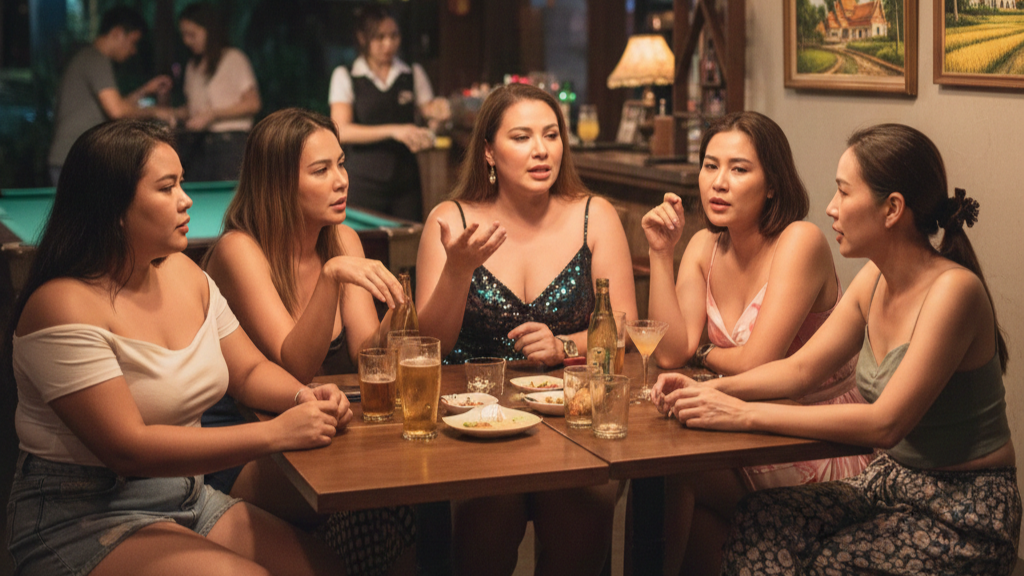
In Chiang Mai’s tourist spine—close enough to the Night Bazaar that the city’s night economy hums in the background—there’s a small place with a big argument baked into its business model. “Can Do Bar” is regularly described as Thailand’s only venue owned and managed cooperatively by sex workers, and that “owned and managed” part is the point: not a charity project, not a rescue story, but a workplace built by the people who actually do the work.
The origin story begins with Empower Foundation, a long-running Thai sex worker–led organisation (มูลนิธิส่งเสริมโอกาสผู้หญิง, roughly “Foundation for Promoting Women’s Opportunities”) that has spent decades insisting on one stubborn idea: sex work is work, and workers deserve rights—แรงงาน (labour) protections, not moral panic. Out of that organising came a practical question: if the law and the industry keep pushing workers into grey zones, what would a “best practice” workplace look like if workers could design it themselves?
So, in 2006, Empower’s members in Chiang Mai pooled resources to open “Can Do” as a worker-owned project—often described as sex workers buying into and running their own bar as a collective, a literal stake in the premises and decisions. The venue has been framed as an “experitainment” experiment—an experiment in entertainment—meant to prove that a sex work–adjacent nightlife business can follow the kinds of rules other workplaces take for granted.
What did that look like in practice? Accounts of “Can Do”’s operating principles repeatedly circle back to basics that become radical when workers are usually denied them: pay at or above minimum wage, paid leave and paid sick leave, recognition of public holidays, and overtime that is voluntary and paid properly. Coverage and summaries connected to Empower also highlight access to ประกันสังคม [social security], another “ordinary” protection that is often out of reach in informalised sectors. The bar’s very existence turns policy talk into something you can walk into, order a drink inside, and argue about with your own eyes.
“Can Do”’s public message is famously blunt: its “main attraction,” as one widely circulated profile put it, isn’t selling sex so much as selling the idea that sex workers can create safe workplaces and deserve dignity. That distinction matters in Thailand, where prostitution has long been illegal on paper while the industry persists in practice, leaving workers vulnerable to selective enforcement, stigma, and the constant risk of raids that treat everyone as either criminal or victim. In that climate, a worker-owned venue also becomes a shield: shared rules, shared decision-making, and a collective voice that’s harder to silence than an individual worker negotiating alone.
The present tense of “Can Do Bar” isn’t just nightlife—it’s politics. Sex worker-led advocacy in Thailand has kept pressing for decriminalisation and legal recognition, including petitions and public campaigns that argue penalties don’t end the industry; they just make it more dangerous. In March 2025, Prachatai English reported that Empower planned to propose a sex worker protection law, signalling ongoing engagement with formal lawmaking rather than quiet survival in the shadows. At the same time, broader national debates about regulating “underground” entertainment economies continue to flare, with competing narratives about tourism, morality, safety, and who gets protected.
That’s why “Can Do”’s story keeps traveling far beyond Chiang Mai: it’s a rare, concrete case where sex workers are not “managed” but are managers—owners, rule-writers, and the people who decide what “safety” actually means on the ground. In a region where sex workers are so often spoken about rather than listened to, Can Do’s quiet provocation is simple: we can run the place ourselves—ทำเองได้ [we can do it ourselves]—and the world doesn’t collapse. It just starts looking a little more like a workplace, and a little less like a trap.
Ah, Can Do Bar. Every time Auntie hears that name, she smiles the kind of smile you get when someone finally stops asking for permission and just builds the damn thing themselves. In a country where sex workers are forever talked about as victims, sinners, statistics, or “social problems,” a group of women looked around Chiang Mai and said: enough. We’ll run the place. We’ll own it. เราทำเองได้ — rao tam eng dai — we can do it ourselves.
Let’s be clear, Auntie hates fairy tales, but this is not one. Can Do Bar isn’t a cute NGO pet project, and it’s not a rescue fantasy designed to make polite liberals feel warm inside. It’s a workplace. With rules. With wages. With sick leave. With women who clock in, clock out, argue in meetings, negotiate, and sometimes disagree — like adults. Radical, apparently.
What makes Can Do uncomfortable for authorities, moral crusaders, and even some well-meaning feminists is precisely that it refuses the usual script. No trafficker lurking in the shadows. No saviour swooping in. No woman waiting to be “rehabilitated.” Just sex workers who decided they were tired of being managed by men, by bosses, by police, by laws written without them. Ownership changes everything. When you own the bar, suddenly “safety” isn’t a slogan — it’s your lights, your doors, your rules, your collective decision about what happens inside.
And yes, Auntie can already hear the clutching of pearls. “But prostitution is illegal!” So is pretending Thailand doesn’t run on informal labour, shadow economies, and selective enforcement. Criminalisation doesn’t stop sex work; it just decides who gets rich and who gets raided. Can Do exposes that hypocrisy by existing calmly, unapologetically, and visibly. No apology tour. No bowing. Just receipts.
What I love most is how Can Do flips the power dynamic. Workers aren’t whispering complaints in dressing rooms. They’re voting. They’re deciding pay structures. They’re negotiating working hours. They’re proving — painfully, practically — that sex workers understand dignity better than anyone who’s ever tried to save them without listening.
And here’s the thing that really scares the system: if sex workers can run a bar safely, fairly, and collectively, then the whole moral architecture collapses. No more excuse that exploitation is inevitable. No more pretending abuse is “cultural.” No more using women’s bodies as an abstract battlefield for politics, religion, or tourism branding.
So Auntie raises a glass — not to the bar itself, but to the idea it refuses to hide. Can Do isn’t asking to be loved. It’s asking to be recognised. As work. As labour. As women who decided they’re done waiting for permission. And honestly? That’s the most dangerous thing of all.