


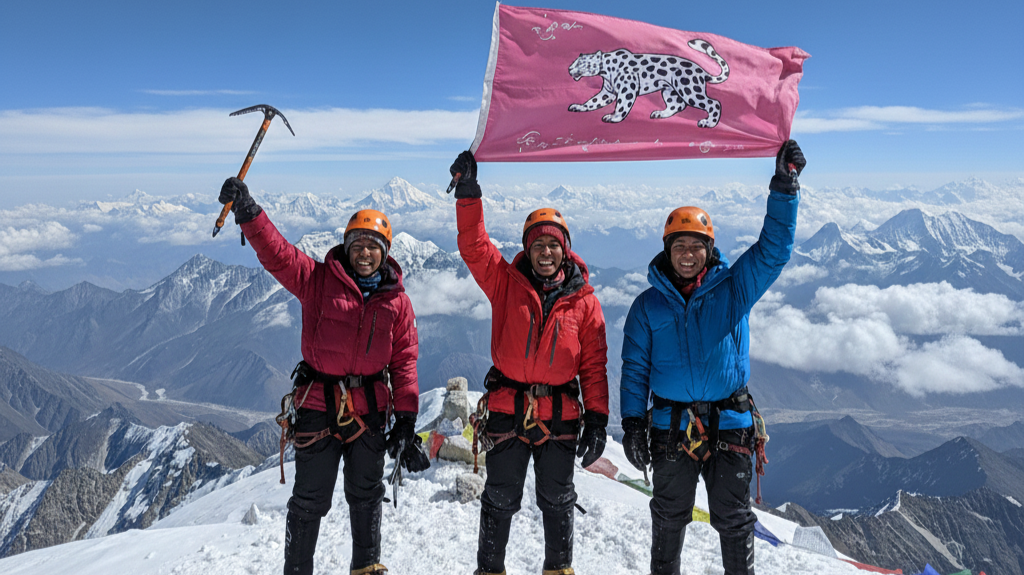
For most of modern mountaineering history, Sherpa women were essential to Himalayan expeditions and yet almost entirely absent from the stories told about them. While global audiences learned to associate the word “Sherpa” with male climbers fixing ropes on Everest, women remained in the background, sustaining the entire high-altitude economy from below. They ran households, managed finances, raised children, farmed at altitude, traded along mountain routes, and increasingly operated the teahouses and lodges that made commercial trekking and climbing possible. Their physical endurance was never in doubt; their visibility was.
The exclusion of Sherpa women from mountaineering was not about ability, but access. Risk-heavy climbing work was framed as incompatible with motherhood, training opportunities flowed almost exclusively to men, and expedition hierarchies were male by default. That began to change in the late 1990s, as individual women quietly pushed their way into climbing teams, often without sponsorship, institutional backing, or media attention.
One of the most consequential figures in this shift is Lhakpa Sherpa, who first summited Everest in 2000 and has since climbed it more times than any other woman in history. Her achievements are extraordinary not only because of the numbers, but because of the conditions under which they were achieved—limited financial support, repeated marginalization, and personal hardship that global mountaineering culture rarely acknowledges. For years, her record went largely unnoticed, revealing how women’s endurance is often normalized rather than celebrated.
A newer generation of Sherpa women has gone further, challenging not only who climbs, but who leads. Dawa Yangzum Sherpa became the first Nepali woman to earn IFMGA certification in 2018, a qualification that confers professional authority, safety oversight, and international recognition. This marked a structural shift: guiding credentials mean control over routes, risk decisions, and income, rather than symbolic participation.
Today, Sherpa women are active across the full spectrum of high-altitude work. They summit 8,000-meter peaks, fix ropes, guide clients, manage logistics, and take part in rescue operations. All-women Nepali expeditions, including those involving climbers such as Nima Jangmu Sherpa, have challenged the persistent idea that women climbers are anomalies rather than professionals. These expeditions are not about separation from men, but about creating space for training, sponsorship, and visibility in a system that historically excluded them.
Yet progress remains uneven. Sherpa women still receive fewer sponsorships, earn less for equivalent work, and face relentless pressure to justify risk in ways men are rarely asked to. Media narratives often frame them as inspirational exceptions or emotional symbols, rather than skilled workers navigating a dangerous, commercialized industry. As Everest tourism grows ever more profitable, the gap between who bears the risk and who reaps the rewards continues to widen.
The story of Sherpa women in mountaineering is not one of sudden empowerment, but of long-delayed recognition. Their presence on the world’s highest peaks forces a reckoning with how gender, labor, and visibility intersect in global adventure culture—and with whose strength is taken for granted, and whose is finally allowed to be seen.
Oh, global media, Auntie needs a word. Every time a Sherpa woman appears on your screens, muscles flexed against a backdrop of ice and sky, you reach for the same tired adjectives. Strong. Tough. Fearless. Indomitable. It’s all very flattering, but also deeply lazy. You don’t tell us what she earns, who trained her, who insures her, or who absorbs the risk when something goes wrong. You just marvel at her strength like she’s part of the landscape—another glacier, another miracle of altitude.
Let’s be clear: Sherpa women are not strong by accident, and not strong for your inspiration. They are strong because survival, labor, and endurance have always been demanded of them, long before a single foreign climber needed their Instagram summit shot. When you fetishize their strength, you quietly excuse the systems that exploit it. Strength becomes a personality trait instead of a workplace condition.
Auntie has seen this trick before. Call women resilient, and you never have to ask why they must be. Call them fearless, and you never have to discuss safety standards. Frame them as symbols, and you never have to talk about contracts, pay gaps, or who controls the money flowing down from Everest’s glossy commercialization.
And the motherhood question—oh, how the cameras linger there. As if every Sherpa woman climber must explain her womb before her résumé. Men climb, women justify. Men are ambitious, women are brave. Same mountain, very different vocabulary.
What global media loves most is the exceptional woman. The lone heroine who overcomes culture, poverty, and gravity itself. What it avoids is the collective truth: that Sherpa women have always carried Himalayan life on their backs, and that their entry into mountaineering is not a revolution, but a correction.
So here’s Auntie’s modest request. The next time you write about a “strong Sherpa woman,” tell us about her skills, her certifications, her pay, her risks, and her choices. Admire her strength, sure—but stop treating it like folklore. She’s not a myth. She’s a professional. And she deserves more than awe.