


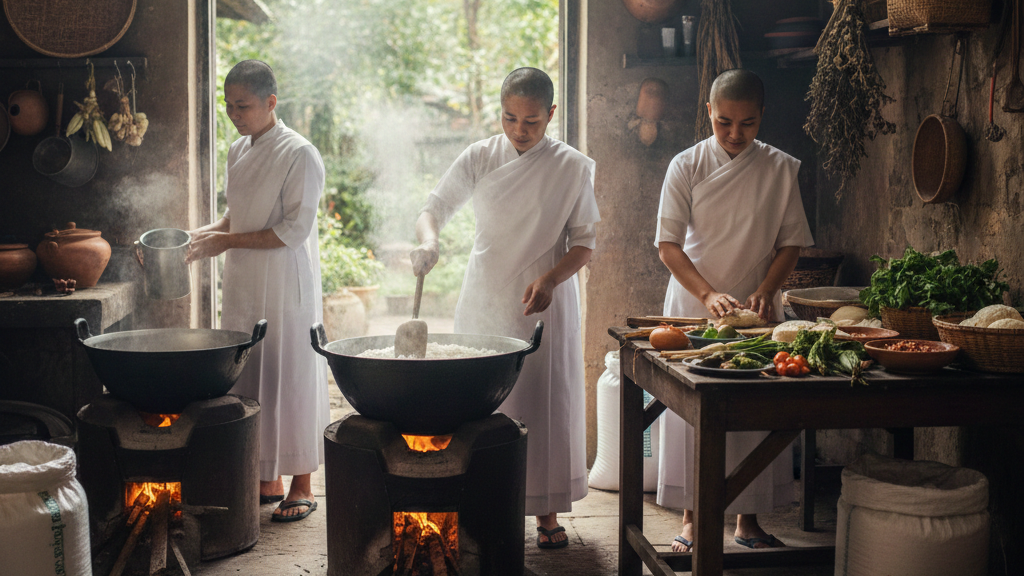
In Thailand, the image of Buddhism is inseparable from saffron robes, shaved heads, and disciplined male monks walking barefoot at dawn, bowls in hand. Yet hidden in plain sight is another religious life, quieter and far less secure: that of the female Buddhist renunciant. Search terms like “Thai Buddhist nun,” “women ordination Thailand,” or “mae chi rules” quickly reveal a paradox at the heart of Thai Theravāda Buddhism—women can renounce the world, but not on equal terms.
Most Thai women who choose a religious life become mae chi (แม่ชี), white-robed female renunciants who shave their heads, live celibately, and usually observe the Eight Precepts (ศีลแปด, sǐn bpàet). These include abstaining from sexual activity, eating after noon, entertainment, adornment, and sleeping on luxurious beds. In practice, a mae chi’s life resembles monastic discipline, but without full ordination. Mae chi are not members of the official Sangha (คณะสงฆ์, khána sǒng), the state-recognized monastic body, and this distinction shapes every aspect of their existence.
Daily life for mae chi often unfolds inside or alongside a wat (วัด, temple). Days typically begin before sunrise with chanting in Pāli, meditation, and chores. Unlike monks, mae chi rarely go on alms rounds; instead, they may cook for monks, clean temple grounds, prepare offerings, or help with ceremonies. While some nunneries emphasize study and meditation, many mae chi find themselves performing supportive labor, leaving limited time for contemplative practice. Their white robes symbolize purity and renunciation, yet also mark them as liminal—neither laywomen nor fully ordained monastics.
The question of rules is central. Mae chi generally keep Eight or sometimes Ten Precepts, but these are moral commitments rather than a full Vinaya (พระวินัย, monastic code). By contrast, fully ordained female monks, known as bhikkhunī (ภิกษุณี), follow 311 Vinaya rules governing conduct, communal life, and discipline. Historically, bhikkhunī existed in early Buddhism, but the Theravāda bhikkhunī lineage died out centuries ago in mainland Southeast Asia. In Thailand, a 1928 Sangha order is widely cited as barring monks from ordaining women, and modern religious authorities have consistently refused to recognize bhikkhunī ordination.
Despite this, a small but determined group of Thai women have pursued full ordination abroad and returned to Thailand as bhikkhunī. The most prominent figure is Dhammananda Bhikkhuni, ordained in Sri Lanka in 2003 and now based at Songdhammakalyani Monastery. Her presence has sparked fierce debate. Supporters argue that denying women full ordination contradicts the Buddha’s teachings on liberation; critics claim that reviving bhikkhunī violates tradition and social harmony. Officially, bhikkhunī remain outside the Thai Sangha, without legal status or state support.
This lack of recognition has concrete consequences. Mae chi and bhikkhunī alike often rely on personal savings or private donors, while monks benefit from institutional networks and cultural expectations of generosity. There is no guaranteed healthcare, pension, or formal educational pathway for most female renunciants. Ironically, entering religious life can be financially easier for men than for women, reinforcing broader gender inequalities within Thai society.
Yet the appeal of renunciation persists. For many women, becoming a mae chi offers escape from marriage expectations, caregiving burdens, or economic precarity. It can also provide spiritual authority in a society where women’s voices are often constrained. Meditation centers run by women, informal teaching roles, and growing public discussions about gender equality in Buddhism suggest a slow shift in attitudes, especially among urban and educated Thais.
Thailand today thus presents a layered reality: women can renounce desire, family, and worldly life, but not institutional marginalization. The white robes of the mae chi signal devotion and discipline, yet also highlight the unfinished question at the heart of Thai Buddhism—whether spiritual liberation can truly coexist with structural inequality. As debates over bhikkhunī ordination continue, the lives of Thai Buddhist nuns remain a powerful lens through which to examine gender, authority, and tradition in modern Thailand.
Oh sweetheart, let Auntie say this slowly, with a sip of tea and an arched eyebrow: if enlightenment were handed out according to discipline, devotion, and self-denial, Thai women would have reached nibbāna centuries ago. And yet here we are, in 2026, still pretending that white robes are somehow spiritually lighter than saffron ones.
Thailand loves to boast about being a bastion of Theravāda Buddhism. Temples everywhere, monks everywhere, merit-making everywhere. But when it comes to women who renounce sex, money, vanity, family expectations, and worldly ambition, suddenly the system gets shy. “Oh no, not like that,” it whispers. “You can renounce, dear—but don’t get ideas.”
Enter the mae chi (แม่ชี): shaved head, white robes, eight precepts, infinite patience. She wakes before dawn, chants in Pāli, meditates, eats once or twice before noon, cleans the temple, cooks for monks, serves the lay community, and asks for very little. In return? No official status, no Sangha membership, no guaranteed support, no voice in religious governance. Devotion without authority. Holiness without hardware.
And then everyone acts surprised when feminists raise an eyebrow.
Let’s be clear: this isn’t about women wanting power for power’s sake. This is about a system that trusts women to scrub floors but not to hold lineage. That praises their morality while institutionalizing their marginality. That invokes “tradition” whenever equality knocks at the temple gate. Funny how tradition is always so flexible for politics and money, but suddenly petrified when women ask for robes.
The bhikkhunī question really exposes the nerves. The Buddha allowed women’s ordination. History confirms it. Texts confirm it. Logic confirms it. Yet Thailand still hides behind a nearly century-old administrative ban like it’s divine law carved in stone. When women like Bhikkhunī Dhammananda dare to step fully into the Vinaya, they’re treated as troublemakers rather than truth-tellers.
And don’t even get Auntie started on economics. Men can ordain poor and be supported. Women often need savings just to renounce. If that’s not structural sexism wearing incense-scented perfume, I don’t know what is.
But here’s the part that gives me hope: women keep coming anyway. They shave their heads anyway. They chant anyway. They meditate anyway. They teach anyway. They renounce anyway. Quietly, stubbornly, magnificently.
So no, this isn’t just a “religious issue.” It’s a mirror. Buddhism in Thailand is being asked a very simple question: do you believe liberation is gender-neutral, or only symbolically so? Because until women can renounce on equal terms, the robes may be sacred—but the system underneath is still very much worldly.