


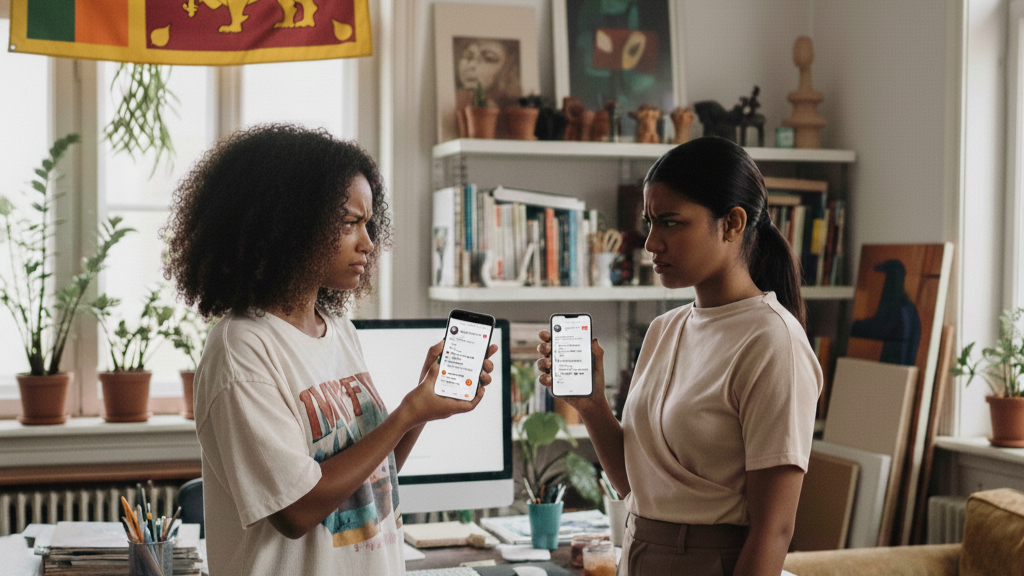
In Sri Lanka, women are not being “cancelled” online. They are being silenced, disciplined. According to a major joint study by UNFPA Sri Lanka and UN Women Sri Lanka, online gendered hate speech and gendered disinformation are not accidents of the internet or the excesses of free speech. They are tools. Their purpose is simple: to scare women and gender-diverse people out of public life until silence feels safer than visibility.
This is not about a few angry comments or “hurt feelings.” The study identifies gendered disinformation as a deliberate strategy that weaponises sexuality, morality, and “character” to destroy credibility. In Sri Lanka, this usually takes a familiar form: rumours about sexual behaviour, insinuations of immorality, leaked or fabricated images, deepfakes, and accusations of being westernised, anti-family, anti-religion, or anti-nation. These attacks rarely bother with facts. They rely on something more powerful: shame.
And shame works here. Nearly two-thirds of survivors surveyed withdrew from social media entirely after experiencing online gender-based violence. More than half reported real-world consequences—family pressure, job loss, reputational damage, anxiety, depression, and suicidal thoughts. This is not “online drama.” This is a systematic narrowing of who gets to speak.
Sri Lanka’s honour culture supercharges this violence. Women’s bodies, behaviour, and sexuality are still treated as communal property, policed by families, neighbours, employers, religious leaders, and comment sections. When a woman is accused online, the punishment often comes faster than any verification. Employers panic. Families intervene. Communities gossip. Silence becomes self-defence.
The timing is not random. The study shows that attacks spike during moments of national tension: the Easter attacks, COVID-19, the economic collapse, Aragalaya. When women speak publicly during crises—especially journalists, activists, academics, and protest organisers—they are disproportionately targeted. The abuse is rarely about their arguments. It is sexual, humiliating, personal. The message is clear: political speech by women comes with a price.
This is where global manosphere culture goes local. Sri Lanka does not need self-identified “incels” to reproduce incel logic. The same ideas circulate daily in Sinhala and Tamil spaces: “modern girls” are immoral, feminism destroyed society, women manipulate men, men are the real victims. These narratives are packaged as jokes, advice, or “common sense masculinity,” but they function as permission structures. Permission to harass. Permission to shame. Permission to silence.
Social media platforms help. Facebook and WhatsApp emerge repeatedly as key sites where abuse spreads, mutates, and escalates—often starting as public pile-ons and moving quickly into private harassment, threats, and blackmail. Survivors describe reporting systems as slow, opaque, or useless, especially in local languages. Outrage performs well. Misogyny travels far. Accountability is optional.
Perhaps the most chilling finding is how normal this has become. Many women interviewed said they expect abuse if they speak publicly. Expectation is not resilience. It is learned fear. When harassment is predictable, self-censorship feels rational. When silence becomes routine, violence has already succeeded.
This is why framing online misogyny as “free speech” misses the point. What is happening in Sri Lanka’s digital public sphere is not debate. It is exclusion. Gendered hate speech and disinformation work not by winning arguments, but by making participation unbearable. Every woman who logs off, every activist who deletes a post, every journalist who thinks twice before speaking is proof that the system is working exactly as designed.
The question, then, is not whether women should “toughen up.” It is whether Sri Lanka is willing to admit that its online public sphere is being shaped by intimidation—and that silence, in this country, is no longer accidental. It is engineered.
I’ve been to Sri Lanka many times. From Jaffna to Anuradhapura, from Colombo down to Galle. I’ve sat in buses with cracked windows, in cafés with sweet milk tea, in living rooms where aunties watch you closely and then feed you anyway. Different places, different histories, different wounds. And yet—online—the music is always the same.
Different usernames. Same tune.
Everywhere I go, I hear it in Sinhala comment sections, in Tamil Facebook threads, in WhatsApp forwards that travel faster than sense. A woman speaks up and suddenly the chorus begins. Who does she think she is? Check her character. Look at how she dresses. She’s westernised. She’s immoral. She’s against our culture. Press play. Repeat.
I see you, Tamil and Sinhala sisters. I see how quickly your opinions are reduced to your bodies. I see how your credibility is measured not by what you say, but by whether you can be shamed into silence. I see how the moment you become visible—journalist, activist, student, influencer, protester—you also become fair game.
And let’s be honest: this is not about disagreement. This is not debate. This is discipline.
Men online love to pretend this is just “free speech,” or “jokes,” or “boys being boys.” Please. When rumours about your sex life are treated as political arguments, when fake photos do more damage than facts, when entire comment sections turn into public stonings, that’s not speech. That’s social control with Wi-Fi.
What fascinates me—darkly—is how nationalism melts so easily into misogyny. Sinhala or Tamil, Buddhist or Hindu, Christian or Muslim, the script barely changes. Protect culture. Protect honour. Protect tradition. And somehow, miraculously, the threat is always a woman who talks too much, knows too much, wants too much.
Meanwhile, the men shouting the loudest online are often the quietest in real life. Anonymous. Fragile. Furious. Borrowing global alpha-male nonsense and stitching it onto local honour politics like it’s always belonged there. Incels with a cultural upgrade. Same resentment, new costume.
And you, sisters—you learn the rules fast. Post less. Smile more. Lock your account. Delete that opinion. Think twice. Then think again. Silence starts to feel like wisdom. But let me tell you something uncomfortable: when silence feels smart, the violence has already worked.
I didn’t travel all that way, across checkpoints and temples and coastlines, to believe Sri Lankan women are weak. You are not. You are being targeted because you are visible. Because you matter. Because your voices scare people who benefit from keeping things exactly as they are.
So I see you. I hear the noise. And I know exactly why they’re trying so hard to make you disappear.