


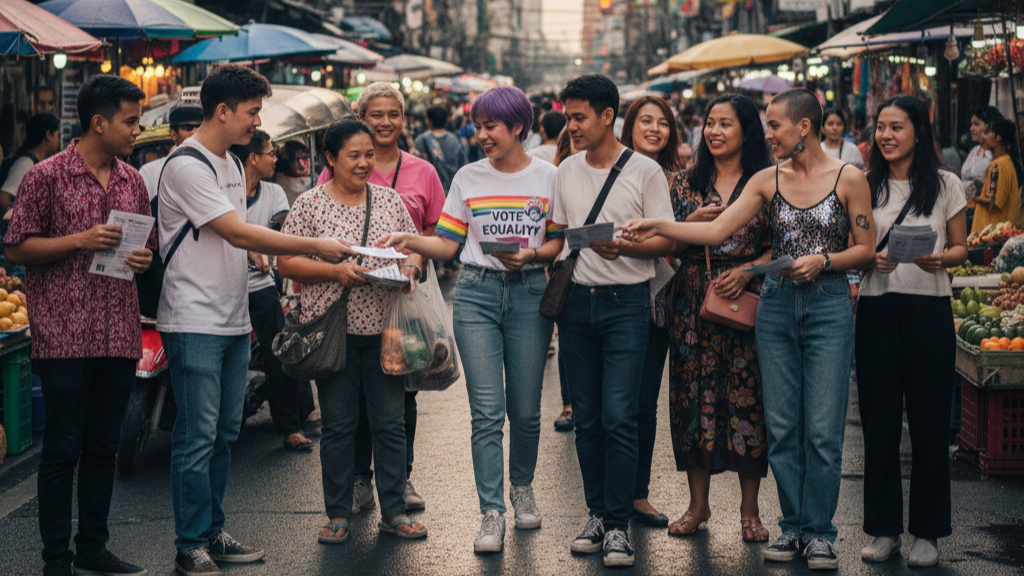
Thailand’s 2026 general election is shaping up to be one of the most socially charged ballots in years, propelled not just by traditional debates over the economy or corruption but by a rising public focus on gender issues and LGBTQ rights that could redefine what it means to be represented in Thai democracy. With a constitutional referendum and parliamentary elections set for 8 February 2026, voters are being drawn into conversations about identity, dignity, and legal equality in ways that extend far beyond the ballot box.
In recent months, discussions over “voluntary personal titles” — a proposal that would allow citizens to choose gendered prefixes like นาย (Nai/Mr), นางสาว (Nang Sao/Miss), or even move beyond those binaries — have dominated headlines and social media feeds across the kingdom, sparking both hope and controversy. The policy, championed by reform-minded parties such as the People’s Party, aims to allow people to choose titles that reflect their gender identity, not just their sex assigned at birth — a seemingly small change with enormous symbolic and practical implications for transgender, non-binary, and gender-diverse people. Opponents argue it could create confusion in areas like medical care or emergency services, where biological sex might matter for treatment. Supporters counter that updating social conventions to respect identities is essential to reducing discrimination and affirming lived experience.
Thailand’s position on LGBTQ issues has already seen historic progress. It became the first country in Southeast Asia to legalize same-sex marriage, an achievement that has energized activists and political organizers alike. Yet despite that milestone, key legal protections — like a robust gender recognition law to make it easier for people to have their gender accurately reflected on official documents — remain under debate and are widely seen as the “next big step” for equal rights advocates.
Historically, Thailand has had notable LGBTQ figures in politics. Tanwarin Sukkhapisit, who identifies as kathoey (a Thai term often used to describe transgender women or effeminate gay men, though its usage and connotations can vary), made history in 2019 as the first openly transgender member of the House of Representatives, winning a seat with the then-Future Forward Party and drawing international attention to Thailand’s evolving political landscape. Their tenure was cut short by legal challenges — a reminder that representation still faces structural barriers — but their campaign and presence in parliament opened space for conversations that were previously relegated to the margins.
In the run-up to 2026, progressive parties like Move Forward and Pheu Thai have continued to foreground LGBTQ rights and gender equality legislation as core parts of their platforms, promising not just social reforms but tangible policy changes. In previous elections, six major parties released competing proposals aimed at addressing discrimination, expanding access to health services for gender-diverse people, and enshrining equality under the law.
For many voters — especially younger Thai citizens who came of age in a more connected and socially pluralistic world — these debates are not abstract. They touch real lives and reflect broader regional and global trends in LGBTQ politics in an era where some countries advance rights while others retreat from them.
Yet tensions remain. Conservative voices within Thai society and among professional groups have raised concerns about the pace and direction of gender-related reforms, framing some proposals as threats to tradition or public safety. These disagreements reflect a broader struggle over how Thailand defines itself: as a tolerant and modern democracy that embraces diversity, or as a conservative society anchored in fixed social norms.
Whatever the outcome on election day, the presence of LGBTQ and gender-focused issues at the heart of political debate marks a significant turning point in Thai politics. The 2026 election is not just about who gets into office — it’s about who gets to define what it means to be fully visible, fully human, and fully equal in the Kingdom of Thailand. And for many voters and candidates alike, gender justice and LGBTQ+ inclusion are no longer peripheral concerns but central pillars in the next chapter of the country’s democratic story.
If Southeast Asia is watching, it’s because Thailand’s election could offer lessons — and inspiration — for nations wrestling with similar debates over gender, identity, and the future of inclusive governance.
Oh Thailand. Every election season you manage to surprise me, and not always in the way your generals or moral guardians would prefer. This time it’s not tanks, coups, or banana-peel coalitions stealing the spotlight. It’s prefixes. Yes, khun, nai, nang sao. Tiny words, apparently terrifying enough to trigger national panic.
I’ve watched Thai politics for years, from smoky back rooms to glossy campaign stages, and let me tell you something: when a country starts obsessing over whether someone can be called Mr or Miss, it’s never really about grammar. It’s about control. It’s about who gets to name themselves — and who doesn’t.
The debate over gender titles in this election feels absurdly small and explosively big at the same time. On one side, people saying, “Let citizens choose how they’re addressed.” On the other, dire warnings about chaos, confusion, ambulances crashing because someone’s ID doesn’t match their hormones. Please. Thai bureaucracy survives floods, coups, and governments that last shorter than Bangkok pop-up cafés. It can survive a checkbox.
What really rattles the establishment isn’t paperwork. It’s visibility. Thailand loves its kathoey on television, in comedy sketches, in beauty pageants — as long as they stay decorative, amusing, safely non-political. The moment queer and trans people step into parliament, policy, and power, suddenly we’re told society is “not ready.” Funny how society is always ready to consume queer culture, but never quite ready to share authority.
And let’s talk about the candidates. Seeing openly LGBTQ people run for office — not as mascots, not as footnotes, but as serious political actors — matters more than any slogan. Representation isn’t symbolic; it’s structural. Laws don’t write themselves. Budgets don’t pass by vibes. If gender-diverse people aren’t at the table, their lives will keep being negotiated by people who think gender is something you can solve with a dress code.
I hear conservatives say this election is becoming “too Western,” too woke, too noisy. Sweetheart, gender diversity didn’t arrive in Thailand with Netflix. It’s been here longer than most political parties. What’s new isn’t queerness — it’s courage.
Young voters get this. They’ve grown up online, bilingual in memes and injustice, allergic to hypocrisy. They know equality isn’t a threat to tradition; it’s a test of whether tradition can evolve without turning cruel. They’re not voting just for policies. They’re voting for dignity.
So here we are, heading into another Thai election where the question isn’t just who will govern, but who counts. Who gets named. Who gets seen. Who gets taken seriously.
From where I’m standing — lipstick sharp, eyes open — this isn’t identity politics gone mad. It’s democracy finally catching up with reality. And reality, darling, is gloriously diverse.