


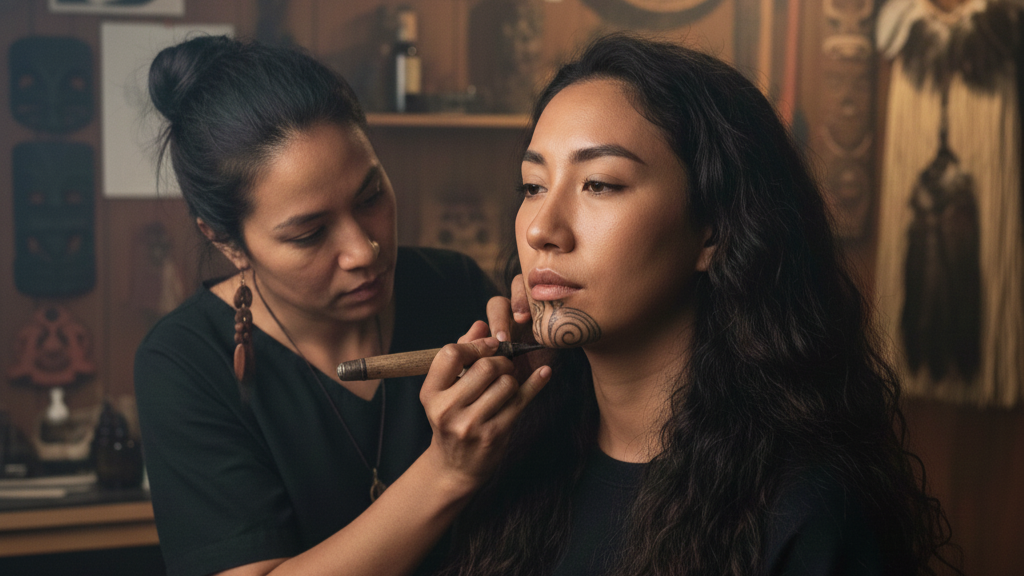
For decades, the Māori chin tattoo known as moko kauae was pushed to the margins, dismissed as a relic of the past or misunderstood as a radical statement. Today, it has re-emerged at the very centre of public life in Aotearoa New Zealand, worn proudly by women in parliament, television studios, courtrooms and universities. Once hidden or discouraged by colonial pressure, moko kauae has become one of the most powerful visual expressions of Indigenous identity, mana (authority, prestige) and cultural continuity — and its return is changing what leadership looks like in New Zealand.
Moko kauae is part of tā moko, the traditional Māori art of tattooing, but it is uniquely associated with wāhine (women). Placed on the chin and sometimes extending to the lips (ngutu), it is not decorative in the Western sense. It is a living record of whakapapa (genealogy), responsibility and belonging. Unlike modern tattoo flash, moko designs are not chosen from a catalogue. Each pattern is developed through careful consultation with a tohunga tā moko (expert practitioner), reflecting the woman’s ancestry, life path and role within her whānau (family), hapū (sub-tribe) and iwi (tribe).
The structure of moko kauae follows recognisable principles while remaining deeply personal. Central vertical lines often reference whakapapa, anchoring the wearer to ancestral descent lines. Curved elements can signal whānau connections or significant life experiences, while symmetry speaks to balance between the physical and spiritual worlds. Negative space is as meaningful as inked skin, allowing breath and movement, reflecting Māori concepts of wairua (spirit). Traditionally, Māori say the moko already exists beneath the skin — the tattoo does not create identity but reveals it.
Historically, receiving moko kauae marked maturity and readiness to carry responsibility. Not all women received it; those who did were often recognised as holders of knowledge, ritual authority or leadership. Colonial rule, missionary influence and assimilation policies sharply curtailed the practice by the early twentieth century, leaving generations of Māori women disconnected from this visual language of identity. Its resurgence since the 1990s is therefore inseparable from wider movements of language revitalisation (te reo Māori), land rights and Indigenous self-determination (tino rangatiratanga).
That resurgence is now highly visible in public life. One of the most internationally recognised figures is Nanaia Mahuta, New Zealand’s former foreign minister, whose moko kauae made global headlines when she addressed the United Nations. Far from being symbolic alone, her presence challenged long-standing assumptions about professionalism, diplomacy and appearance in Western political spaces. In broadcasting, journalist Oriini Kaipara became the first primetime news anchor to wear moko kauae, reshaping what authority and credibility look like on national television. In politics, MPs such as Meka Whaitiri have spoken openly about the moko as an expression of accountability to their people rather than personal branding.
These women are not exceptions but signals of a broader shift. Judges, academics, teachers and public servants are increasingly choosing to wear moko kauae openly, asserting that Māori identity does not need to be muted to be taken seriously. The visibility has sparked debate, particularly online, but it has also forced institutions to confront embedded biases around race, gender and power. For many Māori women, the decision to receive moko kauae today is both deeply personal and quietly political — a refusal to separate professional competence from cultural identity.
Crucially, Māori leaders continue to stress that moko kauae is not a trend. It is a whakapapa right, reserved for Māori women, governed by tikanga (custom) and relational responsibility. Its growing presence in public life is not about spectacle but about normalisation — making Indigenous identity visible, everyday and unremarkable in a society built on its erasure.
In that sense, moko kauae is more than ink on skin. It is history written forward, a declaration that Māori women belong everywhere decisions are made, stories are told and futures imagined — carrying their ancestors with them, right on their faces.
Every time a Māori woman with moko kauae appears on TV, in Parliament, or — heaven forbid — representing her country overseas, the same tired chorus starts up. “Is that professional?” “Why bring culture into politics?” “Wouldn’t it be better if she looked neutral?” Neutral, darling, is just another word for “looking like the dominant culture expects you to.” And Indigenous women have been doing that emotional labour for centuries. They’re done.
What I love about moko kauae is that it sits right there on the face, impossible to ignore. You don’t get to scroll past it. You don’t get to pretend Māori identity is something quaint for kapa haka competitions and museum displays. It looks back at you and says: I am here, I belong here, and I’m not asking permission. That takes guts. And yes, mana.
Let’s be clear: this isn’t about rebellion for rebellion’s sake. Moko kauae is about whakapapa, responsibility, accountability. It’s not “self-expression” in the Instagram bio sense. It’s closer to a lifelong contract with your ancestors and your community. Which, frankly, is more commitment than most politicians show to their campaign promises.
And yet, the outrage always seems to come dressed up as concern. “Won’t she face discrimination?” “Won’t this limit her career?” Funny how that concern never quite extends to dismantling the systems that do the discriminating. Instead, the burden is placed — again — on women to make themselves smaller, quieter, less visible, more palatable.
What really rattles people is not the ink. It’s the confidence. A Māori woman with moko kauae is not trying to blend in. She is not apologising. She is not translating herself for your comfort. She is asserting that leadership does not have one face, one accent, one acceptable look.
Auntie finds that deeply satisfying.
Because here’s the thing: when Indigenous women wear their identity openly in spaces of power, they don’t lower the standard. They raise it. They remind us that professionalism without humanity is hollow, and that history doesn’t disappear just because it makes some people uncomfortable.
So the next time you see a woman with moko kauae reading the news, running a ministry, teaching your kids or shaping policy, take a moment. Not to judge. Not to comment. Just to recognise that you are witnessing survival made visible. And that, my friends, is not something to fear — it’s something to respect.