


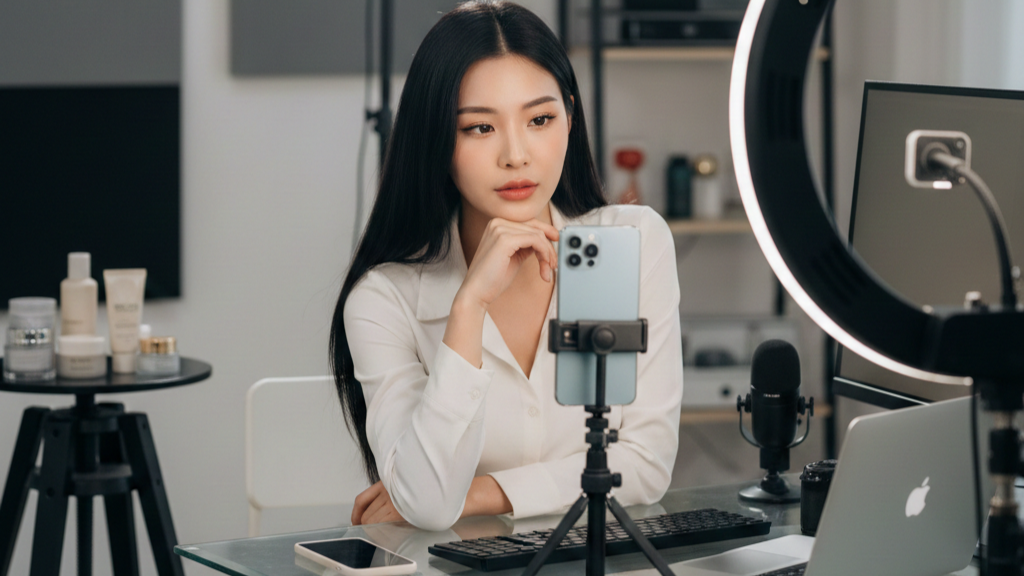
In East Asia’s vast and restless digital ecosystem, the influencer profession has become one of the most feminised yet tightly policed forms of contemporary labour. From Seoul to Shanghai, Taipei to Tokyo, the influencer economy—often framed as glamorous, flexible and empowering—is in practice a gendered business where women dominate numerically, set trends culturally, yet remain constrained by persistent expectations around beauty, youth, respectability and emotional labour. In 2025, the rise of influencers in South Korea, China, Taiwan and Japan reveals not only how content is made and monetised, but how gender norms are reproduced, negotiated and sometimes quietly subverted online.
Women form the backbone of the East Asian influencer economy. In lifestyle, beauty, fashion, food, parenting and wellness—by far the most commercially active sectors—female creators account for the majority of accounts, posts and engagement. This dominance is no accident. Influencer culture draws heavily on forms of feminised labour that have long been undervalued offline: care, aesthetics, emotional storytelling and social mediation. Platforms reward women who can make the personal feel relatable, aspirational and intimate, turning everyday routines—skincare rituals, office outfits, home cooking, relationship reflections—into monetisable narratives. Yet this visibility comes at a cost. Female influencers are subject to intense scrutiny over appearance, age, marital status and sexual behaviour, with reputational risk often higher than for their male counterparts.
Nowhere is this tension more visible than in South Korea, where influencer culture sits at the intersection of hyper-competitive beauty standards and global pop soft power. Korean women dominate K-beauty content, shaping skincare trends that travel worldwide, while simultaneously navigating an unforgiving gaze that equates credibility with flawless youth. Influencers are expected to embody 관리 (gwanri, self-management), presenting disciplined bodies and polished lives that mirror broader social pressures placed on women in Korean society. At the same time, a growing number of female creators subtly challenge these norms by discussing burnout, cosmetic surgery fatigue, fertility anxiety and the emotional cost of perfection—topics that resonate strongly with younger women disillusioned with traditional success scripts.
In China, the influencer economy operates at an industrial scale, but gender hierarchies remain embedded in its structure. Women dominate beauty, lifestyle and parenting content, often as KOCs (Key Opinion Consumers) whose relatability fuels trust and sales. These creators perform an enormous amount of affective labour, cultivating intimacy with followers through livestreams, daily check-ins and personal disclosures. Male influencers, by contrast, are more visible in high-ticket sectors such as finance, technology and entrepreneurship, where authority and expertise are coded as masculine. Even within livestream commerce, women are often valued for warmth and charm, while men are positioned as rational deal-makers. The result is a stratified economy in which women generate volume and engagement, while men are more likely to capture prestige and longevity.
Japan presents a quieter but equally gendered influencer landscape. Female creators thrive in niches built around 日常生活 (nichijō seikatsu, everyday life), where subtlety, consistency and emotional restraint are prized. Many successful Japanese women influencers cultivate carefully controlled personas—soft-spoken, aesthetically refined, non-confrontational—that align with cultural expectations of femininity. Yet within these constraints, some carve out spaces for gentle resistance, discussing singlehood, child-free lifestyles, or career dissatisfaction in coded, indirect ways. Male influencers exist, but they are fewer, and often clustered in humour, gaming or commentary rather than lifestyle authority, reinforcing a familiar division between masculine voice and feminine embodiment.
Taiwan stands out for its comparatively open digital culture and strong female participation across political, social and cultural influencer spaces. Women influencers are highly visible not only in lifestyle content but also in civic commentary, LGBTQI+ advocacy and social debate. This reflects Taiwan’s broader gender-progressive environment, where online influence can extend beyond consumption into public discourse. Female creators in Taiwan are more likely to articulate explicitly feminist positions, challenge gender roles and speak openly about mental health, reproductive rights and workplace inequality—topics that would be far riskier in neighbouring markets.
Across East Asia, influencer work also exposes the gendered lifecycle of visibility. Women tend to rise faster but are pressured to constantly reinvent themselves to remain relevant, often pivoting from beauty to wellness, from dating to motherhood, from aspiration to advice. Ageing remains a sensitive fault line; while male influencers are allowed to mature into authority figures, women face sharp drops in brand interest once they move beyond narrowly defined ideals of youth. Queer and gender-nonconforming influencers add further complexity, achieving high cultural impact but facing algorithmic suppression, harassment or limited monetisation opportunities, particularly outside Taiwan.
The influencer profession in East Asia is therefore neither a simple empowerment story nor a straightforward exploitation narrative. It is a gendered economy that mirrors society while subtly reshaping it. Women drive its creativity, its emotional texture and its commercial success, even as they navigate moral policing, platform volatility and relentless self-surveillance. In doing so, they turn influence into a form of contemporary women’s work—highly visible, deeply precarious, culturally powerful and still unevenly rewarded.
Alright, Auntie is rolling up her sleeves and putting the kettle on, because this one needs a proper sit-down.
Let me say it clearly, before someone accuses me of jealousy, bitterness or “not understanding the algorithm”: the influencer economy in East Asia runs on women. Full stop. It runs on women’s faces, women’s bodies, women’s voices, women’s kitchens, women’s living rooms, women’s emotions, women’s patience, women’s ability to look cheerful while being quietly exhausted. And yet, somehow, when the real money, authority and longevity show up, the room fills with men in hoodies explaining “strategy.”
I watch young women in Seoul wake up at 5am to film skincare routines that require the discipline of an Olympic athlete. I see Chinese livestream queens smile for six hours straight while selling rice cookers, lipstick and vitamin supplements, all while managing comments, harassment and conversion rates. I see Japanese lifestyle creators crafting the illusion of effortless iyashi (healing calm) while walking a tightrope of social acceptability. And in Taiwan, bless their courage, I see women who dare to talk about politics, gender and desire—and pay for it with hate mail, demonetisation or sudden “community guideline” problems.
Meanwhile, men get to age. Men get to rant. Men get to pivot into “thought leadership.” Men get to be taken seriously once they decide they are serious. Women, on the other hand, must remain attractive but not threatening, relatable but not messy, honest but not angry, visible but not too visible. There is an expiry date stamped somewhere between “too old” and “too feminist,” and the platforms know it.
What fascinates Auntie is how this system sells empowerment while quietly enforcing obedience. “Be your own boss,” they say—just don’t gain weight, don’t get divorced, don’t get political, don’t get tired, and please keep smiling. The algorithm loves confidence, but only the kind that doesn’t challenge anyone important. Call it digital filial piety: perform well, behave nicely, and don’t embarrass the family—or the brand.
And yet. And yet. Women keep bending the system. They slip real conversations into GRWM videos. They talk about infertility between mascara strokes. They sneak feminism into product reviews. They build communities where followers are not just consumers but witnesses. This, to me, is the real quiet revolution of East Asian influencer culture.
So no, Auntie doesn’t roll her eyes at influencers. I roll my eyes at the lie that this is an easy life. Influence is labour. Feminised labour. Highly visible, poorly protected, ruthlessly judged. The question is not whether women belong in the influencer economy. They already built it. The question is when the platforms, the brands—and society—will finally admit it and pay accordingly.