


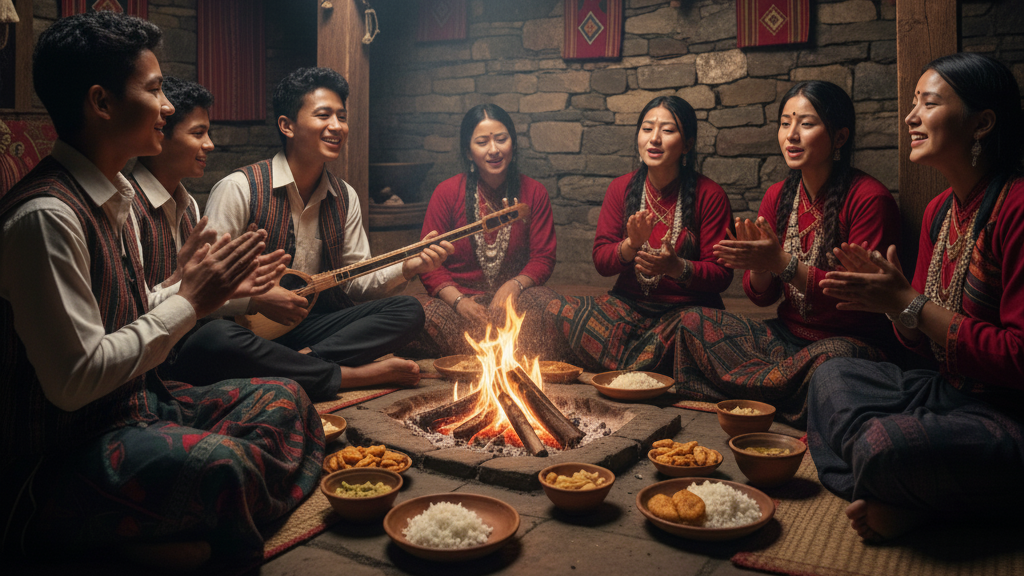
In the misty mid-hills of Nepal, where terraced fields cling to steep slopes and evenings arrive early, courtship still follows patterns that feel strikingly different from both arranged marriages and modern dating apps. Among Gurung and Magar communities, the Rodhi (or Rodhi Ghar) complex stands as one of South Asia’s clearest examples of a structured, community-sanctioned youth courtship institution. Even as migration, media, and urban aspirations reshape village life, Rodhi continues to exist—sometimes quietly, sometimes transformed—as a reminder that intimacy, consent, and choice can be cultivated collectively rather than hidden in secrecy.
A Rodhi Ghar (literally “Rodhi house”) functions as a communal evening gathering space organized by village youth. After daily agricultural work, young women and men meet to sing, joke, exchange riddles, and talk late into the night. The atmosphere is lively and public, governed not by parental oversight but by peer norms and shared expectations. Rodhi operates simultaneously as a youth club, a cultural classroom, and a social testing ground, where participants learn local songs, oral history, and etiquette alongside the subtler skills of flirting, negotiation, and boundary-setting.
Song lies at the heart of Rodhi courtship. Musical exchanges—often resembling lok dohori (folk call-and-response singing)—allow young people to test each other’s wit, creativity, emotional intelligence, and verbal agility. These duets rely heavily on metaphor, teasing, and coded desire. A clever lyric or confident response can elevate a suitor more effectively than family status or material wealth. Crucially, women are active performers, not passive listeners. They sing back, challenge lines, redirect conversations, and publicly reject advances that fail to persuade. Through voice and timing, they exercise a visible form of choice.
The public nature of Rodhi matters deeply. Courtship unfolds in a collective setting, observed and informally regulated by peers. This visibility reduces the risks associated with private, unsupervised encounters and normalizes refusal. Consent, or manjurī (agreement/consent), is communicated through participation, tone, humor, and responsiveness rather than silence or obligation. In this sense, Rodhi creates a socially buffered space where intimacy develops without isolation, and where rejection does not automatically translate into shame or retaliation.
For young women in particular, Rodhi offers room to exercise agency within otherwise conservative rural settings. While marriage decisions may still involve family negotiations, Rodhi shapes the emotional pre-history of relationships. It allows women to observe potential partners over time, assess behavior, drinking habits, respectfulness, and temperament, and signal interest or disinterest in ways the community understands. In Magar contexts, where remarriage carries relatively low stigma compared to dominant high-caste Hindu norms, this flexibility aligns with broader patterns of pragmatic partnership rather than rigid marital permanence.
Rodhi also serves an educational and moral function. Songs and stories transmit values, humor, cautionary tales, and social norms. Yet within Rodhi spaces, everyday gender hierarchies often soften. Women joke openly with men, tease elders, and articulate desire in ways discouraged in other village contexts. Patriarchy is not erased, but it is negotiated, bent, and temporarily suspended through ritualized interaction.
Today, Rodhi exists in tension with change. Labor migration, schooling schedules, television, smartphones, and tourism steadily reshape or shrink these gatherings. In some areas, Rodhi is commercialized or misunderstood, occasionally mischaracterized as vulgar or morally suspect. For many Gurung and Magar elders, this misrepresentation feels deeply unfair. Rodhi is not about promiscuity, but about disciplined socialization, mutual respect, and community cohesion.
Seen from the present, Rodhi Ghar offers a powerful counter-narrative to the idea that consent-aware, women-visible courtship is a modern import. In Nepal’s hills, young people continue—sometimes quietly, sometimes defiantly—to practice a tradition that places voice, wit, and collective accountability at the center of intimacy, reminding us that the architecture of safe courtship has deep local roots.
Spicy Auntie here, sitting comfortably on a metaphorical floor mat somewhere between nostalgia and rage, sipping tea and thinking: why is it that every time women, consent, and community figure out a workable system, modernity barges in and says, “Cute, but have you tried chaos?” Enter Rodhi Ghar, Nepal’s quietly brilliant youth courtship space, where young people flirt in public, sing their feelings out loud, and—brace yourselves—women talk back.
Let me repeat that slowly for the back row: women sing back. They tease, they reject, they accept, they redirect. No ghosting, no stalking, no pretending silence means “maybe.” Consent is audible. It has rhythm. It has witnesses. Honestly, if half the men who slide into DMs today had to survive a lyrical duel in a Rodhi Ghar, global harassment statistics would drop overnight.
What I love about Rodhi is not that it’s “traditional” (tradition alone doesn’t impress me), but that it’s structured. Courtship doesn’t happen in dark corners where power goes unchecked. It happens under collective eyes, in a space governed by peers. That matters. When desire is public, accountability follows. When rejection is normalized, entitlement weakens. When women are performers rather than prizes, the entire script changes.
And yet—here comes Auntie’s sigh—we keep hearing that Rodhi is “declining,” “fading,” “no longer relevant.” Funny how systems that give women voice are always described as outdated, while systems that isolate them are branded modern. Smartphones arrive, young men migrate, algorithms replace aunties and songs, and suddenly we’re shocked that dating feels unsafe, transactional, exhausting. You don’t say.
Was Rodhi perfect? Of course not. Patriarchy still loomed outside the door. Marriage negotiations still involved families. But inside that space, something rare happened: patriarchy had to negotiate. Women could test men over time. They could laugh at them. They could say no without being punished. In my book, that’s not folklore. That’s infrastructure.
What really irritates me is how quickly such traditions are misrepresented. Rodhi gets caricatured as vulgar, backward, or morally suspicious. Translation: women were visible, vocal, and not properly quiet. Heaven forbid. Meanwhile, silence is sold to us as virtue, and isolation as freedom.
So here’s Auntie’s unsolicited advice: before dismissing Rodhi as a relic, maybe ask what it got right. Collective spaces. Slow courtship. Peer accountability. Women with microphones, not muzzles. You don’t need to recreate it exactly, but you might want to steal the blueprint.
Because if love is going to be risky anyway, I’d rather it happen with songs, witnesses, and the radical audacity of women singing back.