


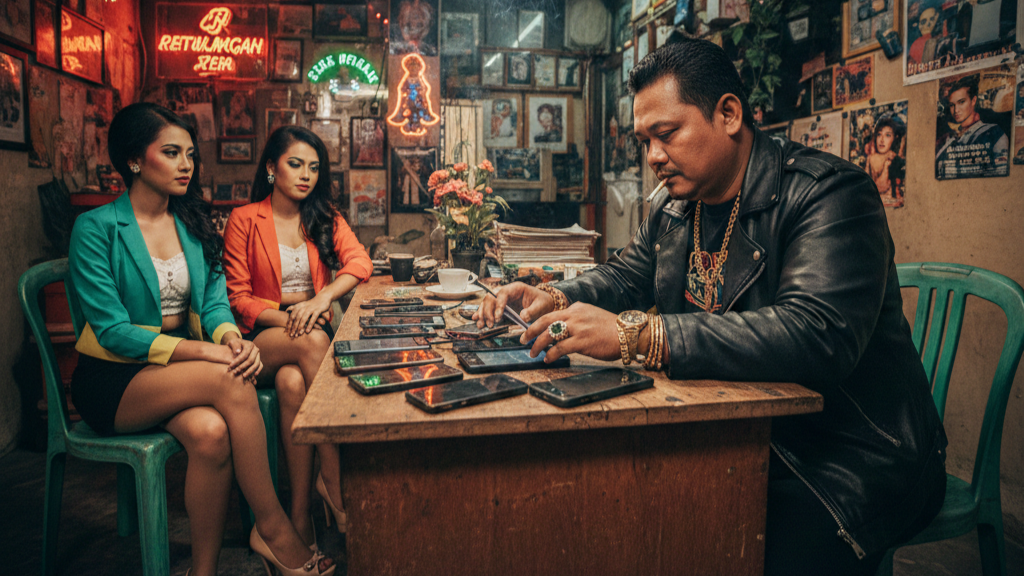
Across Southeast Asia, the quiet migration of sex-service information from street corners and classifieds to encrypted messaging apps has reshaped how intimacy, money, risk, and secrecy intersect. Among all platforms, Telegram has emerged as a particularly influential backstage infrastructure. Not because it invented the digital sex trade, but because its architecture — large public channels, private invite-only groups, anonymous handles, message forwarding, bots, and weak real-time moderation — fits perfectly with how informal and semi-illegal markets already operate. In much of the region, Telegram has become less a social app than a logistical layer: a place to list, filter, coordinate, warn, and quietly disappear.
This role is most visible in Indonesia, where Telegram usage is massive and deeply embedded in everyday digital life. Indonesian police statements and local reporting over the past few years repeatedly describe prostitution networks using Telegram channels as rotating catalogues: profile photos, short descriptions, city tags, and temporary contact handles that vanish after transactions. Moral conservatism, strict laws on sex outside marriage, and periodic moral panics have paradoxically reinforced Telegram’s appeal. When public platforms tighten moderation or remove accounts, activity does not disappear; it compresses into closed Telegram ecosystems where administrators screen members, recycle content, and move groups every few weeks to avoid scrutiny. Telegram’s scale in Indonesia makes it uniquely efficient: a single channel can reach tens of thousands of users before it is flagged, reported, or abandoned.
A similar pattern appears in Vietnam, though the political context is different. Vietnam’s rapid urbanisation, smartphone saturation, and heavy state monitoring of online spaces have created strong incentives for users to favour platforms that feel less visible. Vietnamese media investigations and police announcements have linked Telegram groups to organised sex-service networks, often framed as part of wider cybercrime ecosystems. In some cases, authorities have cited Telegram explicitly when justifying nationwide restrictions on the app, arguing that it hosts large volumes of illegal activity. The important point is not whether Telegram is uniquely criminal, but that its structure allows entire micro-markets to function in parallel to the visible internet, blurring the line between social networking and underground commerce.
Malaysia sits slightly differently in the regional picture. Telegram-based sex-service advertising appears frequently in enforcement reports, but often intertwined with scam operations. Malaysian media coverage has highlighted cases where Telegram channels posing as escort listings were used to extract deposits, blackmail users, or funnel victims into fraud schemes. This overlap is revealing. Telegram does not simply host sex-service information; it hosts a broader economy of trust-based deception, where the promise of intimacy becomes one more hook in a crowded attention market. In that sense, sex-service groups are not an isolated phenomenon but part of a larger constellation of illicit Telegram uses.
In Singapore, Telegram’s role is highly visible but not necessarily dominant in terms of volume. High-profile court cases involving Telegram groups advertising sexual services have received extensive coverage, precisely because Singapore’s enforcement capacity and media environment make such cases legible. Telegram groups here function less as sprawling bazaars and more as tightly managed directories, often short-lived and aggressively policed. The city-state illustrates how platform visibility can distort perception: Telegram appears omnipresent because it is named, scrutinised, and prosecuted, not because it hosts the region’s largest markets.
Elsewhere, the picture fragments. In Thailand, Telegram exists alongside a dense ecosystem of other platforms and informal networks, often serving cross-border or niche communities rather than mass domestic markets. In the Philippines and Cambodia, Telegram is more commonly discussed in connection with scam compounds, trafficking risks, and organised cybercrime, with sex-service advertising appearing as one strand within much larger criminal infrastructures rather than a stand-alone scene.
What unites these contexts is not culture or morality, but design. Telegram’s promise of privacy, its tolerance for scale, and its frictionless group creation make it attractive wherever legal ambiguity meets high demand. Crackdowns tend to displace activity rather than eliminate it, pushing groups to rebrand, migrate, or fragment. For policymakers and researchers, the challenge is that Telegram leaves few stable traces. Channels appear, mutate, and vanish; what is visible today may be gone tomorrow, replaced by an identical clone under a new name.
Understanding Telegram’s role in Southeast Asia’s sex-service information economy therefore requires resisting simple narratives. This is not a story of a single “bad app,” nor of uniquely deviant users. It is a story about how digital infrastructure adapts to social pressure, legal constraint, and human desire — and how, in Indonesia and Vietnam especially, Telegram has become the most efficient meeting point for all three.
Spicy Auntie sighs, pours herself a cup of something strong, and wonders when exactly we decided that secrecy was the problem rather than the symptom. Everyone is suddenly shocked — shocked! — that Telegram has become a digital back alley for sex services across Southeast Asia. As if desire politely queues up where the law tells it to. As if repression has ever produced virtue instead of better hiding places.
Let’s be honest. Telegram didn’t “corrupt” anything. It simply listened. It listened to the hum of moral panic, to laws that criminalise intimacy, to societies that whisper about sex but shout about shame. And it built a nice, quiet room where people could exchange information without being stared at, reported by neighbours, or dragged into court because someone else decided what is “proper.”
In countries where morality laws loom large, Telegram feels less like an app and more like an escape hatch. No names, no faces, no aunties asking when you’ll marry — except me, and I only ask because I care. When public platforms crack down, when newspapers scream about “decency,” when police parade arrests like trophies, the message is clear: do it quietly, do it invisibly, do it elsewhere. Telegram simply says, Sure. Come in.
But here’s the part that makes Auntie roll her eyes: authorities keep chasing the app, not the conditions. Shut down a channel and two more pop up. Arrest a few administrators and the listings migrate overnight. You don’t dismantle an underground economy by pushing it deeper underground. You just make it riskier, messier, and more profitable for the worst actors — scammers, traffickers, exploiters — who thrive on secrecy and fear.
And let’s talk about hypocrisy. Societies that consume sex relentlessly — in advertising, entertainment, fantasy — suddenly clutch their pearls when people organise it efficiently. We moralise the worker, pity the client, and pretend the demand appeared by accident. Meanwhile, the real conversations — about labour rights, consent, safety, digital harm — get buried under sensational headlines about “Telegram vice rings.”
Spicy Auntie is not here to romanticise anything. Telegram groups can be ugly places. People get scammed. Women get exploited. Power imbalances multiply when there’s no protection. But pretending that deleting an app will restore virtue is like blaming the mirror for what you see in it.
If Southeast Asia wants fewer encrypted sex markets, it needs less panic and more honesty. About sex. About law. About why people choose silence over visibility. Until then, Telegram will keep doing what it does best: holding the secrets we refuse to face — neatly organised, endlessly replaceable, and one tap away from disappearing.