


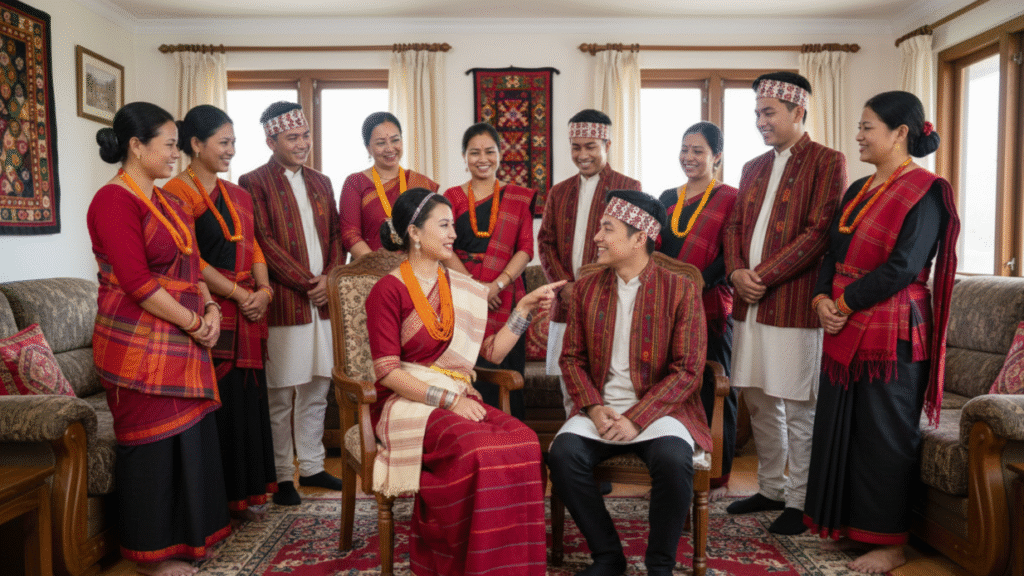
In a country where marriage is still overwhelmingly shaped by patriarchy, caste, family pressure and male initiative, there is a corner of India where the script has long been flipped. In the hills of India’s northeastern state of Meghalaya, among the Khasi people, the question of “who proposes” has never been a question at all. Women choose. Men move in. Lineage follows the female line. And the system has endured for centuries, quietly defying the norms that dominate the rest of the subcontinent.
To understand why the Khasi are often described as “India’s exception,” it helps to start with kinship rather than romance. Khasi society is matrilineal: clan identity, ancestral property, and family continuity pass through women, typically the youngest daughter, known as the ka khadduh. This is not a symbolic role. The ka khadduh inherits the ancestral home, becomes its custodian, and is responsible for caring for aging parents and maintaining family rituals. Marriage, therefore, is not about a woman being transferred from one household to another. It is about a man entering a woman’s world.
In this context, female initiative in marriage is not revolutionary; it is logical. Traditionally, a Khasi woman selects her partner, and only after her decision does the family become involved. There is no dramatic proposal scene, no public declaration. Consent is assumed to originate with the woman. If she is uninterested, the matter ends there. Social shame does not follow her refusal, because her choice is structurally recognised. The husband, upon marriage, moves into the wife’s household in what anthropologists call uxorilocal residence. Children belong to the mother’s clan. The man remains connected to his natal family but does not transmit lineage to his own offspring.
This arrangement stands in sharp contrast to dominant marriage practices across much of India, where women are often expected to be passive recipients of proposals, whether in arranged settings or in so-called “love marriages.” Elsewhere, a woman’s refusal can be framed as arrogance, disobedience, or moral failure. Among the Khasi, refusal is simply preference. The system assumes female agency because it must: inheritance, continuity, and social stability depend on it.
Colonialism and Christianity reshaped Khasi society in significant ways, introducing monogamy, church weddings, and Victorian gender ideals. Yet matriliny survived. Even today, while church ceremonies are common, the underlying logic of marriage remains intact. Property does not pass to husbands. Clan identity does not change at marriage. A woman proposing, initiating, or ending a relationship is not read as a challenge to masculinity but as part of the social fabric.
This does not mean Khasi society is a feminist utopia. Men often dominate political institutions, village councils, and formal leadership roles. Economic pressures, urbanisation, and migration have strained traditional arrangements, and there is an ongoing debate—sometimes bitter—about whether matriliny disadvantages men. Some men’s rights groups in Meghalaya argue that the system leaves men without security or authority. Yet these debates themselves reveal something striking: in this part of India, it is men, not women, who are publicly articulating anxieties about marginalisation.
In recent years, younger Khasi couples navigating urban life, education, and salaried work have adapted the tradition. Dating apps, romantic partnerships, and even mutual proposals now coexist with older customs. But the core principle remains unchanged: marriage begins with female consent that is socially meaningful, not merely personal. A Khasi woman does not need to “break norms” to propose. She is operating within them.
At a time when India is grappling with debates over marital rape laws, declining female labour force participation, and the persistence of child marriage, the Khasi example is often invoked—sometimes awkwardly—as proof that “Indian culture” is not monolithic. Patriarchy is not destiny. Alternatives have existed all along, not imported from the West, not invented by modern feminism, but embedded in indigenous systems that valued women as anchors of social continuity.
Calling the Khasi “India’s exception” is accurate, but it also risks missing the point. Their traditions are not an anomaly; they are a reminder. Long before proposals were staged with rings and hashtags, before marriage became a transaction negotiated over dowries and status, there were societies on the subcontinent where women choosing their partners was simply how life worked. The exception, perhaps, is not Meghalaya—but the rest of the country that forgot such models were ever possible.
Spicy Auntie here, sipping her tea and smiling knowingly, because every time someone tells me that “Indian culture” has always meant men proposing, women waiting, and families deciding, I feel an irresistible urge to point northeast and say: Meghalaya. Look. Over there. That’s India too.
Among the Khasi, women choosing their husbands is not a TikTok trend, not a feminist provocation, and certainly not a Western import. It’s just how things work. No dramatic knee-bending, no diamond theatrics, no aunties whispering “don’t be difficult.” A woman decides. If she says yes, the family talks. If she says no, life goes on. Imagine that. Consent without punishment. Preference without shame.
What fascinates me is how uncomfortable this makes the rest of India—and frankly, a lot of men elsewhere in Asia. Suddenly we hear worried voices asking whether Khasi men are “disempowered,” whether matriliny is “unfair,” whether this system is “outdated.” Funny how concern for fairness only surfaces when women aren’t the ones doing the compromising. Where was all this anxiety when women across the subcontinent were being married off before they could spell their own names?
Let’s be clear: Khasi society isn’t some pink-filtered feminist paradise. Men dominate politics, money talks louder than tradition in cities, and patriarchy always finds a way to squeeze in through the back door. But here’s the crucial difference: marriage itself does not start with female erasure. It starts with female choice. That alone changes everything.
In most of India, even today, a woman refusing a proposal can be labelled arrogant, selfish, or “too modern.” Among the Khasi, refusal is just information. No melodrama. No moral panic. No lectures about biological clocks delivered by relatives who haven’t had a hobby since 1983. A woman’s “no” does not need explaining.
And this is why I get prickly when people say gender equality is “against Indian culture.” Which culture, darling? The one shaped by colonial laws, caste hierarchies, and Victorian morality? Or the one quietly surviving in the hills, where women inherit homes, anchor families, and don’t wait to be chosen like items on a matrimonial menu?
So the next time someone tells you women proposing is unnatural, unfeminine, or un-Indian, please do me a favour. Smile sweetly. Mention the Khasi. And watch how quickly tradition becomes very flexible when it stops serving male comfort.
Spicy Auntie will be right here, enjoying the view from Meghalaya—where women never needed permission to choose.