


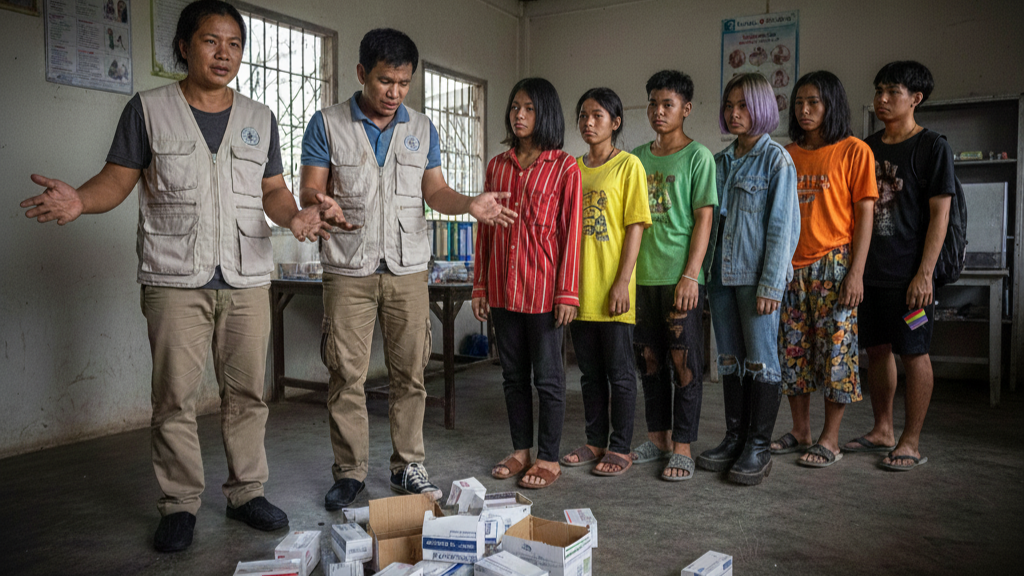
Across Southeast Asia, the sudden general contraction of international aid in 2025 landed not as an abstract budget problem but as a dramatic emergency, especially for minorities, women and LGBTQ communities in particular, that depend on fragile, community-based services. The freezing and dismantling of major USAID-linked programmes coincided with a broader tightening of global aid, producing a double shock: projects ended abruptly, replacement funding proved scarce, and the organisations closest to marginalised people were left to manage the fallout. The effects are clearest when you look at how this played out in three very different settings: the Philippines, Thailand, and Cambodia.
In the Philippines, the most immediate damage was felt in HIV services that have long relied on international funding to reach key populations, including many LGBTQ people. Community clinics and outreach teams that provide free testing, peer navigation, and treatment linkage operate on continuity: relationships matter, follow-up matters, and trust is built slowly. When funding freezes hit, organisations reported staff layoffs, shortened clinic hours, and suspended outreach. For people living with HIV, even short interruptions can mean missed appointments or delayed treatment. For those at risk, it can mean losing the only non-judgmental access point they trust. Philippine civil-society groups scrambled to find domestic partners and short-term grants, but many warned that patchwork solutions cannot replace multi-year health funding. The risk is not only a rise in infections, but a setback to years of progress built on community-led care.
Thailand’s experience shows a different but related vulnerability. Here, LGBTQ organisations are often less focused on direct health delivery and more on rights advocacy, legal support, and civic-space protection. When international funding dried up, the first casualties were not always clinics but people: lawyers, researchers, outreach workers, and community organisers. In Thailand, groups working on gender and sexuality issues reported scaling back documentation of discrimination, pausing strategic litigation, and cancelling trainings that help communities understand and claim their rights. This matters in a country where legal protections remain uneven and where civic space has tightened in recent years. Without sustained funding, watchdog and advocacy roles weaken, just as political pressure and online harassment intensify. The effect is a chilling one: fewer public challenges, less rapid response when abuses occur, and more isolation for people targeted because of who they are.
Cambodia illustrates how cuts to “general” health funding ripple through the entire ecosystem, disproportionately affecting LGBTQ people even when programmes are not explicitly labelled as such. In Cambodia, large health NGOs have historically acted as hubs, supporting HIV and tuberculosis care, rural outreach, and networks of community partners. When USAID-linked funding was put on hold, those hubs began to wobble. Clinics faced uncertainty, outreach to remote areas slowed, and smaller community groups that rely on these networks felt the squeeze immediately. LGBTQ people in Cambodia often access services through these broader health structures rather than through standalone “LGBTQ centres.” When the structure weakens, they lose discreet, stigma-aware pathways to care. The result is not always dramatic closure headlines, but something more insidious: reduced reach, fewer follow-ups, and growing gaps between need and access.
What unites these three cases is not just the loss of money, but the way aid cuts reorder priorities. When resources shrink, organisations are forced to choose between keeping the lights on and investing in prevention, between emergency response and long-term change. Mental-health support, legal aid, safe-space programming, and community education are often the first to go because they are harder to fund and harder to quantify. Yet these are precisely the services that help LGBTQ people survive discrimination, violence, and exclusion.
The wider context makes recovery even harder. The aid contraction of 2024–2025 was not limited to the United States. Other donors reduced or redirected funding, making competition fiercer and timelines shorter. Many Southeast Asian LGBTQ organisations responded by diversifying funding sources, leaning on volunteers, or integrating their work into broader health and human-rights coalitions. These strategies can keep programmes alive, but they also stretch already thin teams and risk diluting focus.
For LGBTQ communities, the stakes are concrete. Reduced HIV outreach means higher health risks. Weakened legal support means fewer paths to justice. Shrinking civic space means less visibility and more fear. The lesson from the Philippines, Thailand, and Cambodia is that international aid, for all its flaws, has often funded the most unglamorous but essential work. When it disappears abruptly, the cost is paid not in spreadsheets but in interrupted care, silenced advocacy, and lives made more precarious.
If Southeast Asia’s donors and governments want to avoid reversing hard-won gains, the response cannot be emergency charity alone. It requires recognising community-based LGBTQ organisations as core social infrastructure, not optional add-ons, and ensuring that when funding shifts, it does not simply vanish, leaving those at the margins to absorb the shock alone.
I’ve been around long enough to know that when politicians and donors say “restructuring,” “reprioritising,” or my personal favourite, “temporary suspension,” what they often mean is: good luck, you’re on your own now. And when aid money dries up, it never hits the powerful first. It hits clinics with plastic chairs, hotlines run by exhausted volunteers, and tiny offices where LGBTQ people finally felt safe enough to walk in and exhale.
Let’s be clear: this isn’t about abstract geopolitics. This is about the HIV counsellor in Manila who suddenly can’t follow up with her clients. The legal advocate in Bangkok who used to document harassment cases and now has to choose which ones are “urgent enough.” The outreach worker in Cambodia who knows exactly which rural paths to take, but no longer has fuel money or test kits. When funding collapses, people disappear from spreadsheets—but not from reality.
What makes me angriest is the hypocrisy. For years, donors loved to talk about “community-led solutions,” “key populations,” and “leaving no one behind.” PowerPoint slides were polished, conferences well catered, rainbow flags waved proudly for the camera. And then—click—funding frozen, contracts paused, no transition plan, no safety net. Suddenly, “community-led” means “community, you lead yourselves… without resources.”
In Southeast Asia, LGBTQ organisations have always been asked to do more with less. Be professional but invisible. Vocal but not too loud. Political but not inconvenient. Now they’re also expected to absorb the shock of global aid cuts as if resilience were a renewable resource. It isn’t. Burnout is real. Fear is real. Silence creeps back in fast when support systems collapse.
And don’t let anyone tell you this is only about money. When health services shrink, stigma grows. When legal aid disappears, abusers get bolder. When civic space tightens and watchdog groups go quiet, it sends a message: you’re on your own, and nobody powerful is watching anymore. In countries where being LGBTQ is already risky, that message can be dangerous.
Yes, local philanthropy matters. Yes, governments should step up. Yes, communities are resourceful. But pretending that international aid didn’t play a crucial role in building today’s fragile progress is historical amnesia at best, and cynical revisionism at worst.
So here’s my Spicy Auntie question to donors and decision-makers: if your funding model collapses overnight, and the first casualties are queer people, people living with HIV, and those already pushed to the margins—was your commitment ever real?
Because solidarity that evaporates when budgets tighten isn’t solidarity. It’s branding. And LGBTQ communities across Southeast Asia deserve better than being treated as optional line items in someone else’s political spreadsheet.