


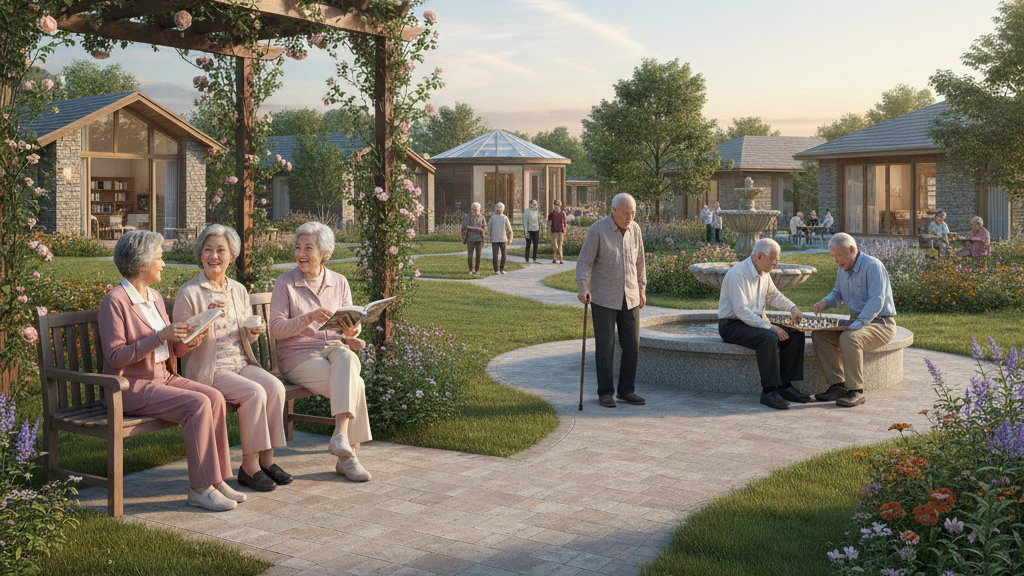
Across Asia, the idea of how to grow old is quietly—but radically—changing. For generations, ageing was assumed to happen at home, surrounded by family, often with women absorbing the unpaid labour of care. Nursing homes, where they existed, were widely seen as last resorts, places associated with illness, abandonment, or poverty. Today, a new model is emerging across Southeast Asia and beyond: retirement villages that promise not just care, but lifestyle, autonomy, and community. The rise of retirement villages in Asia reflects deeper shifts in demography, family structures, and expectations about what a “good old age” should look like.
Asia is ageing faster than any other region in the world. Countries such as Singapore, Thailand, Malaysia, China, South Korea, and Japan are seeing sharp increases in the proportion of people aged 65 and above, driven by longer life expectancy and falling birth rates. At the same time, traditional multigenerational households are shrinking. Adult children migrate for work, women are more likely to be employed, and fewer families can provide full-time elder care at home. Retirement villages are stepping into this gap, offering a middle path between ageing alone and institutional nursing care.
Unlike conventional nursing homes, retirement villages in Asia are typically designed around independent living. Residents live in private apartments, villas, or studios, with access to shared amenities such as gardens, gyms, swimming pools, cafés, libraries, and activity rooms. The emphasis is on choice: seniors can cook for themselves, decorate their homes, come and go freely, and participate in social life on their own terms. Medical or personal care is usually optional, available on-site or on call, rather than imposed as a default.
In Southeast Asia, Malaysia has positioned itself as an early mover. Purpose-built senior villages and urban independent-living complexes are slowly gaining visibility, particularly around Kuala Lumpur, Penang, and Negeri Sembilan. These developments often combine resort-style design with practical features such as barrier-free layouts, emergency response systems, wellness programmes, and proximity to hospitals. While uptake among local seniors has been cautious—reflecting lingering cultural stigma around “outsourcing” elder care—interest is growing among middle-class retirees who value privacy, safety, and companionship without surrendering independence.
Thailand’s retirement village landscape is more diverse and, in some areas, more mature. Long known as a retirement destination for foreigners, Thailand now hosts a mix of expat-oriented villages and facilities increasingly catering to Thai seniors as well. Northern cities like Chiang Mai, as well as coastal and resort areas, have become hubs for lifestyle-focused senior communities. Some villages resemble relaxed neighbourhoods with organised activities and light support, while others operate as high-end care resorts with nursing staff, rehabilitation services, and long-term care options. Affordability, climate, and access to private healthcare remain key draws.
Indonesia, by contrast, is still in the early stages of developing formal retirement villages. The concept exists mostly in fragmented or informal forms, particularly in lifestyle destinations such as Bali. Here, ageing foreigners and affluent Indonesians often create loose communities around villas, serviced residences, or mixed-use developments rather than fully regulated senior villages. Regulatory uncertainty, uneven healthcare access, and cultural expectations around family care have slowed wider adoption, but demographic pressure suggests that structured senior living models are likely to expand in the coming decade.
In Singapore, land scarcity and strong state involvement have led to integrated senior housing that blends independent living with healthcare, social services, and even childcare facilities, promoting intergenerational contact. Beyond Southeast Asia, retirement villages are taking different shapes. In East Asia, especially China and Japan, large-scale senior living developments increasingly incorporate technology, from health monitoring systems to smart-home features, reflecting both labour shortages and a tech-driven approach to elder care.
What unites these varied models is a redefinition of ageing itself. Retirement villages market not decline, but continuity: the ability to maintain routines, friendships, hobbies, and dignity well into later life. For many seniors, especially women who have spent decades caring for others, the appeal lies in finally having space that prioritises their own wellbeing.
Yet the rise of retirement villages also raises difficult questions. Cost remains a major barrier, making many developments accessible only to middle- and upper-income retirees. There are also unresolved tensions around regulation, quality standards, and the risk of social isolation if villages become age-segregated bubbles rather than integrated communities. In societies where filial piety still carries moral weight, choosing a retirement village can provoke guilt, judgement, or family conflict.
Still, the momentum is unmistakable. As Asia grows older, retirement villages are becoming laboratories for new ways of living later life—less hidden, less medicalised, and more intentional. They reflect a region negotiating between tradition and modernity, family obligation and individual choice, care and independence. Whether they become a niche solution or a mainstream option will depend not only on economics and policy, but on how Asian societies ultimately choose to value ageing itself.
Spicy Auntie is not packing her bags just yet. Let’s be clear. I am nowhere near booking a sunlit apartment in a leafy retirement village with aqua aerobics at 9 a.m. and quinoa bowls at noon. Getting ready? Kidding. Still a looong way to go. But I am watching. Closely. And the more I read about Asia’s shiny new retirement villages, the more one uncomfortable question keeps tapping me on the shoulder like an unpaid bill: who exactly are these places for?
Because let’s be honest. Retirement villages are lovely. Spacious rooms, safety rails disguised as “design features,” yoga classes, communal dinners, discreet medical support. Independence without isolation. Ageing with dignity. I get the appeal. If I could afford it one day, I might even enjoy it. But here’s the thing Auntie can’t ignore: most women in Asia will never have that choice.
Women live longer. Women earn less. Women interrupt their careers to care for children, husbands, parents, in-laws, everyone except themselves. Women age with thinner savings, patchier pensions, and bodies worn down by decades of unpaid labour. And suddenly we are told: don’t worry, there are options! Yes. Options with monthly fees that quietly assume a lifetime of stable income and property ownership.
Ah, but wait, they say. There are the children. The family. Of course there are. Daughters, mostly. Daughters-in-law. Women again. The same women already juggling jobs, childcare, rising living costs, and emotional burnout. The same families stretched thin by migration, urbanisation, and shrinking households. The idea that “the family will take care of it” sounds reassuring—until you ask which family, which woman, and at what cost.
And then there’s the State. Or rather, the polite absence of it. Governments are very enthusiastic about “active ageing,” “silver economies,” and private-sector innovation. Much less enthusiastic about universal elder care, non-means-tested pensions, or publicly funded assisted living. Retirement villages flourish precisely because the public safety net is full of holes. They are not a solution; they are a market response to policy failure.
So yes, Spicy Auntie watches the retirement village boom with mixed feelings. Curiosity, even admiration, on one side. Deep unease on the other. Because ageing should not become another luxury product, another space where women who carried societies on their backs are quietly priced out at the end.
I’m not packing my bags. I’m sharpening my questions. If we’re serious about dignity in old age, then affordability, public responsibility, and gender justice cannot remain afterthoughts. Otherwise, retirement villages risk becoming just another gated community—this time, at the end of life.